VOL. 27, #3, Fall 2009
AGTA Lab Bites The Dust, Latest Burma Gem News, Gemstone Tidbits, Gem Quotes, Beware: Internet Shopping Scams, Graff Robbery, In The News
- Home
- Newsletter
- VOL. 27, #3, Fall 2009

AGTA Lab Bites The Dust, Latest Burma Gem News, Gemstone Tidbits, Gem Quotes, Beware: Internet Shopping Scams, Graff Robbery, In The News
AGTA Lab Bites The Dust
by Robert Genis
More changes arise in the laboratory world with the announcement by AGTA on July 29th that it has closed its gemological testing center (GTC) in New York. The lab opened in 1988 but closed due to inadequate business to sustain operations. Insiders have always told us the laboratory NEVER made any money. The powers that be could no longer justify the lab losses to the membership. Obviously, laboratories are not immune from economic pressures
As Forecaster readers know, we never supported the AGTA lab. We believe the AGTA lab was originally started because many dealers were furious with Cap Beesley of the the American Gemological Laboratories (AGL) due to the Fred Ward Emerald case. Without going too deep into the merits of the case, both AGL and GIA contended an emerald was treated before it was sold to a private client. Fred Ward argued the private buyer broke the emerald. The jury believed Beesley, the judgement went against Ward, and many in the trade wanted Beesley's hide.
We never liked the fact an AGTA grading report did not address stone quality the way an AGL document does. For example, an AGTA report might simply say Burma-no heat. It would not tell you if it is a good or a bad Burma, unlike the AGL which grades gemstones in a linear and numerical manner.
It has always been our position that there must be an arm's length principle between the dealers and the laboratories. Any lab created by dealers for dealers surely will lack objectivity and have the wrong priorities. It's human nature. Dealers are much better at arguing with lab staff than consumers. Simply winning gemstone terminology arguments can add untold profits to dealers. A lab must be above this kind of potential shenanigans. Independent laboratories are the only way to go for the serious collector/investor. When you buy a house, you want an independent appraisal, not one written by the seller's brother. For a rare coin, you want an independent laboratory grading. Ditto in spades for gemstones. That is why we have only recommended the GIA and the AGL for years.
We remember the boom investment diamond and colored gemstone days of the late 1970's and early 1980's. The major player in the investment diamond market was International Diamond Corporation (IDC). They graded and sold their own stones. At the time, most legitimate investment firms marketed GIA grading reports for diamonds and AGL grading reports for colored gemstones. When the diamond market collapsed, many people were left with IDC grading reports. Many people had to spend money and have their stones regraded by the GIA before anyone would bid on them. Grading was always suspect from IDC; whether their grading was accurate or not was not even the point. The lesson is sellers and the labs must not be affiliated in anyway. It is the fiduciary responsibility of the dealers to maintain this arms length principle in any transaction.
In my opinion, AGTA violated this precept. They never really gained a great deal of market share from AGL and their lab reports were never really accepted by the major auction houses or fine jewelers, so perhaps they will not be missed. The majority of AGTA lab reports were, naturally, pushed by AGTA dealers. We guess they will need to find a new lab.
Latest Burma Gem News
Burma Ban
In the last Gemstone Forecaster, we wrote about the hope by gem dealers the ban on imports of Burma ruby and jade would be lifted. However, the ban on imports from Burma has been renewed for one year by the US House of Representatives and the Senate. Recently, Secretary of State Clinton announced a major shift in the Obama administration's policy towards Burma, pointing out that the long-term U.S. policy of sanctions had failed to promote democratic reforms in the military-run state. "To help achieve democratic reform, we will be engaging directly with Burmese authorities. This is a policy that has broad consensus across our government," Clinton said. The new policy would include "engagement, appropriate sanctions and humanitarian assistance."
Burmese pro-democracy leader Aung San Suu Kyi has welcomed U.S. plans for direct high-level diplomatic engagement with Burma's military rulers. Suu Kyi has already spent more than 13 of the last 19 years in detention, was rarely allowed to leave her home in Rangoon. She was sentenced in August to a further 18 months' house arrest over an unauthorized visit by U.S. national John William Yethaw to her Rangoon home.
Burmese Auction
Burma will hold a midyear Gems Emporium in October-November to encourage national gem traders to sell more quality gems, jade and pearls. The 18th Mid-Year Gems Emporium will take place at the Myanmar Convention Center on the basis of competitive bidding. The goal of the midyear Gems Emporium is to boost the country's foreign exchange earnings. The government's Central Statistical Organization revealed that in the fiscal year 2008-09, Myanmar produced 32,921 tons of jade and 18,728 million carats of gems which include ruby, sapphire, spinel and peridot, as well as 754 kilograms of pearl.
Burma Government and Dealers Expands Gem Trade
As a general rule, Burmese gem dealers rarely market their goods. However, in reaction to the Europe and and US bans of their products, they are taking a more active role in finding customers. Myanmar gem merchants took part in a gem shows of the Association of Southeast Asian Nations (ASEAN) held in Kunming and Nanning, China. Burmese dealers also took part in the recent five-day ASEAN gem show in Bangkok, Thailand.
Burma is also seeking gem trade with Sri Lanka, participating in some gem shows held in Colombo, the capital of Sri Lanka for the market expansion. Burma also wants to target gem shows in the United Arab Emirates and Oman.
Gemstone Tidbits
The New Look Hope Diamond
The Smithsonian Institution Museum of Natural History is celebrating the 50th anniversary of its acquisition of the Hope Diamond by giving the blue diamond a new look. The Smithsonian is asking the public to vote on one of three new designs proposed by Harry Winston, Inc. The huge blue diamond will be on view at the museum without its setting until it is temporarily reset in the winning new design. The stone will ultimately be placed back into the historic setting that has been on view in the museum for the past fifty years. You can vote for the designs here:
Click here to go to the Smithsonian.
Lindsey Lohan and Jewelry
In June, Lindsay Lohan was questioned in connection with $400,000 worth of Dior jewels that suddenly went missing from her Elle photo shoot. She was later cleared in the case. She was recently accused of taking expensive jewelry from posh Beverly Hills store XIV Karats, and hasnt returned them. Lindsay had the jewelry on loan from the store for over two months. When she was contacted about returning them, Lindsay simply said she didn't have them. Lindsay claimed that they had been stolen from her safe and had video surveillance showing three people in her house. An 18 year old teenage boy was recently arrested but there has been no word on the XIV Karats jewels. Allegedly, he was her cocaine dealer.
Meteorite collection
Meteorite collector extraordinaire, Robert Elliott was expected to sell his entire collection for over $800,000. The collection of rocks raised just $200,000 when they went under the hammer at Lyon and Turnbull auction house in Scotland. The enthusiast's collection included pieces of meteorites from all over the universe. Given the bad worldwide economy, it was probably a bad time to sell.
Notable Quotes
"Gemstones and precious metals are portable and have international value. In times of recession people seek solid investments. Jewelry will always return some value whereas with shares or bonds, people can be left holding a worthless certificate."
Chris Devereux
Webbs Auctioneers jewelry consultant
Sunday Star Times-New Zealand August 20,1990
"Gem dealers know how to keep a low profile. Gems are transparent to the airport X-ray."
Ron Ringsrud, gem dealer
Coast Reporter On-Line September 16, 2009
Internet Shopping: No one is watching but you...and us!
by Robert James
EDITOR: This excellent piece was written by a cantankerous Robert James, the President of International School Of Gemology. Sometimes we think Robert should have been a lawyer!
By law, internet website owners are not responsible for what is sold by sellers!
In 2003 a summary judgment was handed down by the United States District Court in California that granted the defendant (Ebay, Inc) a motion for summary judgment, and set a legal precedent that eBay is not liable for stolen or counterfeit goods sold on its website. That case, Hendrickson v- Ebay (165 F. Supp. 2d 1082, 60 U.S.P.Q.2d (BNA) 1335 (C.D. Cal. 2001) became the first of several legal decisions that support the concept of safe harbor in the Digital Millennium Copyright Act law of the United States. Based on various court cases in recent years, safe harbor means that the website owners are not liable for items sold by outside sellers that are stolen, counterfeit, misrepresented, or deceptively or fraudulently sold -- regardless of whether they are aware of the acts or not.
To put this in simpler terms...eBay and other internet websites such as Polygon and TradeKey are not responsible for the items being sold on their websites.
To better understand the full ramifications of this situation we need to address four definitions: deception, fraud, fraud in law, and condone.
Deception: misleading; being dishonest, syn: fraud
Roget's 21st Century Thesaurus, Third Edition
Copyright © 2009 by the Philip Lief Group
Fraud: trickery, deception syn: misrepresentation
Roget's 21st Century Thesaurus, Third Edition
Copyright © 2009 by the Philip Lief Group
fraud in law: fraud that is presumed to have occurred in light of the circumstances irrespective of intent to deceive
Merriam-Webster's Dictionary of Law, © 1996 Merriam-Webster, Inc
Condone: to disregard or overlook (something illegal, objectionable, or the like).
Based on the Random House Dictionary, © Random House, Inc. 2009.
Under CFR Title 16, Section 23 regarding the Federal Trade Commission Guides for the Jewelry Industry there is a list of practices that are considered deceptive trade practices by the FTC regarding the selling of jewelry items at all levels. Unfortunately, given the world wide reach of the internet the FTC Guides are essentially worthless. There exists no provision to enforce The Guides to US or international sellers, and even if there were US enforcement of the FTC Guides the DMCA "safe harbor" provides protection for US website providers who supply the conduit by which the international sellers reach US consumers. Even a cursory review of some of the items for sale on websites such as eBay, Polygon.net, TradeKey.com, BelTal.com, and others give graphic illustrations of just how blatant the abuses can be for deception and fraud in the internet marketplace.
Here are a few examples:
Ebay Item: 280393717269. Valued at $2800.00 by the seller this strand of "grape Akoya" pearls speaks volumes to the extreme damage being done to the true Japanese Akoya industry by Chinese sellers on Ebay who continually misrepresent the source and origin of their pearl products. The seller is in China and is out of reach for most buyers, and Ebay is not responsible for the misrepresentation.
Speaking of fraudulent selling of pearls, this TradeKey seller is claiming to offer "Japanese Loose Akoya Pearl Beads" of AAA quality, 6.5-7mm size, and for only $80.00. An informed buyer would know that the price is far too low for true Japanese Akoya Pearls, but an unsuspecting buyer might fall into this trap. In spite of this deceptive offer, TradeKey is not legally responsible for the misrepresentation by this seller.
Ever wonder where those great looking but totally fake Rolex watches come from that you see on the internet? At least some come from the Chinese wholesale websites. The problem is that this is the same as stealing the Rolex copyright and trademark. There is no such thing as a legal knock off of a Rolex watch. And yet anyone can start a business of this type by hooking up with this seller on the shown website and invest only $56.75. And based on international case law, this website is not responsible for this sellers rip off of the Rolex name and design.
Now, here is where this problem becomes a consumer nightmare and our definitions come into play:
First, sellers in China, Thailand, and anywhere in the world (including the US) can knowingly sell fraudulently misrepresented jewelry and gemstones through internet websites such as eBay, Polygon, TradeKey, etc... and there is no one to do anything about it. The FTC Guides cannot be enforced, the local and state US governments do not have the resources to start going after individual sellers on eBay, Polygon, TradeKey, etc... Perhaps more important, by using the US based internet selling sites like eBay, Polygon, etc...the international sellers can reach a world wide audience using deceptive and fraudulent trade practices while sitting safely in their bungalows thousands of miles away in countries that make no effort to enforce any kind of consumer protection laws.
Second, its perfectly legal. Because of the DMCA "safe harbor" provisions, and the legal precedents set previously, these sellers such as eBay, Polygon, TradeKey, etc...are doing nothing illegal. Totally within the law and protected by the DMCA from any action by harmed consumers...case law on record.
So you have sellers able to perpetrate fraudulent sales practices who are untouchable.
Internet website providers who can legally condone the practice by sheer force of their refusal to act to control the situation.
And consumers who believe that there is some government or trade entity that is responsible for oversight of the whole thing.
There is none. No one is watching.
Is this legal? Absolutely. Are the internet sellers like eBay, Polygon, TradeKey doing anything wrong under the law? Absolutely not.
But is this right? We don't believe so. Not at all! To the point that the ISG recently withdrew our Polygon membership in protest of the issues there.
The Media Curtain
It is our position that a media curtain needs to be drawn in front of this situation. A curtain of information for every buyer to understand that when you shop on any internet website you are shopping in a place that has no obligation to provide you with a proper representation of merchandise...other than their own moral conscience.
Moral conscience. There is a term we don't hear much these days in the jewelry and gemstone industry, but another definition that we need to understand.
Moral: of, pertaining to, or concerned with the principles or rules of right conduct or the distinction between right and wrong; ethical
Conscience: the inner sense of what is right or wrong in one's conduct or motives, impelling one toward right action:
Both above: The American Heritage® Dictionary of the English Language, Fourth Edition
Copyright © 2009 by Houghton Mifflin Company.
Published by Houghton Mifflin Company. All rights reserved.
Fortunately, there are sellers on eBay with a moral conscience to the welfare of consumers and this industry. And there are sellers on Polygon with a moral conscience to the welfare of consumers and this industry. The key is to know how to find them, and for that buyers need information and lots of it, and you need to read and research before you shop with any internet seller. Buyer information is the curtain of knowledge, the media curtain that all buyers need to stop and review before you shop with any internet seller. And make no mistake, places like Ebay and Polygon make their living based on how many sellers they can attract, which may leave their motivation of moral conscience secondary to their motivation for profits. And again, they are acting legally and within the law based on our review and interpretation of the situation.
So consumers and buyers, its up to you to protect yourself any time you shop online. Here are five Consumer Questions for Internet Shopping that everyone should ask before making an online purchase. If you cannot answer each with a resounding YES!...then you should not be shopping with that internet seller regardless of where you find them.
Question #1: Does this seller provide you with a physical and verifiable business location including phone and mailing address that you could use if you have a problem?
Question #2: Is this seller Accredited as an online seller by the Better Business Bureau? And remember that BBB logos can be ripped off from various websites. So don't just look for the logo, visit the BBB website and check out the BBB rating of the business.
Question #3: Does the seller provide you with a full written invoice of your purchase including all pertinent representations made during the item listing? And don't fall for that old inflated appraisal scam. As we saw from Direct Shopping Network, documents can be created by just about anyone and offered as supporting material to a sale.
Question #4: Does the seller offer a money back return policy that allows you to have your purchase independently verified. And if they do offer that return policy, are they somewhere you can reach if you need to do so? Buying from an unknown seller in Kowloon , China is not going to help you if you get ripped off and need to contact the seller....and you live in Muleshoe , Texas .
Question #5: Have you done research of your own to know what you are looking for? There are massive amounts of information on the internet for just about every gemstone you can think of, so you have to ask yourself if you have done enough research to understand what you are shopping for in order to identify possible scams?
And finally, before you make any purchase you should contact the seller and ask THEM the above five questions and get their answers. See how quickly they answer and ask them additionally if they can provide you with consumer testimonials from previous customers who you can contact to verify.
In short, create yourself a Media Curtain of research and information to help protect yourself any time you shop on the internet for jewelry and gemstones. There are a lot of excellent sellers out on the internet offering unique and wonderful jewelry and gemstones at excellent prices. But there is also the worst bunch of pirates we have ever encountered, and right now China has surpassed Thailand as the pirate capitol of the world of gemstones and jewelry.
As a consumer, your only protection is your own knowledge. There is no entity, government or trade, who is watching over this industry.
No one is watching except you...and us.
Graff Robbery
Associated Press
by Raphael G. Satter
August 11, 2009
EDITOR: Since this daring robbery, eight men have been arrested. David Joseph, 22 years old, was charged with plotting the heist. Aman Kassaye, 24 years old, has been charged with attempted murder and false imprisonment. Seven others were charged with conspiracy and one person was released on bail without being charged.
LONDON - Two well-dressed thieves walked into a London Bond Street jewelry store last week and, after brandishing handguns at shop workers, made off with $65 million worth of gems in one of Britain's biggest jewelry heists, police said.
Security camera footage released by police shows two men in crisp suits entering Graff Diamonds' flagship store. It was the third time a Graff store in London had been targeted in a high-profile raid in the past six years.
The men stole dozens of high-end rings, bracelets, necklaces and watches worth 40 million pounds, or $65 million, and fired two gunshots into the ground as they escaped in a series of getaway cars, police said. No one was hurt.
It was among the biggest heists in British history - far outstripping the 1963 Great Train Robbery in which 2 million pounds were lost.
Last week's theft, however, was topped by the 2006 robbery of 53 million pounds in cash from a security company depot in southern England, and was rivaled by the 1987 theft of an estimated 40 million pounds from the Knightsbridge Safe Deposit Center in London.
Police declined to rank the robbery, saying only that it was one of the country's biggest. Items stolen included a pair of white diamond double hoop earrings, a flowing flower necklace with yellow diamond petals, a platinum white Marquise diamond ring and a Chronograff watch, police said.
Graff's store, a classical stucco and stone town house in London's jewelry district, has been targeted by thieves in the past.
The same store lost jewelry worth 23 million pounds in 2003 when it was robbed by jewel thief Nebojsa Denic, a Kosovan Serb and a member of the notorious gang of Balkan robbers known as "the Pink Panthers." Denic was caught and sentenced to 15 years in prison.
In 2007, another smartly dressed pair was chauffeured to the store's Sloane Street branch in a Bentley Continental Flying Spur. They whipped out handguns and made off with 10 million pounds worth of gems.
Graff Diamonds declined to give details beyond the police statement.
IN THE NEWS
Drawn to Adventure in Africa, He Brought New Gem to Light
Wall Street Journal
By Stephen Miller
September 3, 2009
EDITOR: We sadly bring you this story. At press time, the killers of Campbell Bridges are still at large. The local Police Chief has stated they will be brought to justice.
It all began, Campbell Bridges liked to say, the day a charging cape buffalo forced him to flee into a ravine. That was where he discovered a cache of small green garnets that turned out to be the making of his career.
Mr. Bridges went on to become the leading miner of tsavorite, the gemstone he first sighted in 1961 in Zimbabwe. A geologist and an African adventurer known for living in a tree house and setting a cobra to scare off intruders at his mine, Mr. Bridges was a legendary figure in the world of gemology.
But his high profile also might have attracted the attention of criminals. Licensed by Kenyan authorities to operate a mine, Mr. Bridges was killed Aug. 11 at age 71 in a confrontation with suspected illegal prospectors.
Soon after bringing tsavorite to the attention of gemologists in the U.S. in the early 1970s, Mr. Bridges became the stone's foremost pitchman. He appeared in the 1970s in ads from Tiffany & Co. touting "the brilliant green gemstone that is far more durable and far less expensive than emeralds." Before Mr. Bridges discovered the mineral, which was named for the Tsavo national parks near where his mine was located, "only giraffes and other African animals knew about tsavorite," the ads claimed.
Born in Scotland, Mr. Bridges was raised in South Africa, the son of a mining engineer who bestowed on his son the deed to an amethyst mine at age six. It was the beginning of what Mr. Bridges' son, Bruce Bridges, calls "his endless love of the continent and the joy of gemstones."
After training in geology and learning to cut gems in Germany, Mr. Bridges worked as a prospector in East Africa. He panned for gold in Kenya and looked for emeralds. It was while searching for beryllium, an element of emeralds used to shield nuclear reactors of the day, that Mr. Bridges had his run-in with the cape buffalo, resulting in the discovery of tsavorite.
"It is uncommon for a new gemstone to be discovered," says Robert Weldon, a gemologist at the Gemological Institute of America. "He did the gemological world a great service."
In 1967, Mr. Bridges discovered another deposit of tsavorite in northern Tanzania, and commenced mining operations. After Tanzania in 1970 asserted more state control over mining, Mr. Bridges traced the gem-bearing geological formation north, across the border into Kenya. There he set up what became his Scorpion Mine, named for the eight-inch specimens that infested the area.
To avoid the scorpions, army ants and other hazardous fauna including lions, Mr. Bridges took to living in tree houses, 25 feet off the ground. "They are safe and cool," he told a jewelry trade magazine in 2007. "And the views are spectacular."
In the U.S., Mr. Bridges was retained as a consultant by Henry B. Platt, president of Tiffany, which bought quantities of tsavorite as well as another gemstone Mr. Bridges specialized in, blue-purple tanzanite.
"What Campbell did, single-handedly, for colored gemstones and the African species of tanzanite and tsavorite can not be overstated," says Peter Schneirla, Tiffany's chief gemologist.
Mr. Bridges remained convinced that tsavorite was underpriced at a fraction of the cost of emeralds, and attributed this to the fact that consumers didn't attach to it the same romance that emeralds held.
In recent years, production at Mr. Bridges' mine had slowed as shafts approached 300 feet underground. At the same time, increasing numbers of unlicensed miners appeared in the region. Mr. Bridges reported them to authorities, without much result.
A series of confrontations led up to an ambush Aug. 11 in which a pickup carrying Mr. Bridges, his son, Bruce, and some workers was attacked by up to 30 men armed with spears, machetes and clubs. Campbell Bridges was stabbed in the chest.
Late last month, Kenyan police reported they had arrested a man they described as the mastermind of the attack in which Mr. Bridges was killed.
But Bruce Bridges insists via email from Nairobi that those responsible are still at large. He has hired bodyguards in response to continuing threats.
"I will carry on his work to the best of my ability," Bruce Bridges writes of his father, "and do everything within my power to keep his dream alive."
Unprecedented Miniature Carving of Alexander the Great Found
Israel National News
by Nissan Ratzlav-Katz
September 18, 2009
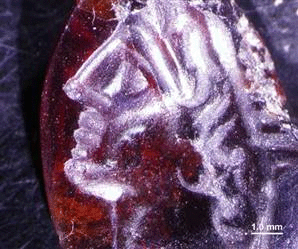 |
Excavations in Tel Dor have turned up a rare and unexpected work of Hellenistic art: a precious stone bearing the miniature carved likeness of Alexander the Great. Archaeologists are calling it an important find, indicating the great skill of the artist.
The Tel Dor dig, under the guidance and direction of Dr. Ayelet Gilboa of Haifa University and Dr. Ilan Sharon of Jerusalem's Hebrew University, has just ended its summer excavation season. For more than 30 years, scientists have been excavating in Tel Dor, identified as the site of the Biblical town of Dor. The town's location, on Israel's Mediterranean Sea coast some 30 kilometers south of Haifa, made it an important international port in ancient times.
"Despite the tiny proportions - the length of the gemstone (gemma) is less than a centimeter and its width less than half a centimeter - the artist was able to carve the image of Alexander of Macedon with all of his features," Dr. Gilboa said. "The king appears as young and energetic, with a sharp chin and straight nose, and with long, curly hair held in a crown."
According to the archaeologists involved in the Tel Dor excavations, the discovery of the miniature Alexander gemstone carving in Israel is fairly surprising. The Land of Israel was not, for the Greek Empire, a central or major holding.
"It has been accepted to assume that first-rate artists - and whoever carved the image of Alexander in this gemstone was certainly one of them - were primarily active under the patronage of the large royal courts in Greece itself or in major capitals," the scientists explained. "It turns out that local elites in secondary centers such as Dor could allow themselves - and knew to appreciate - superior artwork."
Additionally, the new find is important for the study of the historical Alexander the Great. The gemstone was found in the remains of a large public building from the Hellenistic period in the southern area of the tel. Unlike most of the portraits of Alexander in museums throughout the world, with unknown origins, the Tel Dor carving was found and classified within its archaeological context. The face was definitively identified as that of Alexander the Great by Dr. Jessica Nitschke of Georgetown University and Professor Andrew Stewart of UC Berkeley.
Historically, Alexander himself passed through Dor in 332 BCE, during his voyage to Egypt. It appears that the city fell to him without resistance. Since that time until its conquest by the Hasmonean Jewish King Alexander Yannai around 100 BCE, Dor served as a stronghold of non-Jewish Hellenists in the Land of Israel.
Still Seduced by All That Glitters
New York Times
By Souren Melikian
September 4, 2009
EDITOR: This uberbullish article is on the jewelry auction market. Most gem analysts see demand down internationally. However, Melikian argues decreasing gem and jewel sales at Sothebys and Christies are due to shrinking supply of fine diamonds, gemstones and jewelry. This is in direct contrast to the high end collector art market, which has been ravaged in the current recession.
LONDON - Some miracles have a way of going unnoticed. Gems and jewels have been doing brilliantly at auction for months, as if bidders had never been told that there is a recession. And yet this has not aroused much commentary.
Could this silence be due to the fact that global sales in the first half of 2009 dropped by 54 percent at Christie's and Sotheby's alike, compared with the corresponding period of 2008?
Probably. That leaves a nasty impression. But this abrupt fall of global figures reflects the drastic shrinking of supplies, not a dip in demand, which remains as strong as it has ever been, in a striking parallel to what is happening in the art market.
At Christie's, which has been leading the market for years, worldwide jewelry sales during the first half of 2009 went down to $103 million, spectacularly less than the $226 million posted in the first six months of 2008, and at Sothebys the 2009 total, $70 million, likewise looks miserable when compared with the $150 million of 2008. This may have cowed into uncharacteristic silence the propaganda machinery of the two international auction houses. It sounds rather unconvincing to admit that you have taken a big step back, and to say in the same breath that your sales are brilliantly successful.
Unconvincing maybe, but true. No one can reasonably argue that the market is faring poorly when earth-shattering world records are set.
On Dec. 10, when the mood in London was at an all-time low, Christie's sold the most expensive jewel ever. The 35.56-carat blue diamond rose to $24.31 million, or to be strictly accurate, £16.39 million. (In the jewelry market prices are always quoted in dollars, and even the presale estimate for the blue diamond, stated only on request, was given as a flat $15 million.).
The faceting of the diamond was dazzling and the delicate ultramarine blue exceedingly rare, but this was more than just a beautiful gem. Its history went back to the 17th century, when Philip IV of Spain gave it to his daughter Margaret Theresa on her betrothal to Leopold I, the ruler of the "Roman Germanic Empire." Later, it belonged to the Princes of Wittelsbach in Bavaria. To round it off nicely, the stone can be shown today to have been cut by Saida-ye Gilani, the Iranian poet, calligrapher and jeweler employed at the Moghul court by the emperor Jahangir (who reigned from 1605-1627), thus multiplying its potential value manyfold. However, the catalog did not mention this, since it was not known at the time of the sale.
The world leader in diamonds, Laurence Graff of London, finding the blue diamond irresistible, paid a world record price, the highest for any stone ever auctioned.
Five months later, another extraordinary price within its range was realized at Sotheby's in Geneva. This confirmed that the market was indeed exploding at the top end. Once again, the subject of the excitement was a fancy blue diamond.
With its "fancy vivid blue" color, the 7.03-carat gem dazzled connoisseurs out of their wits. It brought a staggering $9.48 million, just over $1.34 million a carat, making the diamond the most expensive stone per carat ever sold in any category. Unlike Christie's fabulous historic diamond, it had no distant past. The bauble was cut from a 26.58-carat rough diamond recovered the year before at the Cullinan mine in South Africa. It was solely the lure of the stone that determined the prodigious price.
Sotheby's press release announced that the buyer, Joseph Lau Luen-hung of Hong Kong, had acquired the diamond, and given it a name, "The Star of Josephine." Josephine being his wifes name, dealers were ecstatic. This really was a private acquisition, fully demonstrating the vibrancy of the market.
Other extraordinary prices were fetched at Sotheby's Geneva auction, which netted a cool $35.76 million. A rare fancy pink diamond cut in the shape of a pear soared to $2.04 million, a huge figure for a 5.29-carat stone.
Where aristocratic provenance could be established, jewels soared sky-high.
A diadem and necklace made by Cartier in 1912 for Olga Princess Paley, Countess of Hohenfelsen, sold at least as well as they might have done in pre-recessionary days, both doubling their high estimates. The diadem (described as an "aigrette tiara"), set with rose-cut diamonds and two aquamarines, brought $512,014; and the necklace, designed in the same heavily ornate style, cost an equally breathtaking $392,700. A late 18th-century pair of ear clips with spinels and diamonds, solemnly cataloged as "the property of a German Princely and Liechtenstein Ruling Family," almost quadrupled the high estimate at $105,000.
When asked about the atmosphere as perceived by the man wielding the hammer, David Bennett, chairman of Sotheby's jewelry departments in Europe and the Middle East, said that it felt like being back in the good old days of the mid-1990s.
Perhaps the astounding bullishness of the jewelry market is best illustrated by the prices achieved much further down the financial scale. Here one might have expected the recession to work havoc. Lower incomes have taken a nasty knock, and uncertainty about the future might have an inhibiting effect. Yet, consider what happened on June 10 as François Curiel, the international director of Christie's jewelry department " and chairman of Christie's Europe " was conducting the company's late spring London sale of jewelry.
An interesting pattern became apparent from the very beginning. Signed jewels set with good quality stones sold like hot cakes regardless of style or period.
The proceedings opened with a necklace of gold swan heads clutching in their beaks blue sodalite disks. The jewel, adorned with the name of Lalaounis and dated 1995 by its London hallmark, went up to $24,450, two and a half times the high estimate.
Later, a necklace made from oval gold links joined by diamond-set clasps and signed Cartier Paris excited bidders, who sent it climbing to $42,750, more than triple the estimate. A gold and diamond "panthère wristwatch," also by Cartier, which came next, managed to match the high estimate at $16,700, even though dozens of that type can be found.
When an important period jewel appeared, the attendance enthusiastically responded as it had done at Sotheby's. Christie's "superb antique diamond brooch" was an unusual composite piece.
Made up from magnificent 18th-century pear-shaped diamond drops hanging from an inverted lotus chalice (a "canopy" in Christie's terminology), it exceeded the high estimate as a private collector from Britain footed the $374,824 bill. The "I want it" mood that prevailed was never more evident.
In its own modest line, an Art Deco travel clock of spinach-green jade, its dial framed by a gold chain motif set off by black enamel, provided evidence of the private buyers' sunny disposition, as it brought $14,260, substantially more than the high estimate. This is typically the kind of object that would have faltered if bidders had not been buying purely for pleasure. Neither rarity nor investment considerations can be invoked to account for a price that far exceeded Christie's estimate.
If any difference with the pre-recession jewelry market could be detected this year, this is perhaps the even greater attention paid to famous provenances or renowned signatures. In other words, there is an intensified search for aura and its reassuring quality.
In Sotheby's Geneva May sale, five of the most expensive 10 lots were Harry Winston jewels set with diamonds and other gems. The perfection of the stones mattered, but the name helped.
The current wave of interest in the jewels of the late 1960s and early 1970s, to which Mr. Bennett drew this writer's attention, probably played its part.
A day later at Christie's, a "mystery set" made in 1956 by Van Cleef & Arpels in the form of two intertwined leaves set with sapphires and diamonds brought $112,845, far more than expected. The delicate workmanship was of the highest order and the elegant design played up the quality of the gems.
Clearly, the sheer pleasure taken in gazing at beautiful stones is the secret weapon that allows the jewelry market to triumph at every level. And the fact that so many buyers find it possible up and down the financial ladder to succumb to the attraction without going bankrupt suggests that the recession, devastating though it is to some, leaves essentially intact countless private fortunes, from very large to relatively small.
When the glitter of a jewel makes it hard to resist temptation, money suddenly becomes available. There might be a lesson here for those who are in charge of the broader economy.