The Tucson Gem and Mineral Show started as a local hobby show with eight dealers and dozens of amateur hobbyists in 1955 at an elementary school gymnasium. It grew in stature after the Smithsonian exhibited at the show in 1961. The show moved downtown with the completion of the Tucson Convention Center in 1972. "60 Minutes" covered the Gem and Mineral Show in 1980. By 1997, Tucson had expanded to 28 shows lasting 22 days. Today, the Tucson Gem Show is the largest gem and mineral show in the world. The shows began on January 25 and the last event ended on February 16. Numerous shows are held in outdoor tents and along a stretch of the freeway. Tucson officials predicted an attendance of approximately 40,000 from 20 countries and an impact of over $41.5 million to the local economy. There were over 4,000 exhibitors.
Two dozen universities and museums from around the world brought the finest collections of gems and minerals. They included the American Museum of Natural History in New York, the Carnegie Museum of Natural History in Pittsburgh, the Smithsonian, the Samotzvety Museum in Moscow, and the Sorbonne in Paris. This is the one show where you can see reptile and fish fossils, prehistoric insects encapsulated within amber, and matching crystal geodes of any variety up to eight feet tall. Tucson offers a market for gems I have never even heard of, plus any gem that is presently available on the world market. There are always a few six-figure Burma rubies, Kashmir sapphires, and Colombian emeralds. At Tucson, you can spend $5.00 on a quartz crystal or $100,000 on an alexandrite.
During Tucson '97, the three main shows for fine colored gemstones were the GLDA with 370 dealers, the AGTA with approximately 230 exhibitors, and the GJX with about 255 vendors. The hot new show is the three year old Gem and Jewelry Exchange (GJX). It is across from the Convention Center located in a tent, or as the promoters call it, an "ultrastructure". The GJX show has carpeting, paneled walls and the best light of the three shows for viewing gemstones.
The consensus among dealers was sales were down approximately 30% from last year at AGTA and 20% at GJX and the GLDA. However, this does mean that the gemstone markets are down, rather Tucson must now compete with the New York, Orlando, Miami, Las Vegas shows and a new show in Japan. Colored gemstone buyers cannot visit every show. Many chose to attend different shows this year.
There was some international buying at the Tucson show from Europe and the Far East. The numbers of Japanese buyers were down from years past. This is probably due to the weak Japanese economy and the new gem show in Japan.
I attend this show to find stones for my clients. Also, the show is critical to obtain market information to analyze trends. I query the dealers, mine owners, and international suppliers. Here is a gem by gem analysis:
Ruby
I saw some pinkish Vietnam ruby at the show. Production is severely limited and asking prices reached $6000 per carat for carat sized gems. The amount of gem Thai ruby seen at Tucson was practically nil. Also, the amount of gem Mong Hsu Burma ruby is way down from years past, but availability remains good. Dealers stated it was increasingly difficult to find fine Mong Hsu ruby in Bangkok. What they rejected last year, they are now being forced to buy to carry an inventory. Dealers believed overseas availability is down about 80% and prices have increased approximately 20%. The Mong Hsu mine has been producing for four years without any shortages. For the first time, there are shortages of this material. Either the production of Mong Hsu material is truly down dramatically, or strong dealers are hoarding in Bangkok in anticipation of higher prices. Fine, gem quality Mogok Burma ruby is rising in price. The rarest of the rubies, unheated Mogok Burmas, have always been practically nonexistent in supply. The few stones I saw were up from last year's prices. As one dealer commented, "These unheated Mogoks are as rare as platinum ski tips. Tell your collectors to load up all the colors (red/magenta/pink), especially if they are unheated. Your clients will be sitting pretty when the Mong Hsu material is gone."
Colombian Emerald
There were a few Colombian emerald dealers at the show. The vast majority of the goods were commercial quality. I found two stones of interest. The first was a killer, 3.5-4.0 color/70 tone, eye clean. It was $5000 per carat, but the problem was it was only .97. I also saw a 5 carat, 4.0 color/75-80 tone, Lightly Included. The Colombian wanted $65,000 per carat! We have seen 10 carat Colombian emeralds reach $75,000 per carat, but this holds the record for a five a carat stone. Dealers explained there was upward pressure on prices due to the deteriorating political situation in Colombia. For those of you with special orders for Colombian goods, you might want to consider the finest examples of African emeralds because they tend to be cleaner than the Colombian gems. As Cap Beesley of AGL said, "It probably makes sense to collect the finest from every mine anyway."
Blue Sapphire
There was a good supply of Southeast Asian and African blue sapphire at the show. Prices are stable. Gem quality Kashmir and Burma sapphire are as rare as ever. I saw one unheated five carat Burma sapphire. It was a 3.5 color, 75 tone, and Moderately Included. I also saw a 6 carat unheated Burma stone, which was difficult to grade in the show lights, but I would say it was a 3/85, Moderately Included. Burma and Kashmir sapphires are up about 10%.
Colored Diamonds
You can even find colored diamonds at the Tucson Gem Show. The action in the colored diamond market is becoming stratified. Dealers were searching for champagne diamonds because they are inexpensive. Dealers were also looking for top pinks and blue colors for their connoisseur clients. This market remains strong. Collectors seem to want the best colors irrespective of price or they want a colored diamond but have limited funds.
Spinel
This was the show where the new Vietnamese spinel debuted. After much ballyhoo, I finally got a chance to view the material. I believe 99% of the material, while pretty and poppy, seems to fit in quality between the high-end Burma goods and the low-end Sri Lankan (Ceylon) goods. Although I bought a few of the finest examples, the majority of the stones are not good enough to collect. They tend to be hot pinks, not gem reds or oranges. Some Vietnamese goods change color from blue to purple. There was also a great deal of new African gems, however, they are not as good as the old Burma material. They are comparable to the Vietnamese goods. The pinks are pastel and the reds have too much brown. I talked to one spinel specialist who stated the only gem red spinel he sold were three stones recycled from his old customers and collectors. In Bangkok, Thai dealers want $2500 per carat for large, fine red spinels. If you own "old color" Burma spinels, hold on. If you want an "old color" Burma spinel, you must purchase the goods from collectors, not on the open market.
Mandarin Orange Garnet
Prices are stable but they may not be for long. Last year there were two orange garnet mines producing mandarin garnets. The original mine is now closed. Alan Roup of Gem Namibia is still producing, but is having problems. Like most new mines, the deeper the mining, the lower the quality. There is a fair amount of subcarat material, but stones above a carat are rare. Alan Roup showed us two 10 carat plus orange garnets. One was an included oval, and other was a flawless trilliant. Asking prices hovered around $20,000 total.
Tanzanite
The tanzanite market seems to be a market of feast or famine. Either there is too much or too little production of tanzanite. Presently, there is too much production, and prices are weak. Lower quality light blue commercial goods are down about 25%, and fine supersaturated blue goods are down 10%.
Tsavorite
Tsavorite production is small. Only one or two dealers at the show even specialize in gem quality tsavorite. Prices are stable. The new production is either too dark or too light in color. Collectors should stick to "Old Mine" colors. The largest gem tsavo I saw was 7 carats.
Red Beryl
The red beryl production has always been nominal. I have always been disappointed with the quality of red beryls that have come through our offices. Dealers want exorbitant prices for material that is always heavily or excessively included. At Tucson, the Red Beryl Mining Company exhibited some of the cleanest and reddest beryl ever. The largest gems were 3 carats. The price for the best quality material was $20,000 per carat.
Big or Unusual
One outstanding gem at the show was a 10 carat Tundura alexandrite. It sold for over $10,000 per carat. The 100% color change went from blue green to rhodolite pink red. It was eye clean, well cut, with high brilliancy. The wholesaler immediately resold the gem to a collector. Another serious gemstone was a 14 carat star ruby. It had an excellent star and was pinkish. Also, we viewed an unbelievable green demantoid garnet. Almost two carats with a perfect horse-tail inclusion. Finally, the largest gem ruby viewed was a 10.49 African ruby, but a little too orangy.
Conclusion
Regarding the future trends in the colored gemstone market, prices are firm to rising for most gems. The only exception is tanzanite. You should expect the diamond and gemstone markets to continue to follow this pattern. This trending up market is not inflation driven. Instead, the supply of fine gems has declined and demand is strong due to consumer confidence. Vast amounts of wealth have been created by the stock market in recent years. Collectors, investors, and high-end jewelry buyers are profit-taking and diversifying into the diamond and colored gemstone markets. In 1997, do not look for a roaring bull market similar to the 1970s, just simple sustained solid growth.
The following was excerpted from the trade publication, "Jewelers' Circular Keystone":
Garnets:
Garnets will continue to grow in popularity, especially the bright orange mandarins from Namibia.
Imperial Topaz:
This stone is sought-after, but supplies from Ouro Preto, Brazil are erratic at best. Prices for finer goods have escalated dramatically.
Alexandrites:
Alexandrites are being seen again, thanks to new production from Russia's Ural Mountains and new finds in Africa and Brazil.
Spinel:
Look for strong sales of small calibrated spinels in lavenders and pinks to saturated reds. The small stones are being aimed at mass market jewelry because of their uniform color and reasonable prices. Spinel's strength is due to the fact it's not subjected to hard to identify treatments.
Ruby:
The International Colored Gemstone Association (ICA) is betting another hot year for the stone after a full year of promotion.
Tanzanite:
Tanzanite continues to enjoy steady demand. Medium and light colors have experienced recent price drops.
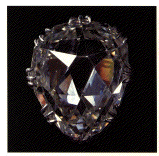
The Sancy diamond is one of the most interesting diamonds in gemstone history. The Sancy story is complicated because of incomplete records and the fact two different diamonds were confused in history. It was one of the first diamonds ever cut with symmetrical facets. The stone is apparently of Indian origin. It fluoresces a distinct yellow under short wave ultra violet light and fluoresces a salmon pink under long wave, with a greenish-yellow phosphorescence.
As the French ambassador to Turkey, Nicholas Sancy bought the 55 carat pear shape in Constantinople about 1570 and took the gem to France. Nicholas Sancy was an avid collector of gems.
During this period, Sancy was a prominent figure in the French court. King Henry the Third was insecure about being bald. He borrowed the stone to decorate a small cap which he wore to hide his baldness. Sancy later became the French Finance Minister. King Henry the Fourth asked to borrow the stone as collateral for a loan to hire mercenary soldiers. A messenger was sent to Paris with the stone, but he never arrived. Sancy followed the route and found the messenger dead. Although the messenger was killed by robbers, Sancy knew the messenger was loyal. After an extensive body search, Sancy discovered the messenger had swallowed the stone, and Sancy recovered the diamond.
Sancy was later the ambassador to England and he sold the stone to James the First in 1604. Queen Maria, the wife of Charles the First, took the Sancy to France in 1644 to raise money for the royalist cause in the civil war. The Duke of Epernon used the Sancy as security for the loan. England never repaid the loan, and the duke kept the stone. Epernon sold the diamond to Cardinal Mazarin. In 1661, he bequeathed the stone to the French crown.
The French crown jewels were on display in eleven cabinets in 1792. Some of the more famous jewels included the Hope diamond, the Regent, and the Sancy. The jewels were appraised at $30 million francs. On September 16, 1792, thieves broke into the Garde-Meuble and carried off all the jewels. Marie Antoinette was accused of instigating the theft. Sergeant, the head of the Treasury was arrested. He took the police to a tree where most of the Crown Jewels were recovered. However, the Sancy and the Hope were not recovered. In 1828, the Sancy turned up and was sold by a French jeweler to Prince Demidoff. It was renamed the Demidoff and was given to his wife, Princess Matolde, niece of Napoleon.
In 1865, it was purchased by a Bombay merchant for $100,000. It was shown at the Paris Exhibition in 1867. The asking price was one million francs. In 1906, the Astor family purchased the Sancy. It was purchased by William Waldorf Astor as a wedding present when his son married Nancy Langhorne of Virginia. Lady Astor often wore the diamond in a tiara on special occasions. It was shown at the "Ten Centuries of French Jewelry" at the Louvre in 1962. After Lady Astor's death in 1964, the stone was inherited by her third son. It is set in a mounting that allows it to be worn on the head.
Interestingly, the Maharaja of Patiala also claims ownership of the Sancy.
JCK Article, January, 1997
"Jewelers' Circular Keystone" published an article, "Auction Houses vs. Luxury Retailers; Myth vs. Reality". Retailers allege auction houses sell treated gems without proper disclosure, represent newly manufactured pieces as jewels from the 1920s and 1930s, and pass off forged or altered pieces, while claiming it is the buyers' responsibility to determine the difference.
At auction, jewelry stamped with Tiffany, Van Cleef and Arpels, and Cartier receive bids 50% higher than equal jewelry without these famous signatures. Cartier has become increasingly alarmed over the number of bogus pieces bearing its name that move through the auction houses. According to Ralph Destino, chairman of Cartier, "People take no-name jewelry from the 1920s and 1930s and engrave our name on it or assemble jewelry from a small piece with an authentic Cartier stamp in hopes of getting the high premiums our name can bring." The recent Antiquorum Cartier sale looked at over 1000 pieces and Cartier found numerous fakes. Even authentic pieces can be altered substantially. A major jeweler recalls buying a Cartier emerald at auction. Later he saw the piece again at a Sotheby's auction without the emerald!
Treatment disclosure is another problem. Catalog disclaimers state the gemstones may be treated and that they cannot make warranties for any stone they sell. Christie's recently began submitting its most important stones to the American Gemological Laboratories in New York for testing and noting unheated gems in its catalog.
Antiquorum (November, 1996)
A 65.15 carat Kashmir bracelet was stolen from the recent "Magic Art of Cartier" auction held by Antiquorum. The sale raised $15 million. On November 14, 1996, it was reported missing from a showcase at the Four Seasons Hotel in Milan, Italy. It was reported missing at 2:20 while 50 people were attending the exhibition. The case was forced open. Police sealed off the area but did not find the bracelet. It was going to be auctioned on November 19 in Geneva, Switzerland. It was produced in 1923 and was considered one of Cartier's most important pieces. The piece was estimated to be worth $2 million.
Christie's (Fall, 1996)
Christie's sold 76% of their lots for $6.1 million. Christie's sold the following colored diamonds: A round 4.53 Fancy Intense Blue-VS2 sold for $291,942 per carat or $1,322,500. A 3.28 marquise Fancy Blue-VS2 sold for $165,091 per carat or $541,500. A .25 oval Fancy Red-SI1 sold for $326,800 per carat or $81,700. An 8.45 oval Fancy Vivid Yellow-VVS2 went for $81,006 per carat or $684,500. A pear shape 13.03 Fancy Intense Yellow-VS1 sold for $39,025 per carat or $508,500. A radiant 6.55 Fancy Yellow-VS1 went for $12,977 per carat, or $85,000. A kite 1.71 Fancy Intense Green Yellow-SI1 sold for $30,263 per carat, or $51,750.
A 8.75 oval Burma Ruby, 4.5-5.0/75-80 tone sold for $38,00 per carat, or $332,500. A 7.44 cushion Kashmir sapphire, 4-4.5/75-80 sold for $13,642 per carat, or $101,500. A 5.36 octagon Colombian emerald, 4.5-5.0/70-75 went for $25,093 per carat or $134,500.
Sotheby's (Fall, 1996)
Sotheby's sold 78% of their lots for $6.6 million. A 9.98 oval Fancy Light Pink-VVS1 sold for $33,317 or $332,500. A 10.15 heart shaped D-IF sold for $40,345 per carat or $409,500. An emerald cut 14.81 F-IF sold for $32,107 per carat or $475,000. The 4.05 & 4.02 matched pear shaped D-IFs sold for $200,500.
Diamonds The Future of De Beers
According to James Picton of South Africa's Standard Equities at a Financial Times conference, DeBeers will remain the dominant player in the diamond market for a long time. He predicts that DeBeers will control 70% of rough diamonds in 2000, down from 73% in 1995. Despite the fact Australia has left the cartel, DeBeers' power base is really Africa. He believes Russia's stockpile of diamonds will be depleted by 1998. Further, he predicts there will be a diamond shortage by 2000.
DeBeers and Russia
The Russians and DeBeers have reached a new pact. This is the second agreement in less than a year. Under the terms of the new agreement, Russia will be a producer-member of the DeBeers cartel. Russia will export $1.2 billion of diamonds, or 26% of DeBeers' total output. The agreement is expected to be signed on March 31, 1997. The Russians will receive first rights to Russia's top quality diamonds. The plan will allow Russia to keep control of its diamond mines and gem-polishing business. Russia will also be invited to purchase rough diamonds at DeBeers secretive, 10 times a year, ritualistic sales, or "sights".
DeBeers Web Site
DeBeers now has its own web site. The site appears to be an extension of DeBeers' typical direct mail marketing. It is heavy on fluff and romance, but it does have some great images of diamonds. It is located at www.adiamondisforever.com.
Armed Robbery
S& G Diamond was recently robbed near 47th Street in New York. A phony UPS man buzzed the company at 10:30 A. M. and said he had a package from one of the company's regular vendors. After he was buzzed in, he announced the holdup, pulled out a gun, and tied up the receptionist. Then an accomplice tied up the nine employees in the office and started grabbing diamonds. The company President, Susan Grant, and an office manager watched all the events in the back office through a video camera. When the men were outside, she called 911 and her insurance agent. She locked the main diamonds in the vault. The robbers started demanding they be let into the back office and started shooting through the door. The robbers started kicking down the door, but heard the police arrive and fled. They raced down the building discarding the uniforms, guns, and the diamonds. One robber was caught in the building and another was later apprehended. Susan Grant said she is going to build a bullet proof window with a pass through for packages.
DeBeers Sales
Year
Total Sales
1990
$4.17 billion
1991
$3.93 billion
1992
$3.42 billion
1993
$4.37 billion
1994
$4.25 billion
1995
$4.53 billion
1996
$4.83 billion
Source: Central Selling Organization
Colombia More Violence
In December, 1996 assassins murdered 24 peasants execution-style in four villages in northern Colombia. There were no arrests and no known motives. Leftist guerrillas and paramilitary groups are fighting for control of the region.
A U.S. pilot was killed recently in Colombia when his plane crashed during a crop dusting coca-eradication operation. The plane was a T-65 Turbo Thrush and was accompanied by Colombian police helicopters. Leftist guerrillas who guard the coca plantations shoot at the planes. These pilots are involved in this operation at the request of the U.S. State Department.
Civil War
In February, the guerrilla war intensified between the Colombian government and the Revolutionary Armed Forces of Colombia. Both sides clashed 30 miles southeast of Bogota. An elite anti-guerrilla unit of Colombian Army troops landed via helicopter into the region near San Juanito. Only 21 of 37 survived the ambush as 150 guerrillas were waiting.
El Espectador, one of Bogota's leading newspapers, criticized the government by stating, "It is hardly sensible to send the patrol into the lion's mouth." The guerrillas still hold 60 soldiers captured in August and 10 Navy marines in January. The Colombian government and the Revolutionary Armed Forces of Colombia have agreed to negotiate their release.
Analysis
The leftist guerrillas are financed by narco-trafficking, kidnapping, and extortion. They maintain 60 units and an army of 10,000. They are striking in small towns after midnight. They kill police, politicians, and peasants. They rob banks, free prisoners from jail, burn down buildings and steal food and supplies. They also destroy the oil pipelines.
Due to the fact 97-99% of all Colombian criminals are never brought to justice, vigilante paramilitary groups have sprung up. They use chain saws to decapitate suspected guerrilla sympathizers. The government has a backlog of over 1 million cases. The political situation in Colombia remains grave.
Emerald Forum
A national forum was recently held in Colombia with 200 representatives from the emerald trade. Included were private mining companies, emerald cutters and dealers. They met to discuss holding an international Emerald Congress in July in Belo Horizonte, Brazil.
Colombian emeralds are considered the best in the world, but the industry is fragmented. The plan is for the Colombian emerald dealers and the Colombian government to work together to develop marketing, cutting, and exporting capabilities.
The topics discussed were:
The plan to market Colombian emeralds internationally, like the DeBeers diamond campaigns. The emerald dealers would like 1997 to be "The Year of the Emerald" with ICGA promotions.
The creation of an emerald bourse, where emeralds could be traded under one roof.
The proposal of an "emerald law". This law may be introduced to the Colombian Congress to facilitate trade.
To seek honest and open disclosure of emerald treatments.
The development of research institutions. For example, emerald cutting schools, appraisal laboratories, treatment investigations, and jewelry manufacturers.
Although it is too early to tell if the venture will be successful, the Colombian government and the emerald dealers do have the money for such a plan.
Burma The Net in Burma
Burma has ruled that using computers to obtain or send information on the economy is illegal. Also, unauthorized possession of a computer for networking is against the law. Offenders can face penalties up to fifteen years. Belonging to a computer club may result in three years in jail. Burmanet, a local electronic mailing list has been deemed an unauthorized club by the State Law and Order Restoration Council (SLORC). However, SLORC has its own home page on the internet.
Civil War
Southeast Asia's longest ethnic struggle is in danger of complete collapse if the Karen National Union is defeated. The Burmese army is using 100,000 troops to crush 2,500 Karen rebels. Two years after a major setback from the untimely loss of its headquarters, Burma's embattled Karen guerrilla movement is now facing a new military and political crisis. This crisis threatens to end the longest armed struggle in Burma for the recognition of ethnic rights and greater autonomy for the Karens. The Christian-led, anti-communist Karen National Union, which has been fighting for autonomy from Rangoon since 1948, was attacked by the Burmese junta. In February, 1997 between 12,000 and 15,000 Karens, mainly women and children, fled to Thailand to escape Burmese artillery, mortar and infantry attacks. SLORC troops swept through the KNU's remaining strongholds in Karen State, forcing the rebels to flee into the jungle. Relief officials say the Burmese army's latest offensive against ethnic Karen rebels has increased the number of refugees fleeing into northern Thailand to more than 100,000. The influx of mainly ethnic Karen and Mon refugees into the north is the biggest mass exodus into Thailand since the Cambodian refugee crisis of the early 1980s. According to figures from the Burmese Net News, Burmese troops have tried to enter Thailand to raid the refugee camps, but have been repelled by Thai troops.
The Maltese Falcon
Remember the 1941 Humphrey Bogart film, "The Maltese Falcon"? In the film, detective Sam Spade sought the Maltese Falcon-a priceless golden bird studded with gems. In the movie, the bird turned out to be a worthless hunk of lead. Ronald Winston has recently created the Harry Winston Falcon. He bought the original prop at auction two years ago for $398,000. He recreated the bird with 10 pounds of gold and it sits on a malachite base. It has two Burma ruby cabochon eyes and interchangeable coral and gold claws. From the falcon's beak hangs a 42 carat diamond. It took two years to finish, and the cost is $8 million.
Palm Beach Robbery
Kathleen DuRoss Ford, the widow of Henry Ford, had 200 pieces of jewelry stolen from her apartment in Palm Beach, Florida. There is a $500,000 reward for anyone who can help. The loss includes a large ruby and diamond ring, a ruby and diamond bracelet with 28 oval rubies, a pearl and diamond necklace, and a Cartier yellow diamond and emerald bracelet. Anyone with information should call the Palm Beach Police Department at 1-561-838-5470.
Newsweek, January 20, 1997 Doug Bandow, senior fellow at the Cato Institute We found this article amusing and maybe too close to home. Editor
"Perhaps it is time to found Collectors Anonymous. But give up collecting? It offers the joy of a bloodless hunt, the thrill of conquest without carcass. It provides an opportunity to learn about art and history, sharpen one's negotiating skills and put together the best possible choices within one's budget. It's simply too much fun to stop. The next time you run across someone with a tendency to prattle on about his collection... be patient. Remember: collecting is a sickness that can strike anyone."
The Offshore Money Book: A Comprehensive Guide for Reluctant Americans By Arnold L. Cornez, J.D. Call: 1-800-488-4149, US$29.95 + S&H, 288 pages paperback, or in your bookstore.
This is an excellent primer on the subject of going offshore. It is not a a list of countries and banks. Rather, it is a logical legal analysis of the advantages and disadvantages of going offshore. Many people think you can simply respond to an advertisement in "The Economist" and open up an offshore company. Nothing is further from the truth. What you really need is a comprehensive plan and $15,000-25,000 to begin. The book analyzes the US real tax ramifications of going offshore. It discusses why you should or should not go offshore and how and where you should place your assets. It takes the mystery out of the International Business Companies and The Foreign Asset Protection Trusts. The author discusses offshore banks, credit cards, and annuities. Further, he discusses privacy and offshore scams.
The book includes numerous offshore internet links on an IBM disk. Highly recommended; by one of the brightest minds in the business. Editor
High Profile
A couple drove their new Rolls Royce (which they had recently purchased for $158,000) to a restaurant in New Hampshire A curious IRS agent spotted the car and wrote down their license plate number. The IRS began a tax audit of the couple and eventually won a conviction for tax fraud. Moral: "If you are going to flaunt it, remember: Big Brother is watching," says Michael Insel, a New York tax lawyer.
Intel Supercomputer
Intel and the US Government are building a new supercomputer 2 1/2 times faster than any supercomputer. It will shatter the teraflop barrier, meaning it can calculate more than one trillion calculations per second. It is named the Ultra, and in a second it can perform as many calculations as the entire US population could do working by hand for 125 years. The computer will contain 9500 Pentium Pro processors operating in tandem, at a cost of $55 million. It will be installed at the Department of Energy in Albuquerque, New Mexico. If you are concerned with how easy it is for the government or business to store information about you, this new computer is chilling news.
Smart Highways
Many states are installing high-tech roadside sensors that promise to speed traffic, eliminate tollbooths, and cut costs. Sixteen of the nation's sixty five tollroads already have this equipment. The primary manufacturers of this equipment are Hughes Electronics and Lockheed Martin. However, besides collecting toll fees, these devices can monitor where a vehicle is at certain times and can photograph motorists and their license plates. The routes you travel can be recorded and stored in a computer file. In Florida and New York, police use toll records to check suspect whereabouts and to check for stolen cars. Tens of thousands of motorists already participate in a smart highway system along State Route 91 near Los Angeles and another system is operating in the Western states along Interstate 5 in California, New Mexico and Arizona.
The information provided in this newsletter has been derived from research and sources believed to be reliable. However, no guarantee is expressed or implied as to their validity. Opinions included herein are subject to change without notice. The gem market is speculative and unregulated. Certification does not eliminate all risks associated with the grading of gems. Recommendations are meant for those who are financially suited for the risks involved. Past performance is not a guarantee of future performance. Neither NGC nor The Gemstone Forecaster guarantee a profit or that losses may not be incurred as a result of following its recommendations. They may also hold positions in areas they recommend. Subscribers should not view this publication as investment advice, nor is it intended as an offer or solicitation with respect to the purchase or sale of any security.