VOL. 24, #1, Spring, 2006
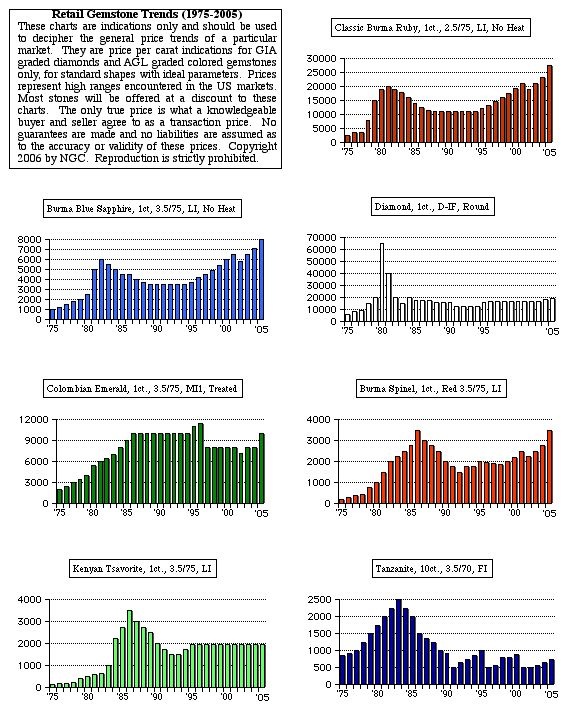
8.62 Burma Ruby Shatters Auction Record, Tucson Gem Show 06, Colored Change Diaspore, Notable Quotes, In The News, Gemstone Price Trends: 1975-2005
- Home
- Newsletter
- VOL. 24, #1, Spring, 2006

8.62 Burma Ruby Shatters Auction Record, Tucson Gem Show 06, Colored Change Diaspore, Notable Quotes, In The News, Gemstone Price Trends: 1975-2005
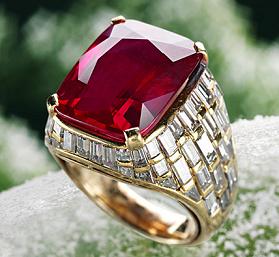 |
On February 17, 2006 in St. Moritz, Switzerland, a 8.62 carat Burma ruby sold for $3.62 million at Christie's "Important Jewels". This set a new world record price for an unheated Burma ruby at $420,000 per carat. Previously, the world record was the April, 2005 Christie's New York sale of the 8.01 carat oval cut Burmese ruby. It sold for $2,200,000 to an Asian private or $274,656 per carat. See The Gemstone Forecaster, VOL. 23, #2, Summer, 2005.
The 8.62 cushion cut Burmese ruby ring by Bulgari was the top lot at Christie's auction. Dubbed "The Graff Ruby," it was purchased by famous jeweler Laurence Graff. Graff is usually a major player in the colored diamond market. Graff's fortune is approximately US$1.3 billion, slightly below that of rock star Paul McCartney. "This is the finest ruby I have ever seen, and I am delighted to own it," Graff said in a statement. Graff said he might set it in a new ring for a client.
This new record probably means either the 8.62 is 50% better than the 8.01 or the Burmese gemstone market has increased over 50% in less than one years time. Let's try and analyze the 8.62 and the 8.01 to see if the 8.62 is superior.
One of the most misused terms in gemological terminology is the term pigeon's blood. Christie's used this term in describing the 8.01 last year. Based upon the AGL grading report, the stone was NOT pigeon's blood. Nevertheless, the catalog said the 8.62 is remarkable for its combination of attributes: "pigeon's blood" red color, superb transparency and absence of any signs of heat treatment.
Regretfully, the ruby was certified by the SSEF lab in Switzerland with the statement "No indications of heating". It is impossible to accurately compare the 8.62 with the 8.01 which was AGL graded last year. With these two widely different grading reports, it is like trying to compare apples and oranges. The SSEF report gives us no clues regarding color, tone, clarity, brilliancy, finish or proportions.
What we do know from the 8.01 AGL grading report, is the stone was not pigeon's blood, at 65% red, and was free of inclusions. You could make a case that if the 8.62 was free of inclusions and was 70% red, the price difference would be understandable.
We can only speculate from the photos about the 8.62. It is practically impossible to accurately gauge minute differences in color across computer monitors. However, in my humble opinion, this stone is not 70% red or pigeon's blood red. The 8.62 appears to have large pink and purple secondary colors. It would be my guess the stone is as red as the 8.01 but probably only 65% red.
The other issue that bothers me is the stone looks really spready, which means the stone has low brilliancy. The 8.01 had 75% depth and 80% brilliancy, which I would prefer to own over the 8.62. If we assume the stones are about equal, we are left with the conclusion the unheated Burma ruby market is increasing dramatically in price. This is true based upon my contacts that travel in and out of Burma and the new prices at the Tucson Gem Show. Of course, all this assumes an efficient market where prices are logical. Perhaps Graff simply got caught up in an auction bidding war and he wanted the stone at any price.
Whatever the reason behind the new record, it is obvious large unheated Burma rubies are rare and the world is finally recognizing this fact. These new prices will filter down to all sizes. The more you have of these stones, the better off your portfolio will be.
In The News
By Thomson Dialog
Financial Times Information Limited
3/20/06
Diamonds: It is said that Alexander the Great found a valley full of both diamonds and poisonous snakes. No one could work out how to retrieve the jewels until Alexander had the idea of throwing down raw meat, to which the diamonds attached. When eagles flew down for the meat, Alexander's men just had to follow them to their nests.
It sounds like fantasy but diamonds are attracted to fat, and the story reminded people how to tell real diamonds from fakes. De Beers still practise Alexander's trick in their South Africa mines today: They use "grease tables" and only the valuable stones stick.
Today, most engagement rings are diamond but after the war, people wanted holidays, cars or colourful gems to celebrate a future marriage. In 1947 a New York copywriter, given the task of finding a slogan for her client's product, stayed late in the office. "I put my head down and said: 'Please God, send me a line.'" Then she scribbled: "A Diamond is Forever" and the market for the gem was never the same again.
Amber: In the 13th century people were killed for it and in the 20th century the Jurassic Park series of films was built on the notion that dinosaur DNA could be preserved in it. Amber is an ancient fossilised resin found most famously along the Baltic coast, where it has bubbled up from an underwater amber forest.
It has been used in jewellery since prehistoric times and, while most amber is yellowy-orange, it can be cloudy white, or even green and blue.
Amber is always more than a million years old while most amber is 40 million years old which means that the Jurassic Park dream is unlikely because dinosaurs lived about 170 million years ago.
In the Middle Ages, peasants in Poland would be hanged without trial for carrying amber. Before then, amber was thought to be lucky.
The Amber Room is the most famous amber object a set of wall panels designed by Prussian kings in the early 18th century and improved by Russian empresses 50 years later.
It was last seen in Prussia's Konigsburg Castle in 1944. For years this expensive piece of interior design was thought hidden in caves or vaults and people were said to have been murdered for it. However a recent theory is that it was lost in a fire in 1945. It must have made a wonderfully scented blaze.
If you rub amber hard it attracts bits of lint and paper to it, and sometimes makes sparks. So it is not surprising that when electricity was first discovered it was named after "elektron", Greek for amber.
Emerald: When Carroll Chatham was 15 he blew out the windows of his neighbours' house in San Francisco in an attempt to make diamonds. "Get another hobby, " said his father angrily.
So he did and, by the time he was 21, in 1939, he had made his first synthetic emerald. It was the first time such flawless emeralds had ever been seen in such numbers. When he took his inventions to a New York store the manager was convinced they were stolen and called the police.
In the ancient world emeralds came from mines in southern Egypt. But the greatest emeralds are from Colombian mines. They are dangerous places, with frequent kidnappings. "How good are you with a gun?" asked one American emerald dealer about a proposed visit to the Colombian mines. "Because you'll probably need at least two." Almost all natural emeralds today are treated with either polymers or oil to reduce the cracks and shapes inside them called "jardin" because they look like a garden. The treatment is so common that it is rarely even acknowledged.
Emeralds are more fragile than sapphires, diamonds and rubies and break more frequently.
Jet: When Prince Albert died in 1867, Queen Victoria went into mourning for nearly 40 years and the fortunes of a small town in Yorkshire turned. No one mourning in Victorian England was allowed to wear coloured stones; widows were never allowed to wear them again.
So, following the Queen's example most women turned to the only black gemstone they knew: jet, from the North Yorkshire coastal town of Whitby. It is the fossil of 170 million year-old trees, ancestors of today's monkey puzzles. Jet was so popular that it led to many fakes. "French jet" is glass; "bastard jet" is either vulcanite a form of plastic or coal. Spanish jet is the real thing but from Galicia and it is softer than the Yorkshire variety.
You can test by scratching it against the back of a tile. Glass leaves a white mark; coal leaves a black. Real Whitby jet leaves an earthy brown line, although the makers of Victorian vulcanite jet soon caught on and added a brown dye to their mix.
Incidentally, Queen Victoria did not stick rigidly to her own rules and was occasionally seen with a diamond and sapphire tiara that Albert had designed for her which sat jauntily over her widow's bonnet.
Sapphire: We usually think of sapphires being blue but in fact they can be green, violet, black, yellow, white or pink as well. They can never be red because red sapphires are rubies.
The best sapphires came from Kashmir. They were discovered by accident in 1880. For the next decade the remote mountainside was torn apart. Just as suddenly the seam finished and nothing as beautiful has ever been found again.
The main source of sapphires Sri Lanka became famous in a story of Sinbad the sailor, who was shipwrecked on an island and saved himself by taking a raft along a river lined with precious stones. That river really exists, carrying sapphires in its flow. Today many sapphires are heat-treated, where they are put into special ovens after which they emerge purer, lighter, and brighter. If you buy one, you should always ask about treatments.
Ruby: Last month, an 8-carat flawless ruby, whose new owner, Lawrence Graff, named it after himself, was bought at Christie's for $2.05 million a record $242,000,000 per carat, almost twice the previous record and three times the highest price paid at auction for a colourless diamond. The gem came from the same source as all the greatest rubies: the Mogok Hills of central Burma.
The most famous "ruby" here is in fact a spinel: A softer and more purplish stone. It is called the Black Prince Ruby and is said to have been given to Edward The Black Prince in 1367 by a grateful King Don Pedro of Castille who had murdered the King of Granada for it (and his throne). Other theories suggest it became part of the Crown Jewels in the 17th century as a replacement for the gems destroyed during the Civil War.
Opal: There was a stone in the crown of the Holy Roman emperors said to be the colour of pure white snow, sparkling with splashes of red wine, and with the ability to shine in the night. It came from the Czernowitza mines in Slovakia, as did another famous opal belonging to the Roman senator Nonius, who valued it so highly that when Mark Antony requisitioned it he refused, even though he knew his punishment would surely be exile. Most opal comes from Australia.
When Queen Victoria learned that deposits had been found in her colony she commissioned many pieces of jewellery made out of it. It was one of her favourite stones.
Some people don't like opals because they have seen only "doublets" or "triplets", which are legal ways of selling small opal chips by mounting them on less precious minerals. But there's also a superstition that dates from the 19th century that says they are unlucky. Sir Walter Scott wrote a ghost story about Baroness Hermione, who died dramatically when a drop of holy water splashed accidentally against her opal. Queen Alexandra, wife of Edward VII, went along with this belief and removed "the unlucky opals" from the late Queen Victoria's collection.
In earlier times, however, these jewels were thought to be positively brimming with luck. The Goths believed they were forged from the eyes of heaven, and 10th-century Arabic scholars wrote that people wearing opals would enjoy great fortune and good health.
Pearls: One of the main reasons for Julius Caesar's attempted invasion of Britain in 55 BC was to get hold of our pearls. Scotland and Cumbria were said to have the best pearl rivers in the world. Caesar craved them, partly because they were beautiful and partly because, as the gems of Venus, goddess of love, they were very good as chat-up presents for women he liked. People fished for Caesar's favourite pearls in Scotland until 1998, when it became illegal. Traditional pearl fishers were travelling people who lived in tents and had their own special language.
Cleopatra also fancied pearls and once had a bet with her lover Mark Antony about who could give the most expensive dinner party. He went first and was astonishingly lavish. She spent less on food but at the end she took off her pearl earrings and swallowed one, which instantly gave her banquet the value of a small Roman province.
Today we almost never see natural pearls such as Caesar's or Cleopatra's. Less than one in a million round pearls sold today is natural, while the rest are created on sea farms all over the world.
Today's so-called "pearl divers" are mostly not diving for pearls at all but for large live oysters, in which the best pearls can be cultivated. It is a harsh business.
Beads are forced into the creature's sexual organs to enable the production of pearls. Half die of shock, which is why many vegetarian organisations recommend their members don't wear pearls.
The Daily Journal
3/12/06
Emerald King in Coma After Shooting
The man regarded as the king of Colombia's lucrative emerald trade lies in a coma with his life in the balance after being shot last weekend, El Tiempo reported. The attack against Yesid Nieto, 35, had been kept quiet for several days. El Tiempo said that Nieto was shot in the head and chest by several assailants who burst into his Bogot¬á apartment. Though the businessman has his own, government-approved security establishment that includes 30 armed bodyguards, he was practically alone at the time of the assault, the paper said. Nieto is the spokesman for the seven powerful clans that control 80 percent of emerald exports from Colombia, the world's leading producer of the gem. The merchant remains in the intensive care unit at Clinica Reina Sofía, a private hospital in the capital, according to El Tiempo, which said that doctors are unsure if Nieto will survive. The daily cited analysts who said the attack on Nieto could spark a renewal of the war between the emerald clans that claimed more than 20,000 lives before a truce was reached in the early 1990s. Some observers suggested that the shooting may have been linked to Nieto's offer to help authorities in their effort to eradicate 6,000 hectares (14,800 acres) of coca leaf - the source of cocaine - belonging to right-wing militias active in the emerald-producing region. The consortium led by Nieto exports some $50 million worth of gems annually, and El Tiempo reports that the emerald king has diversified his holdings with the acquisition of cattle ranches, gas stations and beverage distributorships, among other enterprises.
Identifying Gems and Minerals on Earth and Mars
3/11/06
University of Arizona
Press release
It'll be a snap to identify gemstones once Robert Downs finishes his library of spectral fingerprints for all the Earth's minerals. Downs is almost halfway there. So far, the associate professor of geosciences at The University of Arizona in Tucson has cataloged about 1,500 of the approximately 4,000 known minerals using a technique called Raman spectroscopy. The effort is known as the RRUFF Project.
"We're developing a tricorder," Downs said, referring to the instrument used on the "Star Trek" television show that could be waved over materials to identify their chemical composition. Downs' work is destined for space. Although Downs' current Raman spectrometer takes up an area the size of a tabletop, his colleague M. Bonner Denton, a UA professor of chemistry and of geosciences, is developing a pocket-sized Raman spectrometer to be used on the 2009 Mars rover.
Downs is collaborating with George Rossman of the California Institute of Technology in Pasadena to develop the database of minerals. The technology being developed for Mars will help create handheld instruments for use on Earth. One use for a hand-held instrument would be the identification of gemstones. Downs and Denton will both give presentations on that aspect of the project on Sunday afternoon, March 12, at the 57th Annual Pittsburgh Conference on Analytical Chemistry and Applied Spectroscopy (PITTCON 2006).
Other ways to accurately identify minerals, such as X-ray diffraction and electron microprobe, require grinding a bit of the sample to powder or polishing the sample in a specific manner. However, such rough treatment may not be the method of choice to determine that a glittering gemstone is truly a diamond, rather than just a piece of cubic zirconia. Unlike other methods of identifying minerals, a Raman spectrometer does not require destructive sampling. It shoots a laser beam at the sample. The laser excites atoms within the sample, which then emit a very weak light of a wavelength in a pattern characteristic of the material. "It's like a fingerprint," Downs said.
The technique is named after Sir C.V. Raman, who won a 1930 Nobel Prize for figuring out the underlying physics. But no Raman spectrometer, big or small, can conclusively identify Mars rocks or any other kinds of minerals without the kind of comprehensive database Downs is creating. When an unknown material is analyzed with a Raman spectrometer, it can be identified by comparing it with reference information from a database.
In Downs' lab, a small army of undergraduate researchers is helping complete the RRUFF Project, the first comprehensive database containing the Raman spectra of all the Earth's minerals. The RRUFF project is supported by funding from gemstone connoisseur and collector Michael Scott, founding president of Apple Computer. Scott has a degree in physics from the California Institute of Technology. RRUFF is the name of Scott's cat.
NASA provided funding to develop the instrument for the 2009 Mars Rover.