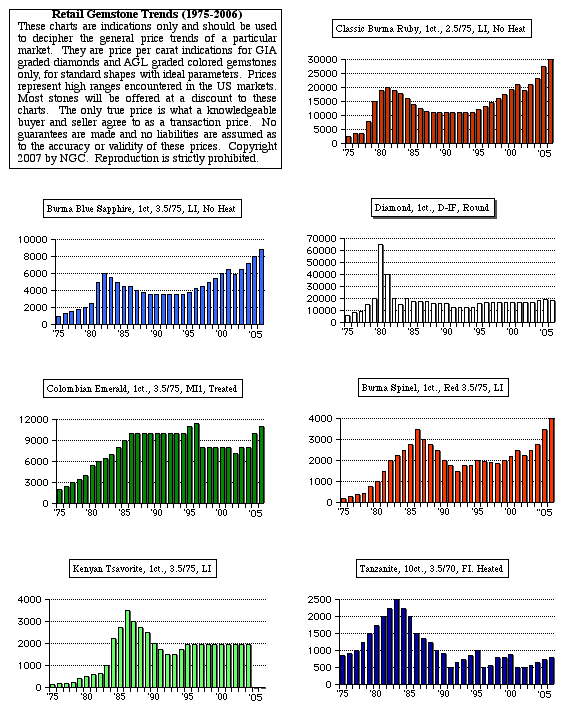
You can buy almost any priced gem at the Tucson Gem Shows from $5 per carat to million dollar gemstones. We thought it would be interesting to find 5 show stoppers. We were not specifically looking for the most expensive but stones that were outstanding in their own right. Even though two of these stones break the million dollar barrier, the other stones are unique and precious, also.
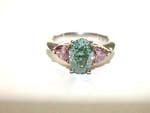
Bluish Green Diamond
Not only does Tucson have colored gemstones but also colored diamonds. Although white diamonds are unusual in Tucson, a new colored diamond section premiered at the AGTA show.
At the Centurion at La Paloma, we found a 1.62 Fancy Intense Bluish Green Oval Diamond. It looks very similar to a Brazilian electric Paraiba tourmaline. The stone has a GIA Grading Report. The stone is VS clarity and is mounted in platinum and the side stones are intense purplish pinks with a total weight of 2/3 of a carat. The stone has even color distribution and no fluorescence.
The stone was sold for $1.2 million right after the show to a private collector. According to the dealer, "I have sold straight reds and greens but this was a very very special stone." Few people realize this two color combination can be more beautiful than a single colored diamond.
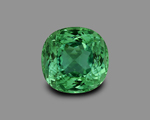
Largest Gem Tsavorite In the World
Green garnet was discovered in 1968 in the Tsavo National Game Park in Kenya. When discovered, miners thought they had discovered a new source for demantoid garnet. High quality tsavorite is rarer than emerald, is cleaner, more brilliant, is not altered with with oil or heat. Plus, tsavorite is available for 1/4 of the price of emerald. Today there are small mines operating in Kenya and Tanzania. As general rule, tsavorite is found in small sizes and a three carat gem tsavorite is rare although occasionally a 10-20 carat is seen.
The 325.13 gem tsavorite was displayed at the AGTA show. An exceptional 925 carat tsavorite was recently found in the Karo area in Block D at Merelani, Tanzania at a depth of 450 feet. The depth where this stone is found is really deep in a third world country. You have to remember the miners have no ventilation and this is extremely dangerous to be at these levels. The rough is believed to be the largest ever discovered. From the rough, a 62 carat, a 120 carat, a 307 carat and the 325.13 were cut. Only the 120 and the 325 are clean. The 325.13 is a vivid gem green color and clean. It measures 42.11 x 36.46 x 28.34. The issue with the stone is the proportions. The culet is cut slightly off center and a small window is evident. The price? A cool $2.2 million.
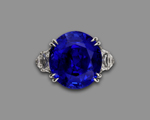
Burma Sapphire
It is no secret the amount of goods coming from Burma has dwindled from the past and the new stones are considerably higher in price. Due to the internet, word travels at light speed even to third world countries. When a large stone sells at auction, the Burmese dealers know about it also. This causes them to probably overvalue the goods they have.
We found a 37.89 oval Burma sapphire at the AGTA show. The gem has an AGL Grading Report. The gem has a rare 75% blue primary color, a 2.5/85 color/tone, and an excellent Total Quality Integration (TQIR). The measurements are 18.85 x 17.16 x 13.22 and the depth is 77%. The stone is Moderately Included but the inclusions are difficult to see because the stone is so saturated. The stone has good proportions and finish and high brilliancy. The stone is not heated and is not clarity enhanced. It is mounted with diamonds.
Mozambique Tourmaline
Recently discovered in Mozambique, Africa, a brand new tourmaline was found which rivals the colors of tourmaline from Paraiba, Brazil. The collector market has really been in search of a new product since the Brazilian Paraiba has dwindled in size and availability. Although not as vivid as the original Brazilian material, the Mozambique colors are close.
The largest new Mozambique Tourmaline was a 76.91 square antique modified brilliant. The stone was available at the AGTA Show. The gem has an AGL Grading Report. The measurements are 25.31 x 24.89 x 18.39. It is green blue in color. The stone is unusual because it faces up green and upside down it is blue. Although not as fine as others seen at the show, the color would be the next tier down from the best. The color and tone is 4.5/50. The stone is flawless with superior cutting and high brilliancy. The stone was subjected to low/moderate heat. The selling price is $4000 per carat.
Burma Spinel
Spinel is considered a gem dealers stone because they tend to covet and desire the gemstone more than the public. Spinel prices have been increasing dramatically lately in Burma and old spinels are being taken back to Burma to be resold. Any gem red spinel from Burma over three carats has always been rare. You can count the amount of killer gem Burma red spinels over 10 carats on your fingers.
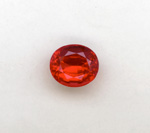
We located a gem oval 12.86 carat red/ orange gemstone. The gem has an AGL Grading Report. The color grade 3.5/70 or the stone is vivid red with a light tone. It is Lightly Included
The measurements are 14.64 x 12.74 x 9.13 and the depth is 71.6%. The stone has good cutting and finish and almost the brilliancy of a diamond. The stone has not been enhanced or clarity treated. It is owned by a private collector who simply wanted to show the stone.
Summary
If you are looking for world class gemstones, the top shows at Tucson are the Centurion, AGTA and GJX. However, you never know what you will find around any corner or in the next booth at any show. Although you may walk many miles in search of specific gemstones, that is the fun of Tucson. You could be there a week and never scratch the surface of all the stones that are available. This is also true if you are looking for crystals or rough gemstones.
One of the most interesting seminars this year was held by Collectors Universe/AGL on February 3, 2007. The seminar was titled Colored Gemstone Grading...Friend or Foe? The main topics discussed included why is the colored gemstone industry not using colored gemstone grading reports and are colored gemstone grading reports good or bad for the industry. Cap Beesley opened the debate and the panel consisted of Al Molina, Doug Hucker, Arthur Groom and Michael Haynes. Abe Nassi and Antoinette Matlins responded from the audience. Here is a sampling of the comments from the major players.
Cap Beesley, President, AGL
"The problem with buying and selling colored gemstones starts with the space between the customer and the counter. The buyer has anxiety about what they are buying and the seller who has anxiety what they are selling.
The objective of the industry is to sell more color. Until now, there have been too many road blocks. We now have a new landscape with Collectors Universe and AGL. Collectors Universe (CU) is an expert in grading high value assets. CU has 5 other entities and they bring a new level of experience and money to the table. The goal is to promote color at all price ranges. Until now, AGL has specifically chosen the high end market for the focus of their grading expertise. Our past clients have been the auction houses, top jewelers and high end colored gemstone dealers. That is where I wanted to be. The new plan is to bring these services down the pipe line. To provide the tools to market more colored gemstones at all price levels."
Michael Haynes, CEO, Collectors Universe
"Collectors Universe is about helping markets grow. When we enter a market, our independent grading increases the enjoyment of people who buy these assets. This tends to also increase values and liquidity in the markets. The gemstone industry is one of the last unregulated markets in America. However, we have learned from the other markets, true independent third party certification matters in terms of value. The jewelry market is presently growing at 3%-8% per year depending on who you believe. We need to grow faster. In some of the markets we are in, they are growing at a compound rate of 28% per year. Selling more colored gemstones is really a marketing problem. The market needs reports that are inexpensive. Further, they must prove value to the dealers and the report must have meaning. We plan on reaching more consumers with our new reports that start at $25. You have not seen anything yet in our marketing efforts towards promoting the colored gemstone industry."
Doug Hucker, CEO, AGTA
"What we are doing is trying to improve sales of colored gemstones by making consumers confident. Let¢s face it. People love color whether it is in fashion or in gemstones. How do you make the consumer confident? By giving them a paper with the transaction. We have to follow the lead of the diamond industry. They give the consumer an independent third party document with the transaction. This allows the buyer to make an informed decision. We need to do the same to help consumers make an informed decision in colored stone purchases.
The major problem with the industry is the lack of young people coming into the colored gemstone business because they lack confidence in colored gemstones. It is easy to learn diamonds, gold and watches. However, it is difficult to learn about colored gemstones. Color can be scary. If you give them a document, it helps all the way around.
The problem is colored gemstone reports are relatively new. Diamond grading reports are accepted. Colored gemstones are complex. Clients want to know if they are getting value for their money. Diamond people can look at the internet and see they are getting value. You cannot do this currently with colored gemstones."
Al Molina, owner of Molina Fine Jewelers, Phoenix, AZ
"The biggest challenge of selling color is creating trust with the public. Colored gemstone grading is necessary and wonderful. It creates an opportunity so the buyer has confidence in what he is buying. Today, 90% of the retail jewelry industry doesn't sell color because they have no knowledge or confidence.
The perception in the diamond industry is that you can buy a diamond from the paper. For example, it is believed all F-VS2's look the same. In reality, this is not true and all F-VS2's will fit into a range. What the colored gemstone industry needs is a system that is repeatable like diamonds."
Arthur Groom, CEO, Arthur Groom and Company, Ridgewood, NJ
"I am very passionate about this topic. I want you all to know I have never lost a sale by practicing full disclosure or with a grading report. Naturally, it is easier to sell a diamond because of grading reports. Many people in the business and many consumers don't trust anyone who sells colored gemstones. In reality, colored gemstone grading reports are good for the industry."
Abe Nassi, major colored gemstone dealer, New York
"We all want to promote colored gemstones. We need an educational system for colored gemstones like they have for diamonds. The truth is AGL has been doing colored gemstone grading for over 20 years. AGL has always promoted colored gemstones with reports and has always tried to get GIA and AGTA involved. It is a brilliant idea to educate consumers and dealers with grading reports. However, most dealers don¢t want reports. They want to hide the truth."
Antoinette Matlins, famous author, Woodstock, VT
"If you walk around the AGTA hall, you do not see many AGTA grading reports. Who is getting these reports? It is not the dealers but often the consumers. They invest in the stones and send them to grading labs to verify what the dealers have told them.
The colored gemstone dealers in this industry are not educated. They often represent material as natural and not heated when in fact the goods are heated. Dealers don't understand the science of gemology but simply tell their clients whatever they have been told. Collectors Universe needs to make inroads into the dealers who sell to the retailers. The dealers know they have been making money this way so why change? The trade in general has not accepted its responsibilities to the final client and most do not provide proper documentation. I have offered to provide gemological services free of charge to AGTA members. They never call me."
Conclusion
The majority of the people who attended the seminar were pro-colored gemstone grading reports. No dealer argued colored gemstone grading reports were bad. In essence, the people in the room were speaking to the choir.
The colored gemstone industry is steeped in tradition and many groups have different agendas. It is easy to point fingers in this market. Many people accuse the dealers of not wanting to market their stones properly. The colored stone laboratories argue amongst themselves about everything from grading to nomenclature. Collectors Universe contends all these issues will sort themselves out if they become the dominant player in the industry. Of course, only time will tell if this is true.
Auction News
Christie's gem and jewelry sales in 2006 reached $354.7 million. This represents a 27 percent increase from 2005 and is the highest annual jewelry total every achieved by Christie's. This is probably because of the participation of new buyers from China, Hong Kong, Indonesia, Taiwan, India, Russia, and the Middle East. Christie's sold seven of the 10 most expensive jewels offered by an auction house, with 43 pieces exceeding the $1 million benchmark.
White diamonds continued to lead the international jewelry market. Colored diamonds continued to attract great interest, especially pink and blue gems. Colored gemstones, especially rubies are in demand.
Notable Quotes
"Diamonds come in a rainbow of colors, and ever since Jennifer Lopez received a mammoth six-carat pink diamond from then-fiance Ben Affleck, colored diamonds have been catching the attention of young couples. However, since they are more rare than white diamonds, these colorful rocks are, sometimes prohibitively, more expensive." Melissa Shabinsky,
CanWest News Service
February 05, 2007
"If you want to go the non-traditional route, colored gemstones like rubies, emeralds and sapphires are a nice departure from the classic diamond. Colored gemstones are still very valuable. Choosing one is more about not being mainstream." Stephanie Appotive, Gemologist
CanWest News Service
February 05, 2007
Collectors Universe Press Release
International Colored Gemstone Association Name AGL and GCAL 'Official North American Laboratories'
Collectors Universe, Inc. (NASDAQ: CLCT), a leading provider of value-added authentication and grading services to dealers and collectors of high-value collectibles, diamonds and colored gemstones, today announced that its subsidiaries American Gemological Laboratories (AGL), which operates the Company's colored gemstone authentication and grading business, and Gem Certification & Assurance Lab (GCAL), which operates the Company's diamond authentication and grading business, have been appointed as the Official Laboratories for North America of the International Colored Gemstone Association (ICA). The ICA is an international organization of gemstone wholesalers, miners and cutters, with members in 41 countries. ICA announced this appointment in Tucson, Arizona at one of the largest venues for gemstone shows in the world with three concurrent shows.
In conjunction with that appointment, AGL and GCAL have agreed with ICA to provide support for ICA members with an initial number of complimentary certification services for both colored gemstones and diamonds in order to familiarize ICA members with the range of services available from AGL and GCAL. In addition, AGL and GCAL have agreed to train and educate ICA members on the gemological issues and the application of certification services in the sale of gemstones and diamonds. ICA, along with AGL and GCAL, also plan to develop co-marketing opportunities to expand the use of AGL and GCAL certification at retail jewelry outlets across North America. In another joint effort, ICA will assist AGL and GCAL in establishing "take-in windows" in the major gemstone countries of the world to facilitate the submission of gemstones and diamonds from ICA members outside of North America. One of the key goals of this joint program is to increase consumer confidence, education and appreciation of gemstones.
"We expect this program to promote third party authentication to achieve our shared goal," stated Joe Menzie, President of ICA. "As part of our shared values, GCAL, AGL and ICA will work together to address the important issues of social responsibilities, ethics and their impact on both the consumer and the gemstone industry."
"All of us at AGL are excited about the potential impact of our new relationship with ICA. Our parallel interests will be of significant benefit to the entire spectrum of colored gemstone buyers and sellers with particular focus on achieving the highest level of consumer confidence, and thereby increase gemstone sales," said C.R. "Cap" Beesley, President of AGL.
"We are thrilled to work with ICA on this initiative," said Donald A. Palmieri, President of GCAL. "Not only will we expand GCAL's diamond grading services to an international audience and further enhance the GCAL name and reputation, but ICA members also will reap significant rewards from this joint program."
Michael Haynes, Chief Executive Officer of Collectors Universe commented, "This relationship represents an extension of our successful experiences in other markets where we have collaborated with the non-profit sector to dramatically increase the respective market consumer confidence using our third party certification. With the launch of the AGL Fast Track certification services which offers services at price points to attract volume submissions never before economically eligible for colored gemstone certification, the ICA relationship can, we believe, immediately boost awareness of this new service with the key and targeted users in cutting, production and wholesaling of colored gemstones. For GCAL, the agreement will open international markets through the joint effort with ICA to establish take-in windows in the important diamond and gemstone producing countries. Moreover, we believe that, by initiating this program in early 2007, AGL and GCAL will be able to reap some benefits in the important 2007 holiday season for jewelry sales."
In The News
Stone Sensations Bangkok Post
by Sriwipa Siripunyawit
March 05, 2007
Although the prices stated in this article are wrong, the thrust of the information is valid. -EDITOR.
Precious stones have long been favoured by people with money to spend on luxury. And while diamonds usually top everyone's list, some other glittering assets have lately been climbing the popularity and price table faster.
Collectors and investors alike - particularly in Europe, North America, the Middle East, Russia and Japan - are increasingly seeking out exotic stones for their beauty and rarity. The result has been an increase in prices, from to to three times to 10 times or more in the past few years, according to Pornchai Chuenchomlada, the president of the Thai Gem and Jewellery Traders Association. Though many Thais seem to fancy diamonds, the global trend has been moving toward other gems. Stones from Burma, especially top-quality rubies, are fetching handsome prices, while tastes overall are leaning toward lighter-coloured stones, says Mr Pornchai. He estimates that the local market for gems including diamonds grows by about 10% a year, but that fewer than 20% of serious local aficionados specialise in colored gemstones. For instance, the price of high-quality ocean-coloured Paraiba, one of the most desirable varieties of tourmaline, has skyrocketed by six times over the past few years, from 10,000 to 20,000 baht for 10 carats to between 70,000 and 80,000 baht apiece. For blue Tanzanite, prices have gone up three to four times and today a 10-carat stone can set the buyer back 100,000 baht. The pink sapphire, which is quite rare, commands prices of 100,000 baht fora five-carat piece, more than double what it cost a few years ago. Also high on collectors' lists are Spessartite, an orange-coloured garnet, along with orange sapphires and some categories of rubies. "Usually, once the prices go up, they rarely drop if the demand is really high while the supply is really limited," explains Mr Pornchai.
Among the stones with high market appeal are Paraiba tourmaline, rubies (top right) and Spessartite. Chaiyos Eiamamornpan, the president of Frank's Jewelry Creation, a high-end Bangkok dealer, has noted similar trends. He says that natural rubies and sapphires from Burma and Kashmir have become highly valuable, with the price appreciation in some categories exceeding that of diamonds. "Usually collectors seeking investment opportunities prefer to go after those extremely rare-to-find items," he says. "That's because, unlike in the case of cheaper stones, usually the prices of high quality gems will surge sharply over time." For instance, he says, the price of a 10-carat Burmese ruby is now four million baht while in the past it cost only one million.
The coloured-stone market differs significantly from the market for diamonds, where supply and prices are scrupulously controlled by the De Beers cartel, though it has faced challenges, notably from Russia, in recent years. If the conditions or a normal market were allowed to prevail, the price structure could be very different.
But buyers pursuing exceptionally attractive categories of colored stones, says Mr Chaiyos, may sometimes have to wait months or even a year to obtain the item they want. "This will never ever happen with diamonds," he adds. Key factors determining gem prices include beauty, rarity, global demand and supply, and, occasionally, marketing and advertising - gems go in and out of fashion like everything else. As well, prices sometimes are affected by speculation in the market. Always ask the gem seller for a certificate or, if you're not sure of its authenticity, invest a little in having a lab test your purchase, says Mr Pornchai. Both experts agree that gems can be a very interesting investment choice as long as investors select the right categories. Typically, Mr Pornchai says, a relatively inexperienced person can notice the differences between real and counterfeit gems, whereas with diamonds it often takes a trained expert to distinguish the genuine article from a fake. In any case, it's necessary for novice collectors and investors to do some serious studying before making decisions or blindly following the trend. "The easy approach is that real and high-quality items won't be cheap, and the cheap ones are usually cheap in quality," Mr Pornchai says. To be on the safe side, the experts advise people to deal only with reputable shops. When making a purchase, always ask for a certificate, which a good dealer will provide without question. For cheaper items, sometimes shops or sellers don't offer certificates. In such cases, Mr Pornchai suggests that buyers take the purchased items to laboratories for quality testing. "Usually it costs some money - 1,000 to 2,000 baht - but the labs will issue the certificate to verify the quality of the gems. And, if they find out that they aren't real, the buyers can return the gems to the shops right away or else they can even sue them," Mr Pornchai says.
Illicit trade on the Thai-Burma border BBC News
by Kate McGeown
March 8, 2007
The river Moei forms a natural divide between Thailand and Burma - and separates the Thai border town of Mae Sot from its Burmese counterpart, Myawadi. If you go down to the river during the day, it looks a quiet, peaceful place. A few people wander across the large Friendship Bridge connecting the two countries, but most are asleep at home, or idly chatting with friends.
At night, though, it is a different story. Suddenly, all the people on the riverbank spring into action, rowing or even swimming across the water, laden with commodities to sell on the other side.
This nocturnal trade is easy enough to explain: While Thailand has relatively few import and export restrictions, the Burmese government has banned the import of many basic commodities, to ensure it retains tight control over the movement of goods. It also makes life difficult for exporters - who find themselves saddled with high taxes and lengthy delays while their applications are being processed. The result is a thriving black market. Merchants cross over the Friendship Bridge during the day, agree to buy certain goods, then come back empty-handed. As dusk falls, boats, rafts and even old tractor tyres start appearing, ready to haul the relevant items over the river to fulfil the merchants' orders - avoiding the officialdom on the bridge.
Bribery system
This cross-border trade works on a well-organised system of bribery. One man, who spends every evening moving furniture from Burma to Thailand, said he has to pay bribes on the Burmese side, the Thai side, and even to cross a small island in between. "I get paid 250 baht ($7) for taking a pile of chairs over - I have to pay 100 baht to the Burmese, 50 baht to the Thais and 30 baht on the island. The rest is my fee," he said. Suchart Treeratvattana, the former chairman of the Chamber of Commerce in Tak province, which includes Mae Sot, admitted he knew that this nocturnal trade was happening. "Obviously it's a problem for the other end, but it doesn't concern Thailand," he said. "After all, the Burmese people need these commodities." Mr Suchart was less ready to admit to other types of cross-border trade, though. He denied any knowledge that sex trafficking took place, although Mae Sot is thought to be one of the main routes through which women are being trafficked into Thailand. He also said that since the drugs crackdown under former Prime Minister Thaksin Shinawatra in 2003, narcotics are no longer being brought over the border from Burma to Thailand. But according to the United Nations Office on Drugs and Crime (UNODC), there has actually been a recent increase in the amount of amphetamine-type stimulants (such as the popular drug Ya Ba) crossing the border, despite a reduction in the smuggling of opium and heroin.
Jade trading
Another, more obvious, type of cross-border trade is in gemstones. The Tak Chamber of Commerce does not keep data on how many precious stones are brought into the area from Burma; Mr Suchart said that official figures were so small as to be insignificant. But you only need to walk down one of the main streets in Mae Sot to see that while legal gem trading may be practically non-existent, the illegal sale of Burmese gemstones is flourishing. A merchant in one of the town's many jade markets estimated that Mae Sot had about 1,000 gem traders. She explained that she had little choice but to come over the border and sell her wares in Thailand. Her family owns a small mine in the northern Burmese region of Mogok - where most of the country's sapphires, rubies and jade come from. She said that if she tried to sell the stones in Burma, the authorities would demand the best ones for themselves, so she could not make a living. Instead, she hires people to bring them across to Mae Sot. "Sometimes the carriers hide the gems inside their bodies - I don't ask how they do it," she said. "Our carriers have to be people we know well, as we have to really trust them. Twice last year, I used a carrier who ran off with my jewels." While the gem traders in Mae Sot - both Thai and Burmese - are looking to gain from this illicit trade, the real winners are the foreign buyers. In one shop I met a Sri Lankan dealer who was buying a blue star sapphire for 400,000 baht ($11,500). He confessed he could easily double his money, selling the stone on the international market.
Increasingly alone
The Burmese are such a huge presence in Mae Sot that you can never forget the country's proximity to this industrial Thai town. In some ways - notably cheap goods and labour - Thailand definitely benefits from having such a poor nation on its doorstep. But as the poverty gap rises, and Burma's problems get progressively worse, the positives are being increasingly outweighed by the negatives. It is not just Thailand that is getting fed up with Burma. The regional grouping Asean (Association of South East Asian Nations) and the international community are gradually losing their patience as well. They are frustrated by the government's continued refusal to progress towards democracy, and angry at the poverty, human rights abuses and high levels of black market trading, such as that seen openly in Mae Sot. Perhaps it is apt that so few people are going over the Friendship Bridge. Right now, Burma does not seem to have many friends left.
If you think diamonds are a girl's best friend, think again. The majority of expensive stones are bought by men, who purchase them for their personal collections. News.com. au
By Hitha Prabhakar
February 13, 2007
"Marilyn Monroe had it all wrong," says Stanislas de Quercize, chief executive of jeweller Van Cleef & Arpels, "especially when it comes to serious collectors. It's an obsession with obtaining that rare and somewhat mythical stone or that exquisite piece. These collectors will stop at nothing to get it." These are anonymous private individuals who search for and acquire the world's most perfect stones, working quietly through diamond suppliers, jewellery houses and auction houses, relying on phone calls and word of mouth. Their search takes them to the corners of the world, from the Argyle mines in Western Australia, where rare pink and red diamonds are auctioned off at the annual Pink Diamond Tender, to Christie's and Sotheby's "Magnificent Jewels" auctions, held in different venues around the world, from Hong Kong to Geneva. "Once in a while, a special stone comes up for sale," says Sally Morrison, director and spokeswoman for the Diamond Information Centre, a public relations organisation representing diamond retailers." Before it becomes publicly available, the jewellery house handling it will contact a few big collectors privately, to give them the first chance to buy."
Not on the short list? Don't worry. We've rounded up some of the world's rarest and most costly diamonds. All are publicly available now, at the prices quoted. No need to wait for auction. Just come up with the necessary cash, and they can grace your finger, neck or vault tomorrow. When it comes to picking out a one-of-a-kind diamond, especially one coveted by collectors, clarity and colour matter more than size.
"As a collector, you want to look at rarity when seeking out a diamond," explains Mr. Morrison. This includes paying attention to how clear the stone is, how free of flaws and how exceptional its colour. Take the flawless white diamond currently being offered by Sotheby's Diamonds for $US16 million ($20.75 million). The stone is relatively hefty, weighing 108 carats. But it's an absence of flaws that makes it worth acquiring. The clarity is rated "D", the highest level. Want a little provenance with your stone? Another diamond now for sale was once displayed at the London Natural History Museum. This 70 carat white sparkler is set at the centre of a multicoloured diamond necklace being offered for $US12 million by Robert Mouawad's private collection. Mouawad is a jeweller well-known in the Middle East for creating pieces for royals such as the Sultan of Brunei and the Emperor of Japan.
Less costly but almost as spectacular is the $US2.5 million Van Cleef & Arpels Drape de Diamantes necklace, a deco piece designed in 1935 but not executed until 2006. Its two emerald-cut white diamonds, 5.4 carats each, are set against 268 marquise-cut diamonds and 63 baguette diamonds, all mounted in white gold. Another get: A platinum-set 15 carat white diamond ring by Neil Lane boasts a celebrity connection: Madonna once wore it. But why limit yourself to white?" Red, green, blue or purple really cause a stir, because they are so rare," says Sam Merksamer, executive director of the Natural Color Diamond Association, an international trade organisation dedicated to increasing awareness of colored diamonds. "With the exception of yellows, colored diamonds tend to be on the smaller side. But that doesn't mean they aren't just as exquisite."