VOL. 26, #1, Spring 2008
Tucson Gem Show '08, Ebay Diamond Scams, Notable Quotes, Collector News, In The News, Retail Gemstone Price Trends: 1975-2007
- Home
- Newsletter
- VOL. 26, #1, Spring 2008

Tucson Gem Show '08, Ebay Diamond Scams, Notable Quotes, Collector News, In The News, Retail Gemstone Price Trends: 1975-2007
Tucson Gem Show '08
by Robert Genis
The Tucson Gem Shows are considered the ultimate gem world extravaganza. Once a year almost everyone in the colored gemstone business makes the annual trek. Many dealers came to this year's gem shows with fear in their hearts. Surely, the dreaded "R" word or recession was going to hit the gem market. Surprisingly, the recession seems to have hit the lower end commercial goods, but fine top end stones are as rare and in demand as ever.
Pricing
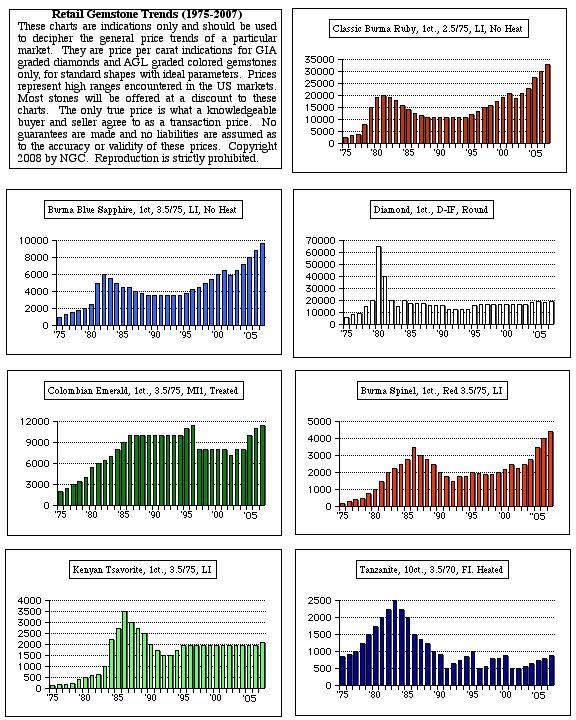
As a general rule, market observers and appraisers come to Tucson to look for pricing trends of colored gemstones. This year was especially difficult because prices were all over the board. Many dealers in booths right next to each other had widely different prices on similar material. This might be explained by the declining dollar. It is possible the dealers with new stock have been buying recently with devalued dollars, while the dealers with older stock bought a while ago. Others speculate the Tucson Gem Shows have really become retail shows that sell to private clients and the dealers better ask high prices. Some dealers said the prices of unheated Burma ruby and sapphire, unenhanced spinel and not-treated Colombian emeralds were up 25% from last year. We are simply raising our Retail Gemstone Price Trends 10% to conservatively reflect the market changes. Tanzanite and tsavorite was also up approximately 10% price.
Hot New Stone
The hot new stone everyone was talking about was the Tanzania spinel. It was discovered in 2003, but large qualities have recently been discovered. Supposedly, a large 52 kilo crystal and many other large crystals were recently found. This has allowed the cutting of many stones in the 20-40 carat range. These stones are reportedly selling for over $10,000 per carat. The problem with these stones is they are not red. They are beautiful and bright but they are pinkish-red. How can these stones sell for the same or more than Burma goods yet not be red? We believe it is smarter to buy the red Burma's and watch this market from the sidelines. As a general rule new finds of stones come out at a certain price level and increase. Perhaps this stone is an exception.
Burma Goods
H.R. 3890 or the Burma Democracy Promotion Act of 2007 is the second attempt to ban the importation of Burmese gemstones into the US. It passed the House and the Senate and will proceed to a conference committee to work out the differences before it goes to President Bush and becomes law. The new law does not effect any Burmese gemstones that are presently in the country. We expected to see less Burma goods at the gem shows. We saw primarily Mong Hsu heated and fracture-filled rubies although unheated Mogok gemstones were rare. Once the ban becomes permanent, Burma stones will become even rarer.
Bottom Line
Gemstones are rising because of escalating oil, precious metal, diamond markets and the declining dollar. We seem to be in an inflationary recession. When inflation becomes a worry, smart collectors/investors diversify into hard assets. Although gemstones are not as liquid as some investments, they provide the ultimate portable store of wealth. if you are financially secure, placing a small portion of your wealth into gemstones makes sense.
Ebay Diamond Scams
Editor: This is an informative article written by Robert James, President, International School of Gemology. It outlines how Ebay scamsters make money and get high positive feedback by selling grossly embellished diamonds. It is reprinted with permission.
Ebay and the FTC!
by Robert James
March 2008
How the bad guys are getting away with it.
I want to say that there are a lot of really good sellers on eBay. Honest people doing honest business. But today, I want to give you some insider information regarding how so many of those sellers using deceptive trade practices can continue in business. I have learned this information from years of trying to do consumer awareness regarding some of these eBay seller practices as reported by consumers. This is case history, not conjecture.
We need to first remember that in spite of eBay's claim that they are just a venue and not responsible for the deceptive trade practices going on, eBay has a collateral interest in the auctions. eBay makes a percentage off of every sale (not to mention the additional 3% they make from payments via PayPal). So it is in eBay's interest to make as many sales as possible, regardless of what it take to do so. Which not only makes eBay a partner in a deceptive sale, it makes eBay an accomplice in a deceptive sale by their refusal to take action. That is perhaps the biggest deception going on at eBay, their claim that they are not responsible for the actions of the sellers. In fact, eBay is the partner of these sellers.
Bad Guys with 100% Positive Feedback Ratings
I have always found it interesting how many eBay sellers using really deceptive selling practices always seem to boast about their 100% Positive eBay rating, or are even able to maintain a 99% positive rating. Well, it's easier than many people may realize.
Take, for example, the seller we looked at yesterday, Number1Solutions. This is the seller who had the 2.00 Carat Canary Yellow Diamond that turned out to be a cubic zirconia. This seller has a 99.5% positive feedback in spite of offering auction after auction of these deceptively titled auctions. There are two ways to maintain a high positive rating when you are doing stuff like this.
The first is simply to pad your auctions feedback with your own shill bidder ID. It is quite easy for a person to open multiple eBay accounts. Buy your own goods, give yourself a high rating, and then you build a huge positive number within a short period of time. You can also work in cahoots with other buyers of your ilk and trade off giving each other big positive feedback numbers.
The second is a bit more sinister. And this is how it often works. When a customer realizes that they have been ripped off and demands a refund, the seller agrees to provide a refund but only after the customer posts up a positive feedback for their auction. The buyer is usually so frustrated and so concerned about getting the refund that they will do just about anything to get their money back. So they post up a positive feedback for the seller in spite of the situation, and then the seller issues the refund and receives yet another positive feedback number to their rating.
This has been reported on multiple occasions on the eBay Consumer Forums and there is little anyone can do since you only get one opportunity to leave a feedback on a purchase. And the other issue is that new customers not familiar with seller will look at the 100% positive feedback rating and think that this must be a good seller. Not knowing that the positive feedback is due to coercion.
Making Money Without Really Selling Anything
There is an easy way to make huge profits on eBay that many of the really sneaky sellers use. No one talks about it much because it sounds too logical. And quite honestly it's legal. Here is how it all works:
First, they get a few rings that are obviously junk. Then put them up at auction claiming they are really excellent quality pieces, require a shipping charge that is in excess of the actual cost to ship, then sell them at a really low price for the kind of ring listed. And as part of their auction in the fine print, they offer a full refund if the customer is not satisfied minus a 10% restocking fee. The seller knows in advance that the item has been misrepresented. And they know the buyer is going to be unhappy with the purchase and demand a refund. But here is where the whole scheme pays off...
When the buyer calls demanding a refund, the seller tells the buyer this: "I will take the ring back but there is a 10% restocking fee, I do not refund the shipping fee, and you must leave a positive feedback for me before I will do anything for you since I am taking good care of you."
Can you see where this is all headed now?
Consider if I offered for sale a Certified 1.50 carat D-VS1 loose round diamond with an appraisal for $16,000.00, and I offered it at a Buy It Now price of $2,000.00. That would be quite a deal. But when I sent you the diamond you were horrified to find that you got a 1.02 carat L/I2 round diamond. You would become very worried about getting your money back and contact me.
I would tell you that I am so sorry you are not satisfied. And I will give you the refund exactly as promised because I want you to be happy with my company. All you need do is post up a positive feedback for me since I am taking such good care of you. Once done I will issue your refund minus the $200.00 restocking fee, and I would also have the $10.00 left over on the excess shipping charges. Leaving $210.00 in my pocket after all is said and done.
My cost for the whole affair: $15.00.
Time involved: 1 day to post the auction. 5 days for the auction to run. 3 days for the customer to get the ring and start demanding a refund. 3 days to do the dance on the refund. Total time 12 days.
Now, if I have 10 doggy looking diamond rings. Post them up in these kinds of auctions 2 times a month each, and each time I make $210.00 in restocking fees and excess shipping fees, my monthly gross income without ever having to actually sell any of my doggy diamond rings is $4,200.00. And I never actually sold anything.
That is one reason we continue to see such wonderful diamonds apparently being sold for such low prices on eBay. The whole point is not to sell diamonds; the whole point is to collect restock fees.
You get to keep the diamond ring. You get to keep the restock fee. You get to keep the shipping fee. And you get to add yet another Positive Feedback to your rating with every sale.
And with millions and millions of new visitors on eBay reading your positive feedback, and the fact that eBay makes money every time you make a sale so they are not going to do anything about it, it's really a pretty good living if you can sleep at night by doing it.
There are a lot of variations on the above. But this is just a look at some of the antics going on with some of the bad eBay sellers who are giving the good sellers a bad name.
Notable Quotes
Mineweb
by David Brough
March 12, 2008
"A 10-carat "D" flawless diamond would now sell wholesale for around $155,000 a carat, up from about $110,000 six months ago."
Martin Rapaport
Themomentblogs
New York Times
March 18, 2008
"I couldn't recommend a better way to spend an afternoon than looking at gemstones. It's akin to staring straight into the eyes of God or the universes."
Anna Sheffield
Financial Post
Karen Burshtein
March 15, 2008
"Colored, or fancy diamonds as they are properly called, are indeed the hot thing in gemstones." Duncan Parker, vice-president at Harold Weinstein Ltd. Gem Lab
Collector News
Purple Diamonds Discovered
In March, Dianor Resources discovered a sample of rare purple diamonds at its Ekomiak V property in the James Bay region of Quebec, Canada. The new diamond discovery is the largest to date in Quebec. The diamond-bearing Ekomiak Conglomerate extends for four kilometers and up to 500 meters in width with individual outcrops measuring 500 meters by 400 meters in size. Some reports claim they found 9 and others 16 micro purple diamonds. They found 856 diamonds from 26 surface rock samples over 2.7 billion years old. The largest diamond was a colorless measuring 1.06 mm x 0.98 mm x 0.56 mm. The largest purple found is of 335 x 379 x 225 microns. The company announced in February plans to raise $10 million in a private placement to cover expenses in hopes of finding some larger purples. Of course, purple is one of the rarest and most desirable colored diamond colors. A new supply would be nirvana for collectors.
More Kashmir Sapphire?
Jammu and Kashmir Minerals Limited earned over US$3.2 million from the two-day auction of Kashmir sapphire. The auction was organized for the sale of rough sapphire corundum extracted from the sapphire mines in Paddar area of Kishtwar district. Approximately 72 bidders came from India and Bangkok. They plan to make it a regular feature and the next auction is likely to take place in six months. Around 17 kilos of rough sapphire corundum was mined out between 1998 and 2004. Since these stones were actively mined between 1880 to 1930, these sapphires have become legendary. The extraction of the rare sapphire from the Paddar mines was stopped after militancy erupted in the state in the 1980s. Lack of mining expertise also hampered work. The main reason for the Jammu and Kashmir Minerals to auction its precious wealth was generating funds to pay salaries to its employees who have not been paid for several months. Now the government wants do a thorough assessment of the sapphire mines to exploit the reserve. All things being equal, top gem Kashmir sapphires sell for double the price of Burma sapphire and four times the price of similar quality gems from Sri Lanka or Madagascar.
In The News
Burmese Gem Sanctions: Doing Good or Just Feeling Good?
by Gary Horvitz
Mizzima News
March 24, 2008
The place of the Burmese gem trade in the overall economy of Burma is an issue under little dispute. Burma is acknowledged to have huge stocks of jade and colored gemstones which are in great demand in China, Hong Kong and other parts of Asia. In turn, Asian traders supply other parts of the world, responding to demand in Europe and the United States. But the vast majority of jade is sold in Asia to Asians. Rubies are a distant second, most of which are sold in the United States and European Union.
The Burmese military government maintains control of much of the extraction, either through state operations or through concessions to private contractors who pay the government royalties. Private traders are authorized by the government to sell gems as long as they pay ridiculously high taxes on their earnings.
A percentage of the jade makes its way to Hong Kong and China on an ad hoc basis, while most of the rubies and other gemstones mined in the northern states find their way to Thailand where they are refined before sale. The majority of the gem stock is sold directly to large trading concerns at state-sponsored auctions.
Since the primary buyers of Burmese jade are Chinese, a Western boycott may have little effect on the overall trading volume. While some jade undoubtedly finds its way to retailers around the world, a few large and well known chains in the jewelry business - Cartier, Tiffany's & Bulgari, as well as the entire European Union - have agreed to boycott Burmese gems. Cartier even does random laboratory testing to verify the origin of its gems and to document its compliance with the embargo.
It is not entirely clear whether the recent delay in government auctions and the reduced volume of gems traded was a reflection of external market factors or whether it was due to internal production delays. There may indeed be turmoil and production problems due to internal politics, but it's very difficult to determine the effect of any such problems. Nevertheless, private gem concessions must continue production in order to generate the income necessary to service their debt and maintain their capital. It is difficult to predict whether reduced demand for rubies in the West will reduce prices or whether internal production problems will reduce inventories of jade in the East and cause prices to rise.
Jewelers of America, a voluntary retail association that supports a ban on Burmese rubies, advised its more than 11,000 members in October of 2007 "to source their gemstones in a manner that respects human rights." But the association has no enforcement arm and can apply no penalties to any retailer wishing to sell rubies.
While the Association advises its members to ask for documentation of the source of the gems they purchase, there is no American law preventing them from purchasing gems of any source. In fact, since most rubies undergo significant transformative processing in Thailand before export and sale, it becomes almost impossible to identify the origin of any particular stone except by detailed laboratory analysis.
Therefore, even though the 2003 Burmese Freedom and Democracy Act signed into law by President Bush prohibited direct importation of Burmese gems, pressure from key members of the jewelry industry convinced the United States Customs service to issue a ruling a year later that made an exception for items of Burmese origin that had been "substantially transformed" in a third country.
"The U.S. embargo has almost nothing to do with the Myanmar side of smuggling. Gems are smuggled by individual miners, private companies that partner with the government, army officials, drug dealers, and rebels.
Gem smuggling from Myanmar to Thailand is even more dangerous than from Afghanistan to Pakistan, but it is also one of the only ways many Myanmar citizens have to break out of extreme poverty. The two primary starting points for colored stones are Mogok and Mong Hsu. "Mules" move a few gems at a time by hiding them on themselves. They then take a two-day trip by foot, motor scooter, or horse to deliver the gems to a dealer in a Thai border town. During the trip, the "mule" - usually a woman - will have to cross several official border crossings, where lackadaisical government officials will conduct a cursory inspection. The smuggler pays a bribe to the official and is waved through; whether an individual is carrying contraband or not is irrelevant.
Once in Thailand, Myanmar smugglers, Thai brokers, and international buyers meet to sell gems. Most gems then go to Bangkok, where they are cut, treated, and sold to international purchasers.
Although Myanmar gems are embargoed by the United States, the reality is that it is impossible to spot a Myanmar gem or for customs agents to take any action to stem the flow. Even in Thai border areas, Myanmar stones are mingled with gems from Africa, India, Cambodia, Australia, Thailand, and elsewhere. There is no certificate of origin at this stage. Once the stones have moved to Bangkok, they are further mingled. This is where the certificate of origin or authenticity often appears. By that time, only a practiced gemologist can offer an opinion on where the gemstone originated."
If the above reflects reality, it is impossible for a United States Customs agent to determine the origin of a gem that is declared, let alone stop the flow of gems that are not declared. This effectively means that any seller could easily disguise the origin of any gem with virtual impunity.
Since the raw stones go through several hands before becoming suitable for export to the United States or the European Union, it is false to say that sanctions will only hurt independent artisans. As long as there is a demand for the stone and as long as the origin of the stones is disguised in the present manner, there will always be a demand. Only the most scrupulous of buyers, willing to meticulously track the origin of these stones could possibly differentiate a stock that might be free of the taint of human rights abuse. Such an effort would require dealing with traders willing to comply with a standard of documentation that is very unlikely to be met.
Peggy Jo Donahue, from Jewelers of America, believes there is strong support for changing the 2003 Burmese Freedom and Democracy Act to close the loophole established by the Customs Service. This is what House Resolution 3890, passed by the House Foreign Policy Committee, chaired by the late Tom Lantos, was supposed to do.
She claims not to know of any opposition strong enough to stall this bill. But the fact is that there was opposition to the 2003 Act that was strong enough to influence the Customs Service and clarify the loophole. I doubt the Customs Service acted on its own in making its ruling.
If the Burmese Democracy Promotion Act of 2007 which recently passed the United States Senate were to become law, it could very well have the effect of limiting the flow of rubies into the United States because the Customs Service is well aware that they all undergo processing before export, therefore all rubies would become suspect. However, it would be unfair to embargo all rubies regardless of origin, since many may come from areas other than Burma. The logical consequence of closing the current loophole would be a demand for and scrutiny of more specific documentation of gemstone origin, which could easily become a serious headache for that department. In fact, it's not out of the realm of possibility that the Customs Service itself might lobby against passage of this legislation.
If higher scrutiny was to become the case, then the large traders who normally buy at Burmese government auctions might become reluctant to purchase stones they know they will have difficulty selling. Considering the creative lawlessness for which the Burmese junta is known, I can only speculate that a more aggressive worldwide embargo on Burmese rubies would only spur the army to transition from being the auctioneer to becoming the smuggler, leading to the widespread false documentation of origin.
Different versions of the Burmese Democracy Promotion Act of 2007 have been passed by the House and Senate. The Senate version blocks rubies and timber. The House version also terminates tax deductions for Chevron investments in Burma. So these differences must be resolved before the legislation can be signed by Bush. It's possible that no substantial action will occur before the presidential election in November, which would mean that this legislation may not be signed before a new Congress is seated in 2009.
Jewelers of America is not the only trade association that has rendered an opinion on the issue. The American Gem Trade Association, with over 1,000 members in the United States and Canada, issued a press release on November 6, 2007, supporting a stronger embargo of "materials originating in Burma."
The International Colored Gemstone Association (ICA), with 500 members in 46 countries worldwide, qualified its statement of support for the embargo saying it "exhorts its members to desist buying Burmese gemstones from any government sources and marketing organizations," while simultaneously strongly recommending "that all parties cautiously consider the negative impact and collateral damage that indiscriminate measures could inflict upon independent and poor populations engaged in mining, processing and trading activities in Myanmar."
Attempting to target specific entities that might be deliberately circumventing any sanctions is problematic, since obtaining evidence of such behavior would be next to impossible for someone outside the industry. Targeting small concerns would be a waste of time, while making inquiries with large jewelry chains is likely to be met by smokescreens and secrecy. Meanwhile, the Burmese government has recently made public comments to the effect that the European Union embargo is having no effect.
What, then, is to be done? Practically speaking, a sanction against Burmese gems may only have a negligible or at best a mixed effect. Its main value may be political in that it remains an appealing and effective organizing issue to maintain an awareness of Burma in the public consciousness. Yet no true political leverage exists until a sanction becomes law, which has not yet occurred. So, for now, we must await the resolution of legal motions before determining the path forward.
The Kashmir Legend
AGL President C.R. "Cap" Beesley trekked to the mountainous region of Kashmir.
By Amber Michelle
Rapaport
December 1, 2007
American Gemological Laboratories President C.R. "Cap" Beesley trekked to the mountainous region of Kashmir, where the sapphire mines for this coveted gem are guarded by rough terrain and political tension.
It was a gemologist's dream come true for C.R. "Cap" Beesley, president of the American Gem Laboratories (AGL), when he got the opportunity to go to the Kashmir sapphire mines - located in the northernmost frontier of India to visit, research and conduct exploration for 12 days. Even though the National Mineral and Development Corporation of India (NMDC) and the Jammu and Kashmir (J&K) provincial government, who jointly administer the mining area, granted permission for the visit, entry into the area was still difficult.
"Ed Cleveland of Kashmir Blue works in the area and is actively involved in humanitarian work in Kashmir. We combined our mutual interests and pulled off the trip by going as a humanitarian mission. We delivered medical supplies to all the isolated villages along the trail," explains Beesley, who has traveled the world as a former gem sciences consultant to the United Nations minerals branch. This trip, however, was somewhat covert as there is danger in the area from militant terrorists, a substantial military presence and marauders looking for hostages. For safety purposes, Beesley and his team always referred to each other by colors, rather than names, to avoid a hostage situation and they never spent more than one night in the same place.
Between the treacherous terrain and the hostile environment, few have ventured into this area. Beesley notes that he is one of three gemologists from a gemological laboratory to ever travel to the Kashmir sapphire mines and the only one to do so in the past 20 years. This inaccessibility of the mines contributes to the rarity of Kashmir sapphires - and has enhanced their desirability. In the auction market, the very name can cause a flurry of bidding. To dealers, the word Kashmir represents the ultimate measure of sapphire quality and for retailers, it is the prize that is always just out of reach.
"Personally, since I had previously worked the 14,000-foot ruby site at Nangimali on the Azad Kashmir, Pakistan side of the line of control and I had climbed to Kaltaro, the emerald deposit, at 16,000 feet, I wanted to complete the triumvirate of precious stones and visit the highest sapphire mine at 14,500 feet," says Beesley.
"Professionally, I also wanted to resolve several issues relative to the past, present and future of the Kashmir gem deposit," says Beesley. "First, my intent was to resolve the critical issue of what we have called 'New Kashmir.' Was the current material we are seeing in the marketplace from a secondary deposit in Kashmir, or was it actually a different geochemical strain coming from the original historic site? Typically, the new material visually resembles Sri Lankan or Ceylonese material, but internally deviates dramatically from its classic Kashmir counterpart." He says he also was in Kashmir to photograph and video-document the region, as well as explore for new gem deposits. His company, AGL, has clients interested in investing in the area who wanted a first-hand assessment of the current situation.
In 1947, India regained independence from British colonial rule and Pakistan broke off from India and became an independent nation. Currently, Pakistan controls about one-third of Kashmir and India the other two-thirds. There is a massive military presence that patrols the borders between the countries and there is often active fighting as both sides try to gain sole ownership of the entire territory.
The route Beasley's expedition took to the Kashmir sapphire mines passed through three key villages - Kishtawar, Atoli and Sumjam - all historically important markers on the sapphire-trading route. The end of the road is the village of Gulabgarh, a predominantly Hindu area.
"The entire trek required walking over 100 kilometers [60 miles]. Along the way, I lost 15 pounds and developed a renewed appreciation for every drop of fresh water and scrap of toilet paper," Beesley says in recalling the trip. "At times, the mountainous paths were so difficult to negotiate that your life was literally in the hands of your mountain guide. The ultimate ascent to the mines required an overnight stay in an isolated cattle outpost at 12,500 feet. The next morning, we continued the climb to the rim of the amphitheater-like valley that rises to over 17,000 feet and overlooks the Hagshu glacier vallery and the 600-year-old Sumjam village. We hired local smugglers to help us navigate the last part of the journey to the mine."
From the final vantage point at the rim of the valley, there was a clear view of the rock formations that account for the uniqueness of sapphire from Kashmir. The mine is protected by armed guards who have no qualms about shooting first and asking questions later. Samples of "New Kashmir Sapphire" were collected on this trip, so that its characteristics could be studied and documented. The new gems coming from the mines have different features than Classic Kashmir Sapphire. At this point, Beesley has determined that the material AGL has been calling "New Kashmir Sapphire" is from the same historic site, but is a lower-quality material. He explains that it is important to be able to verify the origins of sapphire because it can make a 300 percent, 400 percent or even greater difference in the price of the gem if it is determined to be from Kashmir rather than Burma, Sri Lanka or Madagascar.
There is not much Kashmir sapphire coming onto the market these days. The treacherous trip to the mines and 30 feet of winter snow are part of the reason. The NMDC and J&K have developed plans to expand the mine and sell sapphires on a commercial level, but the plans so far have not been implemented. Most recovery efforts are based on extracting sapphire from decomposing feldspar, a mineral that hosts sapphires, pursuing shallow tunnels and working the surrounding debris fields. Many of the sapphires currently coming out of Kashmir are smuggled out by a network of smugglers who sell the stones in Delhi and Jaipur. Locals would like to see the mines increase production legitimately in a way that would support the area's economy.
Kashmir sapphires are so coveted that in April, a 22-carat gem sold at Christie's New York for a record-breaking $134,000 per carat. "Kashmir represents the epitome of amazing sapphires," concludes Beesley. "Their intense blue color that holds up in changing lighting environments and their characteristic velvety, light-scattering internal texture contribute to their uniqueness and desirability in the world of the connoisseur."