Tucson Gem Shows 2010, New Nigerian Red Tourmaline Find, GIA Gubelin Collection Now Online, Collector Gems, Apple Collectors, In The News, Retail Gemstone Price Trends (1975-2009), Notable Quotes
Many dealers approached the Tucson Gem Shows with trepidation. Would they sell enough to meet their costs? After one of the worst Xmas seasons in memory, who could blame them? This is the second show in a row where you could get a hotel room, rent a car, or get a restaurant reservation during the months of January and February: impossible feats previously. Nothing had changed as far as the collector gem market goes. Unheated Mogok Burma rubies, Burma and Kashmir sapphires and untreated Colombian emeralds were as rare as ever.
AGTA Discrepancy
The main show for colored gemstone dealers is the American Gem Trade Association (AGTA) show. Although the quality of high end gem dealers has declined over the years and now includes many lower end dealers, AGTA reported that the trade show had an increase in buyer traffic compared to 2009. A total of 8,176 registered buyers attended the event, making for a 7% increase. The problem is many Tucson privates have learned how to get into the show by knowing a friend of a friend. Generally, these buyers take an inordinate amount of time and usually buy small quantities of inexpensive stones. This drives the wholesalers crazy. AGTA needs to tighten up requirements to get into the show because the dealer backlash against these buyers is strong and irate.
Gem Prices
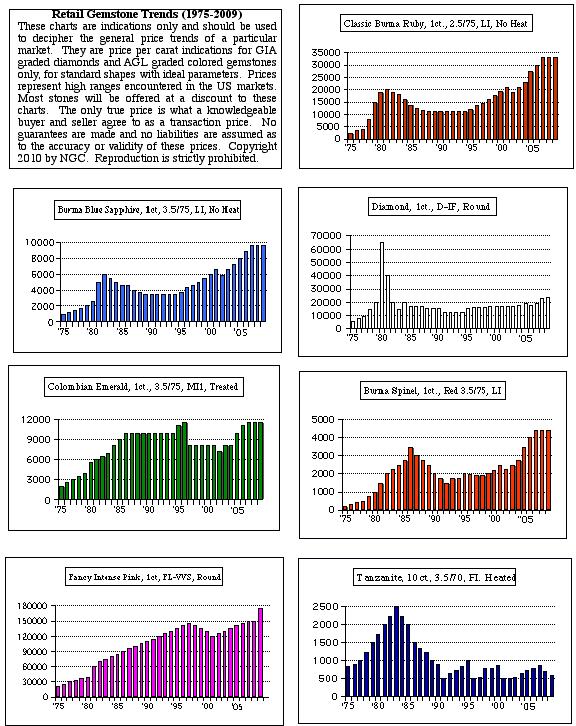
All of the major collector/investor gem prices are firm You would think in these economic times, prices would be negotiable. They are not! The amount of top quality goods at the shows was dismal. Most dealers have such a hard time buying these stones, they do not want to lose money when they sell. They cannot easily replace these stones. Low production and the Burma Ruby ban has made these gems ultra rare. Please note this market is very quiet because of the economy. Goods over $5000 were rarely sold. Commercial quality goods were down another 10%, Retail jewelers’ colored stone inventories are declining but many business lines of credit have been cut or eliminated, which has resulted in little buying. We are keeping most of our Retail Gemstone Price Trends the same for most gemstones from last year even though some other price guides show increases. The weakest stone we monitor is Tanzanite. We have eliminated the tsavorite price chart and included one for Fancy Intense Pink diamonds instead. When the 5 carat Vivid Pink sold for $10.8 million last December, it caused an increase in all pink diamond prices.
Burma Goods
Importation of Burmese gemstones into the US has been illegal since 2008. We heard rumors that unethical gem dealers were bypassing the new law. We doubt this accusation because we did not see any large quantities of Burma ruby or jade. Production is way down in Burma with many miners turning to other mining projects. The few remaining gems found in Burma often end up in Asia. People are free to trade in old "pre-embargo" stones without problems.
Bottom Line
Fine high end collector gemstones are stable. Some large stones or special cases are rising. Collectors can now cherry pick the very best stones. As always, gemstones are not for everyone. They make sense only if you have the liquidity to hold these assets.
I have been in the business long enough to remember Ouro Fino, Brazilian red tourmaline. It was originally found in 1981. It was a killer red color that looked like a ruby, but the goods were included to a degree similar to Colombian emeralds. Even with the inclusions, collectors coveted the gemstone. The mine was played years ago and the best stones are now sitting in collections. Many new gem dealers have never seen this stone. Red tourmaline was recently discovered in Nigeria in 1998. It came in purple, cranberry, orange/pink and multi colors. This material is long gone and most are sitting in collections or mounted in jewelry. Regretfully, none of this material was ever really red. Since the 1998 find, most of the Nigerian tourmaline material has been very low quality. The yield was low and most of the stones were cabochon quality. Last year, some very large pieces of the new red tourmaline were found in the Oyo Valley of Western Nigeria. Crystals weighing 15 and 48 pounds were found. This is unbelievable! Usually a few pieces are found here and there. The material was so large, the owners needed a tile saw to cut them. The new material is yielding about 15-20% from the rough. The great thing about it is some of the best material is bright red and at the same time clean. Until now, most red and pink tourmaline crystals were horribly included.
History
Tourmaline's name comes from the Sinhalese word "turmali," which probably means "mixed precious stones." Bright, rainbow collections of gemstone varieties were called "turmali" parcels. Sri Lankan (Ceylon) tourmaline was introduced to the European society in the late 1600s or early 1700s by Dutch traders. Similar to rubies which were later discovered to be spinels, numerous red gemstones in the Russian Crown jewels from the 17th century, once thought to be rubies, are actually tourmalines. The Empress Tzu Hsi, the last Empress of China, loved tourmaline and bought large quantities from the Himalaya Mine located near San Diego, California in the early 1900s.
Geology
Tourmaline is 7-71/2 in hardness and does not tend to chip or break. Its luster is glassy and it has a high degree of transparency. Tourmaline is a group that applies to several minerals with similar chemical compositions and atomic structures. Tourmalines belong to the hexagonal crystal systems. Tourmaline crystals begin as colorless and the red is created by trace elements.
Red/Pink Colors
Corundum collectors and dealers argue over where to delineate a red ruby vs. a pink sapphire. With tourmaline, the argument is "what is rubellite vs. what is pink tourmaline?" Although the argument will continue, the new find has colors that can be broken down into four groups. The reddest colors have very dark 85-90 tones. Isn’t this always the case with many gemstones? It is almost nature’s trick. These stones are red but black out. Ideally, if you want pure red, choose the reddest stones that black out the least. Approximately 10% of the production is this color. Generally, the best stones are red/pink with light tones. This open color is highly desirable. Some say it is reminiscent of Burma ruby. This color represents the majority of the material. The third color is fuschia. This is the point in Burma rubies where the stones transition to pink sapphires. These stones have a balance of red and pink and look like pink sapphires. Finally, the last color is a hot bubblegum pink like hot pink spinel. The last two colors represent 40%, or the balance of the material.
Sizes/Prices
The new material is available from 3mm rounds to stones of 15-20 carats. The largest stone cut so far is about 55 carats. Gemstone collection suites can presently be purchased in this new material. Relatively speaking, the new material is inexpensive. Top one carat sized stones start at $100 per carat. Prices for gem quality red tourmaline can escalate to over $500 per carat for serious large stones.
Treatments
We know today the original crystals were not irradiated or treated. The crystals are so large, they would never fit into a nuclear reactor, a particle accelerator a gamma ray facility. Ditto for heating the material. It doesn’t mean the material might not be heated in the future. However, the new Nigerian material is flying so fast out the door of the owner, they do not have time to monkey with the product.
Conclusion
Some predict the new material may be the next Ouro Fino rubellite. When those stones first hit the market, people immediately recognized the gems would be rare. The same can be said for the new red tourmaline. What makes this find interesting from a collecting standpoint is the goods are an inexpensive red stone compared to ruby and spinel. It might make sense to buy a suite of the various colors or specialize in one color. If you always wanted to start a gemstone collection and were short on funds, this might be an excellent opportunity. Given the tight economic times, this just may be the right stone at the right time for the right price. Collectors who purchase these goods at the beginning of the market cycle might soon be sitting pretty.
The Gemological Institute of America (GIA) launched a project comprised of data collected from gemstones in the Edward J. Gübelin collection, which the institute acquired in 2005. The GIA Gem Project is free to the trade and available online for the general public. The Gübelin collection consists of more than 2,800 samples representing 225 minerals and gem materials, which come from 48 different countries. Dr. Gübelin, one of the world’s preeminent gemologists, collected colored gemstones from major localities worldwide from approximately 1940 to the year 2000. His lifelong study of gemstone inclusions revolutionized the science of gemology and helped lay the foundation for microscopic gem identification. "Many of the gemstones in this collection are extraordinary examples in terms of color, weight and geographic origin," said Dr. James Shigley, GIA’s distinguished research fellow. "I’m not aware of any other online resource with this type of gemological information. It significantly enhances the educational and display potential of GIA’s gem collection and supports the colored stone trade." The information includes photomicrographs of interesting features, graphical plots of visible, infrared, Raman and photoluminescence spectra and qualitative chemical composition information are also available, depending on the particular gemstone. To date, GIA has collected data on approximately 1,000 of the gemstones, focusing on the corundums, spinels, garnets, beryls and tourmalines. Information on a select group of 50 stones is also available and additional groups of gemstones will be added over time. Check it out at http://www.gia.edu/GIA-Gem-Project. To browse the stones from the collection, use the left-hand navigation bar under "GIA Gem Project."
507 Rough Diamond
A 507 carat diamond weighing over 53 ounces was discovered in South Africa last year. The rough diamond, the size of a chicken egg, sold for a record $35.3 million or over $69,000 per carat. It is the most expensive piece of rough ever sold. Hong Kong's Chow Tai Fook Jewelry Company bought the Cullinan Heritage Stone. Petra Diamonds recovered the stone, the 19th largest ever found, from the Cullinan mine near Pretoria. The stone has the potential of producing one of the world’s most important diamonds. Chow Tai Fook has not decided what they will do with the rock. The stone was discovered in the same mine as the 3106 carat Cullinan, which was found in 1905. The 530 carat Great Star of Africa and the 317 carat Star of Africa were cut from this rough. They reside in the British Crown jewels.
Vivid Blue Diamond
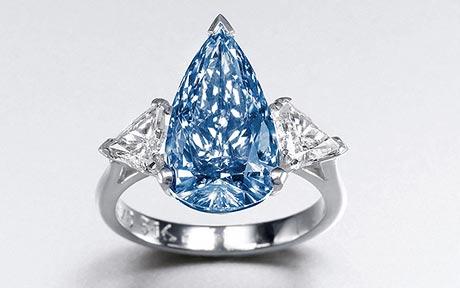
A rare blue De Beers diamond is expected to fetch $6 million at auction at Sotheby's in April. The 5.16 carat pear is internally flawless and graded Fancy Vivid Blue. The stone is part of the the De Beers Millennium collection. If you don’t recall, the collection comprised 12 rare gems and took decades to assemble. It is being put up for sale by a private collector. The diamond is from the collection put together by De Beers to celebrate the Millennium. In May 2009, a 7.03 carat, cushion-shaped internally flawless fancy vivid blue diamond set the world record price per carat for any gemstone at a Sotheby's Geneva auction when it was bought by a Hong Kong collector for $9.4 million.
Gemfields finds 6,225-carat emerald in Zambia
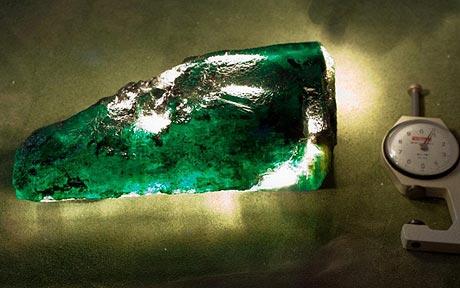
In February, 2010, Gemfields discovered a 6,225 carat emerald in Zambia. The emerald has been named 'Insofu', which means 'elephant' in the language of the Bemba people indigenous to the region. The emerald was recovered during normal mining operations. Gemfields' experts expect to establish a clearer understanding of its value and significance. Ian Harebottle, chief executive of Gemfields said, "This is a unique find. The Insofu displays wonderful color and good translucency. Its sheer size, rich color and fine protective biotite shell make it difficult to see deep into the gem. However, all indications suggest that the core of the emerald is competent and that it should yield a number of cut gems of significant size." The largest gem emerald crystal ever discovered was 7,025 carats and was found in a mine in Colombia.
Prospector Finds 2.13 Brown
Glenn Worthington has prospected at the Crater of Diamonds State Park in Arkansas for more than 30 years. Worthington found his diamond while wet screening in the park's Pig Pen, a low-lying section at the south end of the diamond search area. Though most of his finds have weighed under a carat, in February he found a 2.13 carat brown gem he named the Brown Rice Diamond. The stone has the elongated shape of a grain of rice but is much larger. It has a frosted surface and is the light brown color of iced tea. The Brown Rice Diamond is the largest of 37 diamonds found so far in the park this year. Last April, he registered a 2.04 carat yellow diamond he named Easter Sunrise. He says he plans to have the Brown Rice Diamond cut, and then will sell it. Crater of Diamonds State Park is the world's only diamond-bearing site where the public can search for diamonds and keep any they find. On average, two diamonds are found each day at the park. The three most common colors of diamonds found are white, brown and yellow, in that order. Apple Collectors
$95,000 Apple iPod
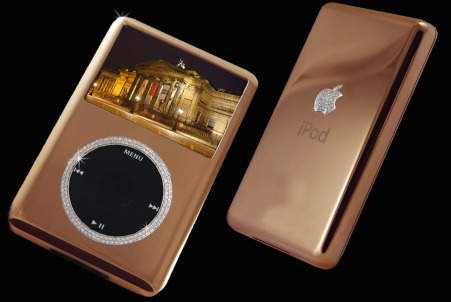
The iPod Supreme Rose edition by Stuart Hughes is an Apple iPod covered with 263 grams of 18k rose gold, creating a copper-like shade. The platinum navigation is studded with 4.5 carats of flawless diamonds. The platinum rear Apple logo plays host to an additional fifty three diamonds. Even the navigation wheel has 4.5 carats of diamonds. This is a limited edition design, consisting of only 10 units available worldwide.
$19,900 Diamond IPad
Want to be the first kid on the block to have a diamond IPad? This special iPad has 11.43 carats of G/H color diamonds and VS2/SI1 clarity set in micro-pave.
Diamonds are forever martini CNNGO by Melinda Joe
March 5, 2010
Think of it this way: You are paying $16,000 for a diamond and get a pretty good martini on the side for free. When The Ritz-Carlton opened at the top of the Tokyo Midtown Tower in 2007, the hotel dazzled the world with its soaring height, spectacular views and a martini that would knock the socks off James Bond himself. The Diamonds Are Forever Martini is decadence in a glass -- a smooth blend of chilled Grey Goose vodka with a lime twist, poured over a flawless one-carat diamond. Good news: You get to keep the diamond. Just try not to swallow it. "The inspiration for the drink came from the former hotel manager who was trying to create a 'wow' cocktail to complement the hotel's other superlatives -- the tallest building, the most expensive suite, the largest guest rooms," says The Ritz-Carlton Tokyo's director of public relations Linda Beltran. Luxury like this comes with a price tag to match: the Diamonds Are Forever Martini sells for a jaw-dropping ¥1,800,000 yen (approximately US$18,000). Despite the price, Beltran says that the hotel has sold two to date. Yet there are currently no plans to introduce another big-ticket cocktail. "Our bartender staff is always creating exciting libations, but The Diamond is Forever Martini will stand in a class by itself for now," she notes. The martini is available on the 45th floor of the hotel in The Lobby Lounge and Bar, where visitors can sink into overstuffed chairs covered in candy-colored pastel silk while listening to live bossa nova from 2:30pm to midnight. The interior, designed by Frank Nicholson, is modern but traditional, with impressively high ceilings and amber wood walls illuminated by giant inverted-gumdrop lamps. On a recent visit to The Lobby Lounge and Bar, cheers ensued from a group of well-heeled men and women dressed in tuxedoes and sequin-studded dresses. Was this the sound of the sale of the hotel's third Diamonds Are Forever Martini? The bartender shakes his head no. Just a raucous bunch enjoying the 'cheap' drinks. "I think the first one sold was a marriage proposal," he says. "Just imagine her surprise."
Diamonds Aren’t an Investors Best Friend Wall Street Journal by Brett Arends
February 12, 2010
EDITOR: Coming from the Wall Street Journal, I sure wouldn’t brag about returns from the stock market the last 10 years. If you invested $1.00 in the S&P in 1999, your money was worth .83 cents in December 2009. Nevertheless, the point they make about white diamonds is accurate. Most people buy white diamonds these days for love, not to turn a profit. However, if The Wall Street would have computed the return of colored diamonds or some colored gemstones vs. stocks, the results would have been dramatically different.
The marketers claim a diamond is forever. And sure, it's a hard stone. It lasts a long time. But what about financially? Is it equally durable? You've just sunk a small fortune into those rocks you're giving on Valentine's Day. Are they likely to hold or gain value over time? I decided to investigate. And the results, alas, aren't sparkling. Even before looking at all the transaction costs, diamonds have proven an absolutely disastrous investment for decades. According to the Rapaport Diamond Index, a respected industry benchmark, prices of top-quality stones have collapsed by as much as 80% in real, inflation-adjusted terms over the last 30 years. Even if you set aside the short-lived but massive price bubble back in 1980—around the time of a similar bubble in gold and many other commodities—the results have still been abysmal. The index has been measured since 1978 by Martin Rapaport and his firm, the Rapaport Group, which provides a variety of research and trading services to the gemstone industry. The index looks at prices for top-quality one-carat stones, those with the best color and clarity. While every stone varies, in 1978 a typical such stone, according to the index, cost around $6,100. Today it costs nearly $11,000.
On the surface, that looks like a gain. But investors are frequently fooled by the effects of inflation. Taking that into account, the stone has actually lost about half its value in real purchasing power. Stone prices peaked in 1980 at about $60,000 in today's money. Some store of value. After the crash in the early 1980s, prices bottomed out in 1985 at about $9,600 in today's money. Since then, in real terms, they've barely edged up. They have, at least, kept up with inflation. But that's ignoring all the related transaction costs, from broker's fees and commissions and retailer markups on buying and selling to insurance costs. Never mind that during the same period, anyone investing in a broad-based stock index fund—or even government bonds—made many times that money. Diamonds are a marketing gimmick as much as anything else. Most men feel they have to give a diamond ring when they propose—even though, as anyone knows after a moment's thought, the only woman worth buying a ring for is the one who doesn't care how much you spent on her ring. (In Shakespeare's "Merchant of Venice," I might add, the successful suitor is the one who picks lead over silver or gold.) The biggest winner in the diamond game is the Oppenheimer family, which runs De Beers, the Standard Oil of the diamond world. The company dates back to Cecil Rhodes and the Victorian era, and once controlled nearly 90% of the world's diamond business. It is still by far the biggest player. (Annual results, out this week, showed sales and profits tumbled across the industry as a result of the recession. But De Beers has merely responded by cutting production and costs. Rising demand from the newly rich in emerging markets means the future looks bright. And the company had no difficulty raising a quick $1 billion from its investors to pay off some debts. Life is good at the top, even when times are tough.) Nicholas Oppenheimer, the billionaire in charge of the company, admitted this week that most of the sales growth in the U.S. over the past decade has been the result of clever marketing campaigns. There's no logical reason why you should have to cut a check to Mr. Oppenheimer's family, or even to their competitors, in order to ask your girlfriend to marry you on Sunday. But you probably will anyway. Most of us do. Marketing is a powerful thing. If you are doing so, Russell Shor, senior industry analyst at the Gemological Institute of America, has some advice. Pear-shaped diamonds can often seem bigger than round ones of the same number of carats, he says. And small differences in clarity are often less visible to the naked eye than differences in color. But you're much better off selling diamonds than buying them. The numbers tell the story. Anyone who invested $1,000 in the Tiffany & Co. IPO in 1987 and just sat back and left their money alone, merely reinvesting the dividends, would have about $26,000 today. Someone who sunk that money into diamonds instead: less than $2,000. Anglo American, the South African mining company that owns a major stake in De Beers, has been a terrific investment for decades. Investors in the stock more than tripled their money last decade—while diamond prices rose by less than a third. Has the longer-term picture for diamonds been any better than that of the last 30 years? Reliable data are hard to come by. Mr. Shor says historical studies show modest price gains before the 1970s boom. "Until the 1970s, prices were relatively stable, trending upwards," he says. "in the mid-1970s, we had a lot of inflation. Diamonds, all of a sudden, soared in value." If the past is prologue, which past? If we see soaring inflation and negative real interest rates again, as we did in the 1970s, diamonds and other hard assets might even take off again. But with investments, as with love, there are no guarantees.
RapaportSotheby’s Spring Sale Offers Superb Color Stones By Jeff Milller March 24, 2010
Sotheby’s will hold an April sale of Magnificent Jewels and a single owner auction, "Always in Style: 150 Years of Artistic Jewels," in New York on April 20, 2010. A majority of the white diamonds that will be featured there are the highly sought, wearable sizes weighing 10 carats and less. One such example is a platinum and diamond ring set with a 9.25 carat, D, internally flawless, type IIa stone, graded triple-EX and assigned a presale estimate of $1 million to $1.5 million. A highlight of the colored diamonds on offer is provided by a rare fancy intense, pinkish-orange diamond ring set with a 7.67 carat, type IIa, cut-cornered rectangular modified, brilliant-cut stone that is the largest flawless or internally flawless diamond of this hue to be graded by the GIA to date. Its presales estimate ranges from $2.5 million to $3.5 million. Another superb example is a magnificent, fancy vivid yellow diamond necklace which features 42 GIA-certified, fancy vivid yellow diamonds weighing a total of 100.17 carats and set in a graduated riviere style. This necklace boasts a presale estimate of $2 million to $3 million and Sotheby's has contended that it will be the first of its kind — set entirely with fancy vivid yellow diamonds — to appear in auction. An 8.66 carat ruby and diamond ring, which Sotheby's described as "one of the finest ‘pigeon blood red’ rubies to be offered on the market," carries a presale estimate of $1 million to $1.5 million. This historical stone is the property of the Gardner family and was formerly included in the collection of Isabella Stewart Gardner, the philanthropist and visionary patron of the arts whose art collection is housed in the Boston museum that bears her name. "Gardner loved jewelry and was depicted by painters John Singer Sargent and Anders Zorn theatrically wearing her rubies on ropes of pearls. According to a letter found in the Gardner family archives, the ruby on offer was acquired from a rajah who sent the stone to Mrs. Gardner in Paris, as she was known to be seeking a ruby in memory of her brother, Charles Stewart," Sotheby's stated. There will also be a collection of seven unmounted Kashmir sapphires up for bid that are well matched and offered as three pairs of cushion-shaped stones and one square-emerald cut stone. The Collection of Kashmir Sapphires weigh from 4.29 to 8.73 carats and its total presale estimate ranges from $1.1 million to $1.5 million. The April sale will include the Marlene Rose platinum and diamond brooch, circa 1930, that was formerly a part of Marlene Dietrich's collection, as well as a collection of jewels from the estate of Nancy M. Daly. Sotheby’s will also present magnificent jewels from the collection of Patricia Kluge as a major highlight of its April sale. The core of Kluge's collection is comprised of a multitude of white diamonds, including an impressive pair of platinum and diamond pendant earclips set with almost 64 carats of pear-shaped diamonds, with its presale estimate. standing at $600,000 to $800,000, and a sapphire and diamond panthère wristwatch from Cartier with a presale estimate of $100,000 to $150,000. Sotheby's will offer an emerald and diamond Art Deco bracelet from Tiffany & Co., circa 1925, featuring a row of 14 beautifully matched Colombian emeralds weighing approximately 39.60 carats. This piece has a presale estimate of $350,000 to $550,000
Scientific ComputingTaking a Close Look at Unique Diamonds March 30, 2010
The song says that "diamonds are a girl's best friend," but scientists are finding that diamonds are a researcher's best friend too. Many of the properties of diamond necessary for technology are impacted by defects and impurities present in the lattice. In collaboration with the Smithsonian Institution Museum of Natural History, the Naval Research Laboratory (NRL) has recently begun studying unique and historic natural-colored diamonds to understand and characterize the defects and impurities that cause the color. NRL has been involved in pioneering work involving chemical vapor deposition of diamond and the use of diamond materials in advanced technologies relevant to the Department of Defense since 1987, and has been complementing its studies of the defects and impurities in chemical vapor deposition diamond materials with its studies of natural diamonds at the Smithsonian. Since late 2005, a team of NRL researchers led by James Butler of the Chemistry Division, has been examining unusual natural-colored diamonds. These include many of the diamonds in the Smithsonian Collection, such at the "Hope" and the "Blue Heart," as well as a collection of 240 fancy-colored diamonds in the Aurora Butterfly collection on loan to the Smithsonian. "Understanding these unique colored natural diamonds provides knowledge useful to both technologists and gemologists," Butler explains. "A better understanding of these defects and impurities (dopants) allow us to tailor the materials properties of diamond materials: from electrically insulating to semiconducting; from optically transparent to a variety of colors; or to provide the isolated quantum states for quantum cryptography or quantum computing."
Hope and Wittelsbach-Graff diamonds
During 2005, Butler and NRL researchers Sally Magana (NRC), Jaime Freitas and Paul Klein worked with the Smithsonian, Penn State University and Ocean Optics to study the optical emission properties of the Hope Diamond. This work, "Using Phosphorescence as a Fingerprint for the Hope and Other Blue Diamonds", was published in Geology, 36, 83-86 (2008). Most recently, NRL has been working with the Smithsonian and the Gemological Institute of America (GIA) to study another famous blue diamond, the Wittelsbach-Graff diamond. Both the Hope and the Wittelsbach-Graff diamonds are believed to have originated from the same region in India in the 17th century, have similar blue color and nearly identical red/orange phosphorescence when excited by ultra-violet light. Hence, it has been speculated that they might have originated from the same stone. The Wittelsbach-Graff diamond was last seen in public in 1958. Then, in 2008, Laurence Graff, a diamond dealer, bought it at auction for 16.4 million GBP. Graff had the stone cut and re-polished, reducing it from a 35.5 carat stone to a 31 carat stone, compared to the Hope diamond which is 45.52 carats. The researchers used a variety of spectroscopic and microscopic analyses of the Wittelsbach-Graff diamond to determine the extreme similarity of the gems, but also observed distinct differences in the dislocation and strain microstructure which suggest that the gems probably did not originate from the same rough stone. The collaboration between NRL scientists and the Museum of Natural History on the Hope diamond and other blue diamonds at the Smithsonian continues, having examined the phosphorescence (due to donor-acceptor recombination), and the boron concentration using secondary ion mass spectroscopy. Also, soon-to-be-published, is work on the spectroscopic and structural properties of a collection of pink diamonds.
Key suspect in murder of Briton arrested CapitalFM KenyaBy Bernard Momany
February 10, 2010
Police have arrested a prime suspect believed to have been involved in the murder of British gemstones dealer the late Campbell Bridges who was murdered in August last year. The suspect was arrested on River Road in Nairobi, six months after the murder of Bridges who was attacked by a mob wielding spears and machetes near Voi town where he operated a multi-million business empire. The 71-year-old Bridges was described by the international media as a "legend" in the gem industry having discovered Tsavorite in Kenya in the 1960’s. "Police have been looking for him over the murder, and following crucial leads provided to us by a man who knew him very well, we were able to arrest him," Central CID Chief Stanley Malinge said. "He is in our custody but we are finalising arrangements to have him transferred to Voi where the crime was committed," he told Capital News. Soon after Bridges’ murder, three suspects were arrested and subsequently charged over the killing. Police said at the time they were looking for some more suspects they believed participated in the murder. At the Central Police station in Nairobi, we caught up with Mr Philip Siengo, the Chief Security officer of Bridges who escaped death narrowly during the August 2009 attack. "I was with Bridges when he was killed, we were ambushed on our way from the police station where we had gone to report threats from a group of people but I managed to escape with injuries," Mr Siengo who stills works at Bridges’ firm said. Mr Siengo sustained head injuries in what he describes a ‘miracle’ escape. "I know the people who attacked us very well, they are just locals and they had been threatening us and my boss. Even the suspect who is in custody was among them," he said. Mr Siengo called on the Internal Security Minister Professor George Saitoti and Attorney General Amos Wako to intervene and ensure the suspect arrested in Nairobi is charged in court because he feared some powerful individuals in government may interfere and have him released. He said the suspect and others still at large had been threatening him since August when Bridges was killed and called on the police to accord him protection.
Retail Gemstone Price Trends (1975-2009)
"The key to appreciating a gemstone is to hold it in your hands, turn it to see the light dance as it refracts through the complex internal chemistry, and – if you want to wax esoteric about it – feel its energy." Adnan Khan
The Journey of a Gemstone
The National
February 20, 2010
"Spinel could be the hot trend of 2010 and beyond, and retail jewellers should be looking to stock more pieces using the gemstone,. Spinels are rarely treated. Heating experiments on spinels show no or only limited enhancement, apart from clarifying some of its turbidity. For me it is a very great pleasure that this stone is a very natural product." Dr Michael Krzemnicki, director of the Swiss Gemmological Institute (SSEF)
Retail Jewellers
Mar 16 2010