VOL. 29, #4, Winter 2011
Cap Beesley Talks, Auction News, Victoria's Secret Fantasy Treasure Bra, International Gemstone News, Burma News Updates
- Home
- Newsletter
- VOL. 29, #4, Winter 2011

Cap Beesley Talks, Auction News, Victoria's Secret Fantasy Treasure Bra, International Gemstone News, Burma News Updates
Cap Beesley Talks
We finally caught up with the always outspoken and never shy C.R. "Cap" Beesley.
Gemstone Forecaster: In 2006, American Gemological Laboratories (AGL) was acquired from Cap Beesley by Collectors Universe. In 2009, AGL was purchased and re-privatized by Christopher P. Smith, who had been Vice President of the laboratory while under CU ownership. Have you settled your legal issues with Collectors Universe?
Cap Beesley: Yes, Alleluia - its finally done!
Do you have a relationship with AGL?
CB: In my opinion, you never cut your umbilical cord to something you have created. I will always have an historical relationship with AGL.
GF: Any plans to start a new lab?
CB: Many individuals and dealers have requested that I reopen a laboratory. There have also been offers of significant private funding for a new venture. My current interest is to avoid the wholesale lab business that is often associated with trade nepotism. I am interested in cultivating a unique set of lab services that caters to the population of gemstone buyers who value truth and accuracy in gemstone information.
GF: Few know you have been a major collector for decades, any plans for a Beesley gem museum?
CB: I have always had an active interest in museums and presenting gem and mineral information in unique venues. As a board member of Yale's Peabody Museum, that interest has reached new levels of expression working with one of the finest groups of individuals that still appreciate the foundational purpose of the museum experience; namely, to document scientific information, educate the general public and ignite the imagination of a broad range of visitors and observers. There are other parallel plans to develop museum concepts that will document my extensive field experience with the United Nations Mineral Branch in unique locations around the world. Hopefully, others will build on this body of scientific data and use our information to expand the scope of gemstone exploration and understanding.
GF: Are you involved in any private ventures?
CB: My current activity is focused on assisting individuals and particularly groups to make wise gemstone acquisitions based on an assessment of the value and the potential of exceptional material. I am also interested in exploring new dimensions of the gem market in order to develop short and long term strategies consistent with client objectives. In some cases this requires providing information in formats that are generally beyond the scope of the current population of gem labs.
GF: Collectors with old AGL grading reports, with your signature, consider them collectors items. Any advice for today's collectors?
CB: I understand the challenge and I am empathetic with their plight. Standards are not trustworthy if they are a floating target. I would suggest that they contact the "new" AGL and request a translation between the original grading terminology and the changes that have been implemented since my departure from AGL. In fact, I would suggest all gem buyers request from every lab a disclosure statement that identifies the tolerances applicable to each grading category in any document for both colored stones and diamonds. It is important for all gem buyers to clearly understand the issue of grading tolerances since they are closely tied to value. For example, the GIA grading tolerance for color in diamonds is plus or minus one grade
a little known fact among gemstone consumers. Don't be shy
you are signing the check!
Forecaster readers are aware of the grading changes. See HERE -EDITOR
GF: What happened with the 74 Carat North Carolina Emerald and the GIA?
CB: One of the outstanding projects of last year was the opportunity to participate in the planning stages of bringing the largest emerald ever found in North Carolina and North America to the marketplace. After several consultations, the 310 carats emerald crystal found on the Adam's Farm in Hiddenite, NC was cut into an unusual shape weighing 74.66 carats and subsequently treated with polymer by Jerry Call, an ex-GIA staff member turned entrepreneur and gemstone cutter. The level of enhancement pushed the limits of moderate. I subsequently suggested we recut the stone to emulate the Catherine the Great Emerald that coincidentally was on the cover of the April 2010 Christie's Catalog and categorize the two stones as the Emperor and Empress.
In order to establish and maintain a chain of custody the stone was submitted to the GIA for documentation of weight, measurements, image and confirmation of the presence of a clarity enhancement agent. To my amazement the GIA report was returned with a comment indicating the following "no indications of clarity enhancement." As a professional courtesy I took the stone back to the GIA, New York lab to point out the error. The gemologist informed me that the enhancement statement did not mean there is no enhancement agent in the material.
According to her explanation, the comment indicates that whatever is present in the stone is having no effect of the visual appearance of the gem. Stunned, I gently indicated that in this case, that conclusion was absolute nonsense and that when the polymer was stripped out of this emerald the difference would be significant. I explained that my only interest was to prevent GIA from being embarrassed by their superficial interpretation. She promptly dismissed my overture to re-examine the stone and arrogantly suggested the discussion was over. Subsequent cleaning of the emerald confirmed my interpretation which was carefully documented with both video and photographs before, during and after the cleaning process. I characterized this exchange as both inexcusable, unprofessional and a sad commentary on the capability of the GIA to recognize enhancements even when confronted with a gemology 101 interpretation.
GF: Are you concerned with the laboratory situation today since you left AGL?
CB: The forgoing illustration is a glaring indication of the gemological arrogance that can infiltrate even the best intentions of a gemological organization. Personally, I was concerned about the laboratory situation when I first organized the "original" AGL. I saw a significant need and designed a series of systems and procedures to meet those needs. Unfortunately, the situation has become even more convoluted as I observe the lab process from the outside. The attempts at harmonization by a group of non-decision makers are shallow overtures that cater to sellers' interests at the expense of the buying public. For example, the TE terminology that has been adopted by many of the labs is totally bogus and misleading. It describes what is actually clarity enhancement as "TE" or "Thermal Enhancement" suggesting that "fracture healing" is an obscure byproduct of the heating process rather than the intentional closure of surface reaching fractures by the addition of healing agents and heat to improve clarity.
In addition, the unwillingness of gem labs to identify the types of fillers in emeralds, as well as, rubies and other gems is equally inexcusable. The technology exists to identify fillers, but the will to protect consumer interest in these matters is nonexistent. Even country of origin has turned into a fiasco. Groups like the GIA insisted for years that country of origin calls were both impossible and inappropriate. Now, the GIA has entered the fray with lots of financial motivation and ICP-MS instrumentation that requires a brain trust to operate and little experience to make these complex assessments. Based on reported performance from experienced dealers, the GIA has only succeeded in polluting the significance of country of origin.
I believe that a meaningful independent regulatory commission should be implemented as the first order of business to correct these abuses. It should include a wide range of professionals that extend beyond the typical industry and gemological think tank approach that tends to operate at the mercy of the trade and associated financial interest.
GF: Any response to the Al Jazeera "hit piece" where four year olds and the elderly are virtual slaves to the government?
CB: The Al Jazeera video that was replayed in the national media was as misguided as the decision to implement the Burma embargo. The video image of children hammering rocks on a rock pile in Mogok is bogus beyond belief. As a regular observer in Burma of their culture, traditions and the impact of the ill-advised embargo, I can attest that the facts that should have been part of this regulatory process have fallen through the cracks. Mogok families, especially women and children are not involved in forced labor as depicted in the Al Jazeera video. Mogok families don't have nannies, au pairs or western style daycare centers to park their children while mommy and daddy are pursuing their careers.
The Burmese people have a tradition called "Kanasay" that allows women and children to freely collect and sell gem material that they find in the streams outside the main washing areas. The idea that there is forced labor is nonsense. The embargo has had a devastating effect on the very people that it was intended to help protect. All this occurs while the Chinese government systematically persecutes and attempts to destroy the Tibetans and other cultures in mass under the same watchful eye of the detached bureaucrats that implemented the Burma embargo. The inconsistency of U.S. policy in Burma verses China is unfortunately tied more to financial interest rather than humanitarian concerns. It's an example of the proverbial fox going after the chicken with the broken wing. The embargo should be withdrawn without hesitation.
For those who want to see the Al Jazeera piece:
http://www.youtube.com/watch?v=yeYDQ2fqBcY
GF: Ralph Esmerian was sentenced in Manhattan federal court to six years in prison for wire fraud, bankruptcy fraud, and concealment of assets. What is your opinion of what happened to Ralph Esmerian?
CB: Ralph Esmerian was one of the great gentlemen of the gem business. His family is tied to an outstanding generational tradition of exceptional gemstone expertise. He was a significant and faithful supporter of science, museums and consumer protection initiatives. His recent challenges represent one of the most unfortunate situations that I have witnessed in my 40 plus years in this industry. In my opinion he gambled on the success of Fred Leighton, signed onto agreements with high priced attorneys, Wall Street sharks and was caught in an economic downturn of devastating proportions. I think, he began making decisions that were inconsistent with who he was personally and now has paid a high price for a series of poor choices. This is a sad situation that did not have a happy ending. Personally, I can think of a number of people in this industry that actually belong behind bars and Ralph isn't one of them. However, he is resilient, creative and I think the lessons he has learned from this experience will help him emerge from this situation stronger than ever.
GF: Thank you, Cap.
Hong Kong Christies-November
China and the rest of Asia bought $82.7 million worth of goods at the Christie's Hong Kong Magnificent Jewels sale. This was a new record for the most ever at a jewelry auction in Hong Kong. A 26.41 Kashmir sapphire sold for $3.8 million or $143,000 per carat. It had an AGL report stating Kashmir-no heat. A pair of 25.38 and 23.12 carat matching cushion Colombian emerald earrings sold for $4 million, or $83,000 per carat. The emeralds had an AGL report stating no clarity enhancement.
Christie's Geneva-November
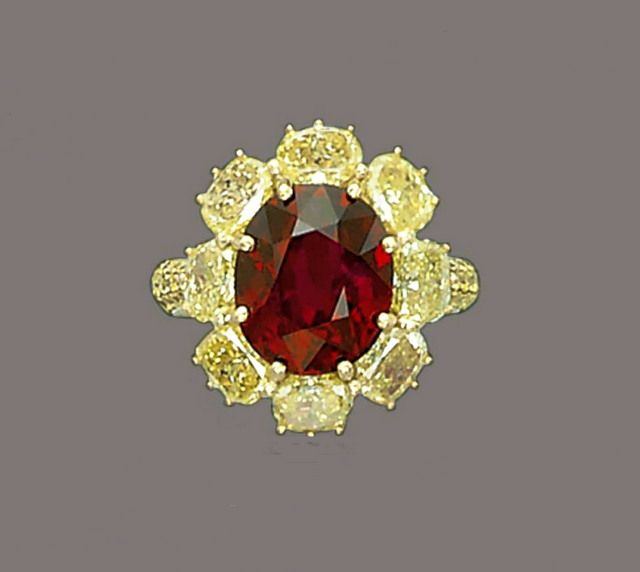
The entire sale generated revenues worth $61.37 million. A gem 8.11 carat, oval Burmese ruby was estimated at $2 million to $2.5 million. It sold for slightly over $2.2 or $271,000 per carat. The gem was red and had an AGL stating Burma-no heat:
 |
A rare and unusual 10.67 fancy gray diamond, SI1, was estimated at $120,000-200,000. It sold for $1.19 million or over $111,000 per carat, a world record price for a gray diamond. It was graded by GIA.
Sotheby's New York-December
A 22 carat rare fancy intense pink diamond, VS2 had been expected to sell for about $13 million but failed to sell. It is unclear why this stone did not sell. Some speculated the grading report was wrong and others blamed the economy.
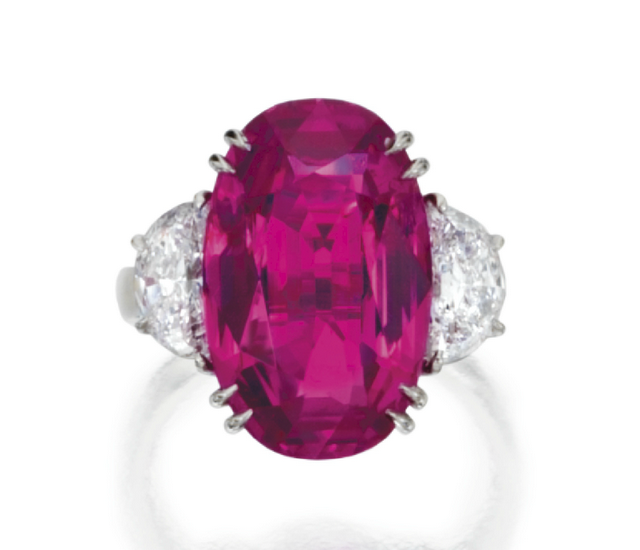
Also, the 10.37 Burma Rose ruby did not sell it. The estimate of $1.5 million and $3 million was too high. Although a beautiful electric magenta stone, the color is not worth $150,000-$300,000 per carat estimate. Only reds get this price, Sotheby's. Come on:
 |
On a positive note, a 16.40 Kashmir sapphire beat estimates when it went for just under $1.6 million or $97,000 per carat. It was bought by an Asian collector. It had an AGL document stating Kashmir-no heat.
Skinner Fine Jewelry-December
A rare star Burma ruby and diamond ring smashed the auction pre-sale estimate of $15,000 to $20,000. Whomever put this low estimate doesn't know Burma star prices. The 28 carat oval cabochon star ruby was extraordinary in size and color, and brought $242,500. It was accompanied by an AGL report stating the ruby is natural, Burma origin:
 |
An 8.40 Kashmir sapphire sold for $369,000 or almost $44,000 per carat. It had an AGL stating the sapphire is natural, origin Kashmir:
 |
Liz Taylor Auction
Christie's Elizabeth Taylor sale expected to bring in $20 million. It shattered the Duchess of Winsor's record of $50 million in 1987 by bringing in $120 million. Her famous 33 carat diamond from Richard Burton sold for $8.8 million to South Korean Daniel Pang. Burton paid $300,000 in 1968.
Victoria's Secret Fantasy Treasure Bra
The $2.5 million aqua-colored Fantasy Treasure bra was worn by supermodel Miranda Kerr. It was created by Long Island's London Jewelers. The lingerie features 3,400 hand-placed gems, including 142 carats of diamonds plus pearls, citrines, and aquamarines. The two main yellow diamonds are over 14 carats and two large white diamonds are over 8 carats each.
The price of these bras has steadily declined over the past few years. The most expensive bra was $15 million in 2000. In 2005, the price was $12.5 million. For the past five years the prices have declined. The price tag his year is the first increase in many years from $2.0 million to $2.5 million. Of course, no one has ever bought one of these bras.
http://www.youtube.com/watch?v=v9jUlUolgr8
International Gemstone News
Chinese Investors Look for Sparkle
Wall Street Journal
By Stephen Bell in and Jason Chow
November 17,2011
Pink diamonds have found a new best friend: China's rich.
Worried that traditional investments like stocks and bonds are losing their sparkle, wealthy Chinese are buying the gemstones to showcase alongside fine wines and contemporary art.
Their interest is driving up prices of Australian pink diamondsthe world's rarestand supporting returns that have outstripped the Dow Jones Industrial Average and Hong Kong's Hang Seng over the past decade.
An index of pink-diamond prices more than doubled between 2000 and 2010, according to Gemdax consultants. That compares with the 63% return on the Hang Seng and 6.2% for the DJIA.
"I see it as an investment, but unlike shares, I can wear it," said Doris Kwan, a Hong Kong-based consultant, who bought a pink-diamond necklace in April at a private sale in Taiyuan, a city in China's northern Shanxi province. "I'm not going to put a gold bar on my body."
Other colored diamonds also are hot: A record was set on Wednesday for the sale of a yellow diamond. The Sun-Drop diamond was sold for 11.2 million Swiss francs, or $12.4 million, at a Sotheby's auction.
The wave of interest is prompting a major shake-up of the jewelry industry, as traders who once catered to Hollywood stars and scions of oil wealth from the Middle East are now expanding in Asia. Store openings and private displays are rising in Hong Kong and mainland China, and jewelers also are seeking to tap institutional investors for funds.
The world's largest jeweler, Chow Tai Fook, is gearing up for next month's listing in Hong Kong in one of the biggest initial public offerings of the year, with plans to raise up to $3.5 billion.
London-based Graff Diamonds is planning a $1 billion listing sometime next year in Hong Kong because the company wants to be close to its fastest-growing market, according to a person familiar with the situation.
Hong Kong's Doris Kwan recently bought this pink-diamond necklace at a private sale in Shanghai.
Graff owns a 25-carat pink diamond renamed Graff Pink, which it bought for $46 million at Sotheby's, making it the most expensive diamond ever sold at an auction.
Pink diamonds, produced almost exclusively at Rio Tinto PLC's Argyle mine in the Kimberley region of Western Australia, are so rare that only a few dozen of the gemstones are offered annually for sale.
For every colored diamond, there are at least 10,000 colorless, also called white, ones. This scarcity has helped underpin prices: Recent auctions of pink diamonds have fetched more than $1 million a carat, with an average price 20 times more than their colorless cousins.
In addition, pink diamonds may not be forever. The Argyle mine is due to finish operations in 2019, and Rio Tinto estimates there may be only 500 quality diamonds left to be unearthed.
As investments, however, colored diamonds are trickier than white diamonds because their rarity makes them more difficult to value. White-diamond prices are set by the Rapaport Diamond Report, but experts rely on prices struck at the big auction houses to value colored ones. Also, the market is far less liquid than that for white diamonds, which turns off some buyers.
Last month, Rio announced the results for this year's invitation-only tender of 55 pink diamonds weighing a combined 47.6 carats. Of 11 heart-shaped pink diamonds included in the tender, the largestweighing 1.31 caratswas sold to Chow Tai Fook.
Queensland-based jeweler John Calleija bid for four stones at the tender and only secured one, while one of his associates was only successful with four bids out of 40. "My phone has been running hot," Mr. Calleija said. "The prices were the highest that I've seen."
Mr. Calleija's clients have traditionally involved A-list actors and celebrities, including the late tenor Luciano Pavarotti. But recently he showed a collection of pink diamonds worth $26 million to a select group of 30 Chinese billionaires at a Hong Kong private club.
While some are starting to question whether the market is running too hot, Ms. Kwan isn't among them. She spent 135,000 yuan ($21,000) on her necklace, featuring 0.8 carat of pink diamonds in a floral design surrounded by small white diamonds. "I'd sell all my stocks, everything else, before my diamonds," Ms. Kwan said.
First Gold, Now Diamonds
The Motley Fool
By Padraig O'Hannelly
November 8, 2011
Again, you should always take possession of the gemstones and diamonds you buy. We would never recommend putting assets into diamond funds. Like gold, you want possession of your goods. - EDITOR
With diamonds being promoted as the next big investment, new funds are popping up to take advantage.
Diamonds were in the news again last week, with the announcement that Anglo American is to pay $5.1 billion to buy out the Oppenheimer family's 40% interest in De Beers.
But it's fair to say that the shiny gems have been attracting more interest as an investment over the past couple of years, as investors seek out safe havens amid the turmoil.
An investor's best friend
And safe havens have been hard to find, with even the traditional investment of gold seeing significant falls on occasion. For those willing to look further afield, 'alternative investments' such as wine and violins have sometimes seemed attractive, but the risks involved in buying such 'emotional assets' are huge.
Joining the list are diamonds which, like most other alternative investments, do not pay a dividend. As Warren Buffett said of gold, "it doesn't do anything but costs you charges and stares at you".
But unlike gold, each diamond is unique, and its value is based on a complicated consideration of factors such as colour, clarity, inclusions, and so on, and the fashions and preferences vary over time. This makes it difficult to establish a definitive index of diamond value, although there are benchmarks such as Rapaport Group's RapNet Diamond Index (RAPI) and the Polished Prices Index.
It should also be noted that, according to the Polished Prices Index, the stones lost 22% of their value during the 2008 financial crisis, and are down 16% since August. So while diamonds may be 'alternative', they are not entirely uncorrelated with other investments.
Enjoying exposure to diamonds
Probably the easiest way to buy into diamonds is to buy shares in a diamond miner, and there are plenty on the London market: Petra Diamonds, Gem Diamonds, Firestone Diamonds, Namakwa Diamonds, Paragon Diamonds, Diamondcorp, Stellar Diamonds and Botswana Diamonds.
All of these shares have seen better days, which of course does not necessarily make them a buy, but Tony Reading's recent article on Petra Diamonds will give you a flavour of what's on offer. Buying a diamond miner also means buying the risks and opportunities related to that specific company and management.
Another option is to buy the stones themselves, but when you consider the likely spread between the buying price and the selling price, the complexity of valuing each diamond, and the depth of your knowledge compared to the knowledge of the seller, you might like to reflect on whether this approach is a good idea. How sure can you be that you're buying right?
Diamond funds
In recent years, and especially in the past year, a number of diamond funds have been established to capitalise on the growing interest.
And given the uniqueness of each stone and the inefficiencies in the market, a skilled management team should, in theory, be able to bring some value to a fund.
The easiest fund for UK-based investors to buy is Diamond Circle Capital, the first publicly listed fund to invest in diamonds. It is run by Diapason Commodities, but its website provides no information without logging in.
Rapaport Group, run by industry veteran Martin Rapaport, is planning to introduce a diamond investment fund aimed at the financial community. It is expected to start with around $10 million, increasing to more than $100 million. "Diamonds are going to track exponential growth of wealth in developing markets," Rapaport is reported as saying. "Chinese demand for diamonds is simply fantastic, so is Indian."
Diamond Asset Advisors, established in Switzerland at the start of 2011, along with Harry Winston Diamond Corporation, is planning to raise $100 million by the end of 2011 to launch a diamond fund, with another $150 million expected to be invested during 2012. The fund is targeting an annual return of 12% after fees.
The Novel Diamond Fund, based in Hong Kong, targets a 20% return from its investment in coloured diamonds. Jim Rogers is among the directors.
Also focusing on coloured diamonds is the Sciens Colored Diamond Fund, which intends to "take advantage of arbitrage opportunities available due to the extreme opacity and inefficiency in the pricing of coloured diamonds". It employs three strategies: short-term trading, improvement of diamonds, and holding as prices rise. High net worth individuals will need at least $2 million to participate, while institutions will need to put up a minimum of $5 million.
The Malta-based Diamond Capital Fund counts insurance entrepreneur Clive Cowdery among the founder investors in its $20 million fund, launched this summer. It will trade as well as just hold diamonds.
Cayman Islands-based KPR Capital's diamond fund was launched in March 2009, targets a 10% return, and applies a hedge-fund style 'two-and-twenty' fees structure. Minimum investment is $250,000.
Fusion Alternatives, another fund targeting high net worth individuals, was set up by former senior managers at the Rapaport Group. Its fund specialises in investment grade polished diamonds.
The Global Diamond Fund: Not much information on this, but on general principles I'd avoid any company that does not have full contact details on its website, and whose site is hosted by Yahoo!
So a very mixed bunch, not for the faint-hearted, and mostly not for the average man in the street.
The nature of diamonds probably makes them unsuitable for a physical exchange-traded fund, but can it be long before more accessible funds become available to the mass market
and what would that mean for valuations?
Illegal mining on the rise, funding criminal groups: DAS
Colombia Reports
by Sara Crust
October 5, 2011
Illegal mining is on the rise in Colombia, and is often operated by criminal groups, according to a study conducted by Colombia's intelligence agency DAS.
DAS estimated that 50% of the country's mines are illegal.
According the newspaper El Espectador, the group with the most control over the unlawful mining industry is the leftist guerrilla organization FARC, the study said. The ELN and neo-paramilitary groups are also known to operate mines.
The mines are used to generate cashflow for additional illegal activities, including drug trafficking and terrorism, DAS said.
The problem is most severe in the Bolivar, Guainia, Risaralda, Tolima and Valle departments. The illegal industry's most heavily excavated minerals are first gold, then silver, coal, coltan and emerald.
DAS urged the government to take action "because it is causing serious consequences for the country in terms of security, economy, environment and social stability."
In failing to address the proliferation of illegal mines, the Colombian government is forgoing a "strategic asset," DAS argued. "The country faces a dynamic regional economic impact resulting from mining, which has the potential to become a matter of strategic importance to national development"
Because the mining is carried out outside of the legal parameters for natural resource excavation, operators need not comply with environmental regulations.
The government should therefore "establish a policy to consider the environment... in promotion of a sustainable excavation process that generates resources for communities in mining areas."
However, shutting down mines creates complications. High unemployment in many regions has led community members to earn a living by working in the illegal mines.
For example, in the eastern department of Guainia, many indigenous communities work for guerrilla groups in exchange for small payments in gold. According to the study, the guerrillas collect a tax of 10% of the communities' daily production.
DAS cited a recent closure of a FARC-operated mine in the San Romualdo Canyon, in the western Colombian department of Tolima, which left nearly three thousand people homeless.
As gemstones rise in popularity, prices also look up
Republica Katmandu
October 16, 2011
It's not just the increase in the price of the yellow metal that has been driving away customers from jewelry shops but a surge in the price of precious as well as semi-precious stones has also caused a slump in the demand of jewelry pieces studded with gemstones.
Gemstones have witnessed a rise of 10 to 15 percent in price in the international market largely due to swelling demand in China and India.
There are several forces driving the price rise - strongest being the surging demand from fast growing economies, particularly China and India. People in both the countries have a fascination for colored stones, some of which are believed to bring good luck. Another contributing factor is the rise of the Yuan against the dollar, the denominating currency for gemstone prices, followed by supply shortage.
The price of high quality gemstones such as rubies has gone up by 50 per cent this year and has doubled in the past two years in the global market.
"Gemstones have lately become expensive by 10 to 15 percent in the local market due to an increase in the price in the international market."A large amount of gemstones available in the market are imported from India and China and since the demand has surged in these two countries, a consequent price rise is being seen in the local market as well," said Ravi Shrestha of Asri Jewelers in New Road.
Precious gemstones such as ruby, emerald and sapphire among others available in the local market come from places such as Burma, Madagascar, Sri Lanka, Thailand, China and Africa, among others.
Tej Ratna Shakya, president of Nepal Gold and Silver Dealer´s Association, "People were not so fond of gemstones earlier but with gold becoming expensive, people are switching over to precious and semi-precious stones due to the security reasons." People are attracted to stones such as ruby, emerald and diamond."More people are today attracted to diamond jewelries and the demand for diamond is growing at 10 percent," Shrestha told Republica.
Burma News Updates
Clinton Offers Path to Ease Myanmar Sanctions, Hails Opposition's Suu Ky
Bloomberg
By Daniel Ten Kate
December 2, 2011
U.S. Secretary of State Hillary Clinton laid out a path to ease sanctions during a trip to Myanmar as she aimed to embolden reformers trying to roll back five decades of military rule.
Clinton met separately with Myanmar's president, Thein Sein, and its most prominent dissident and democracy icon, Aung San Suu Kyi, during her three-day visit, telling both that the U.S. stands ready to lift punitive measures if the government builds upon moves to grant greater political freedoms. Suu Kyi, who Clinton called an "inspiration," said the visit may pave the way for a "new future" in Myanmar.
"I am cautiously hopeful," Clinton told reporters in Yangon yesterday before departing. "Reformers both inside and outside the government have our support, and it will increase as we see actions taken that will further the hopes and aspirations of the people."
Clinton's visit may help ease the international isolation of Myanmar, one of Asia's poorest countries, where Internet and phone usage is sparse and cash is required for most transactions. Thein Sein has released hundreds of political prisoners, eased censorship and started a dialogue with Suu Kyi since his junta-backed party won an election last year to end five decades of military rule.
"This will be the beginning of a new future for all of us provided we can maintain it," Suu Kyi said before embracing Clinton yesterday on the veranda of the lakeside home, where she spent 15 years under house arrest. "Because of this engagement, our way ahead will be clearer and we will be able to trust that the process of democratization will move forward."
U.S. Assistance
Clinton said the U.S. would provide assistance to groups providing microcredit, health care, English-language training and help for land-mine victims. The programs will cost the U.S. $1.2 million, according to an administration official who briefed reporters on condition of anonymity.
Clinton's "confidence-building measures" may help reformers come forward, said Derek Tonkin, a former U.K. ambassador to Vietnam, Thailand and Laos and now chairman of Network Myanmar, a U.K.-based group that promotes reconciliation.
"There are probably many people sitting on the fence, wondering what they ought to be doing," Tonkin said of reform-minded members of the government. "What she has done is very important. The longer this process is maintained the more likely that the changes that we've seen will be sustained and in due course be irreversible."
Market Access
A political breakthrough would allow U.S. and European companies greater access to a market of 62 million people who are dependent on neighbors China, India and Thailand to grow one of Asia's smallest economies. Those countries poured more than $25 billion into ports, power plants and pipelines to capitalize on Myanmar's rich natural resources and strategic location on the Indian Ocean.
U.S. sanctions against Myanmar, formerly known as Burma, have been tightening since 1988, when President Ronald Reagan suspended aid and banned arms sales after soldiers killed about 3,000 student protesters, according to an estimate by Human Rights Watch. A series of congressional acts and presidential orders since then have banned imports, restricted money transfers, curbed aid money, frozen assets, prevented engagement by the World Bank and other agencies and targeted jewelry with gemstones originating in Myanmar.
Easing Sanctions
Before President Bill Clinton banned new investment in 1997, boycott threats prompted U.S. companies such as PepsiCo Inc., Levi-Strauss & Co. and Apple Inc. to leave Myanmar. Chevron Corp., based in San Ramon, California, is one of the few U.S. businesses operating in the country, having obtained a 28.3 percent stake in a gas field and pipeline that stretches to Thailand through its 2005 purchase of Unocal Corp., which made its investment prior to the 1997 ban.
Clinton told Thein Sein that the U.S. would loosen restrictions on engagement by the World Bank and the United Nations, she told reporters on Dec. 1. Other measures leading toward an end to sanctions, including an upgrade in diplomatic relations, would occur if Myanmar takes additional steps, such as releasing more than 1,000 political prisoners still behind bars, she said.
"We agreed that an important test of the government's stated commitment to reform and change will be the unconditional release of all prisoners of conscience," Clinton said after meeting with Suu Kyi.
Thein Sein told Clinton that his government would release more political prisoners, sever military ties with North Korea and seek new ways to ease violence with ethnic groups seeking more autonomy, according to a U.S. official speaking on condition of anonymity.
Political Freedom
At a Dec. 1 dinner with Clinton, Suu Kyi said the U.S. should support reformers in Myanmar's government and encourage officials who are still unsure to join them in fighting hardliners opposed to more political freedom, the official said.
Yesterday, Clinton and Suu Kyi strolled through the yard in front of her two-story paint-chipped house, where dozens of local and foreign journalists had gathered. During their meeting, Suu Kyi acknowledged opposition in some parts of the U.S. to engagement with Myanmar, and made the point that it was important to listen to voices inside the country, the U.S. official said.
Suu Kyi, 66, will run in an election for the first time after her party voted to rejoin the political process on Nov. 18. Last month, she said Thein Sein was "very genuine in his desire for the process of democratization."
The Nobel laureate called for international agencies to help improve health and education in Myanmar. She also said her country aims to maintain "good, friendly" relations with China.
"If we go forward together, I'm confident that there will be no turning back from the road towards democracy," Suu Kyi told reporters in a 10-minute joint appearance with Clinton. "We are not on that road yet, but we hope to get there as soon as possible with the help and understanding of our friends."
Burmese gem emporium to be held in November cancelled
Mizzima
November 3, 2011
The annual Burmese Gem Emporium held each November has been cancelled, said an official from the Myanmar Gems Enterprise. This year, successful gem sales were held in March and July.
The official declined to say why the gem sale was cancelled, but traders said some gem traders from foreign countries had not made full payment. "For gems sold in the previous gem emporium, less than half of the money has come in. The traders in foreign countries have not made full payment," said a gem trader from Mandalay who sold jade in the emporium in July.In May, the Chinese government increased the tax on gems from Burma from 10 percent to 30 percent, and the demand from Chinese traders is falling, according to traders.
In the gem emporiums, buyers must make a partial payment upon purchase and make the total payment within three months. A record value of US$ 2.8 billion in gems was sold during the emporium held in March. In the emporium in July, US$ 1.5 billion in gems were sold. Traders said China's gem traders couldn't buy Burmese gems at competitive prices because of the increased tax rate. Moreover, because of the strong kyat, gem traders said they are placed at a disadvantage."There is no gem market as large as China's gem market. We have to rely on it.
We cannot rely on other markets. If they do not buy, the jade trade will be dull," said a gem-mining businessman in Mandalay.In Burma's gem emporiums, jade is the most purchased item. On average, a total of about 5,000 gem traders from China, Hong Kong, Japan, Thailand and Korea visit the gem emporiums each year. Most of the visitors are Chinese.
After the former Burmese junta suppressed the 2007 Saffron Revolution in September 2008, the U.S. enacted the legislation - JADE Act of 2008 - banning the import of gems from Burma.Since 1964, the Ministry of Mines has held a gem emporium each year. From 1992 to 2003, two gem emporiums were held each year. Since 2004, three gem emporiums are held annually.
The first gem emporiums were held in the Inya Lake Hotel in Rangoon. Since 1993, emporiums were held in Rangoon at the gem museum on Kabaaye Pagoda Road and the Convention Center on Min Dhama Road. Starting in November 2010, the Maniyadanar Hall in Naypyitaw has hosted the gem emporiums.