Vol. 43, #4, Winter 2025
GIA New Colored Gemstone Report, Interesting Auction Results, Burma News
- Home
- Newsletter
- Vol. 43, #4, Winter 2025

GIA New Colored Gemstone Report, Interesting Auction Results, Burma News
GIA has announced a redesigned colored gemstone report, set to launch on January 1, 2026. This update arrives amid lagging demand for white diamond and lab-grown grading reports, as many diamond dealers continue shifting toward colored gemstones to offset declining diamond sales.
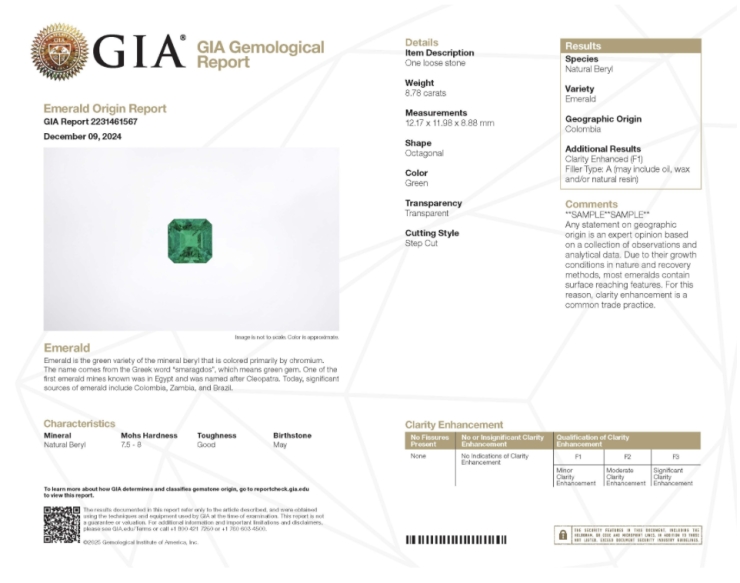
At first glance, the new format looks promising. It features a large, high-quality photograph of the stone— a clear upgrade from the old reports’ subpar imaging. This could be a direct challenge to AGL, which has long set the standard for superior photography in colored gem reports, but has been declining in imaging the last few years.
Below the photo, the report includes a brief historical overview and key characteristics of the gem. This narrative style feels more consumer-oriented than scientific, totally absent from diamond grading reports. While it may appeal to retail buyers, it comes across as gimmicky to serious collectors.
The core gemological details occupy the right side: weight, measurements, shape, color description, transparency, and cutting style. On the far right, the results panel confirms whether the stone is natural (and in this case, beryl/emerald), its country of origin (e.g., Colombia), and any treatments—such as F1 clarity enhancement.
Historically, GIA colored gem reports were inconsistent on treatment disclosure, often relying on a generic QR code-linked statement. Now, clarity enhancement appears prominently front and center. While it’s unclear if this is optional or required, always demand full treatment details on any GIA-papered stone you’re considering.
The Clarity Enhancement Chart categorizes treatments as None, No indication of clarity enhancement, Minor, Moderate, or Significant. The “No indication” category raises concerns for high-end collectors, who insist on true “None.” I am unsure of the purpose of no indications of clarity enhancement. Is this strictly a gift to the dealer community? Are they saying just a little treatment, so small we cannot even locate? To me, enhancement is like being pregnant. Either you are or you are not. It is either indicated or not.
As a longtime GIA observer, I recall the ColorMaster machine and Munsell-derived systems—ambitious attempts to quantify colored stone grading like diamonds. Sadly, none were ever incorporated into a colored gemstone grading report and never succeeded in the marketplace. We still need more than “the color is green.” Will GIA ever deliver a robust, standardized system for colored gemstones? This is a minor improvement, but still not comparable to AGL's full grading report.
You never know what someone will splurge on for Christmas. On November 12, Sotheby’s High Jewelry auction in Geneva concluded with a bang: a 12.78 ct Burmese ruby—we describe as “heavily included”—hammered for over $1.3 million (including buyer’s premium).
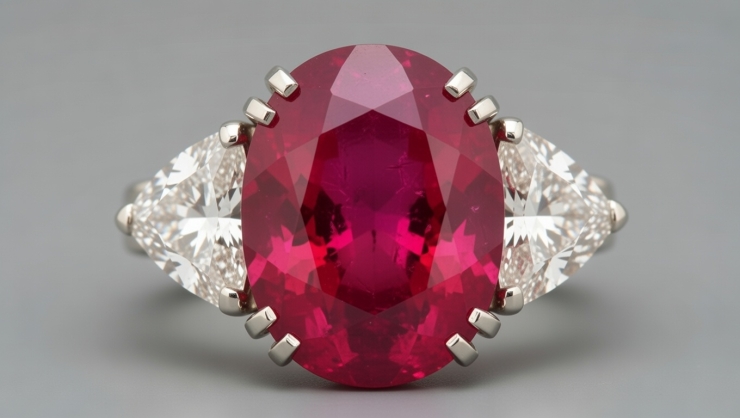 |
| Burma ruby ring, courtesy of Sotheby's |
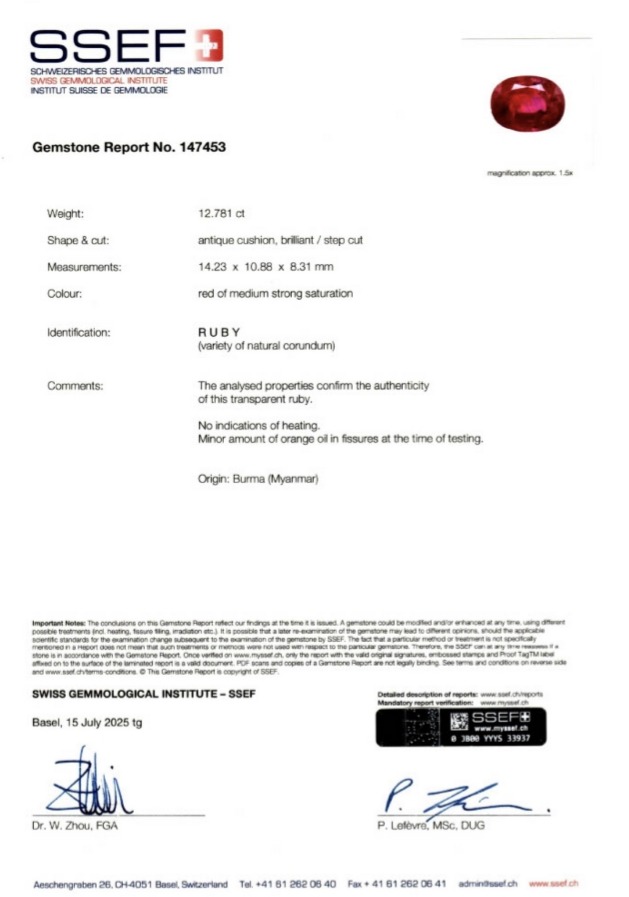
The Stone at a Glance:
When I first saw the gem photographs, the color is a stunning pinkish-red. However, its clarity reminds me more of the clarity of a Colombian emerald than a Burma ruby. Once you read the Comments section of the SSEF report, alarms go off.
The Red Flag: “Orange Filler in Fissures”
SSEF’s comment reads: "Minor amount of orange filler in fissures at time of treating.”
Let’s decode that:
Bottom line:
You cannot accurately grade clarity with filler in place. Acetone testing (to dissolve the oil) is the only way to reveal the stone’s true state. Shockingly, Sotheby’s didn’t require it.
Auction Surprise
In a rational market, a heavily treated, heavily included ruby wouldn’t touch these numbers. But provenance, rarity hype, and holiday FOMO can override logic.
We’d never touch a stone with this comment. The risk of post-purchase “filler evaporation” (and clarity looking visually worse) is too high. Obviously, the only reason to fill a gemstone is to make the clarity look better. Think emeralds. For collectors: demand acetone-cleaned stones and recent independent lab clarity verification before bidding.
Caveat emptor—especially at seven figures.
In a stunning turn of events at Christie’s Magnificent Jewels auction on December 10, 2025, a magnificent Brazilian Paraíba tourmaline suite stole the show—and set a new world auction record for a Brazilian Paraiba gem.
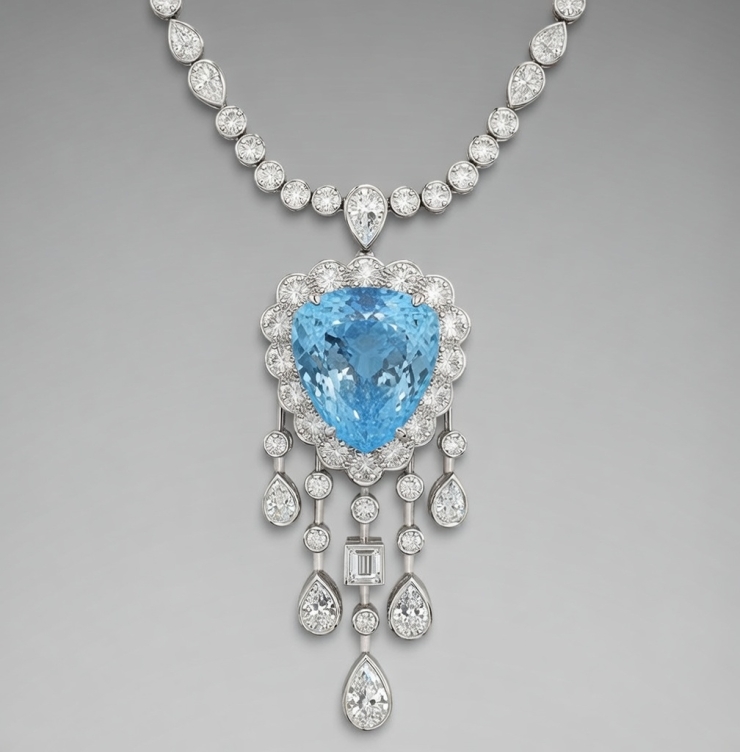 |
| Paraiba necklace, courtesy of Christie's |
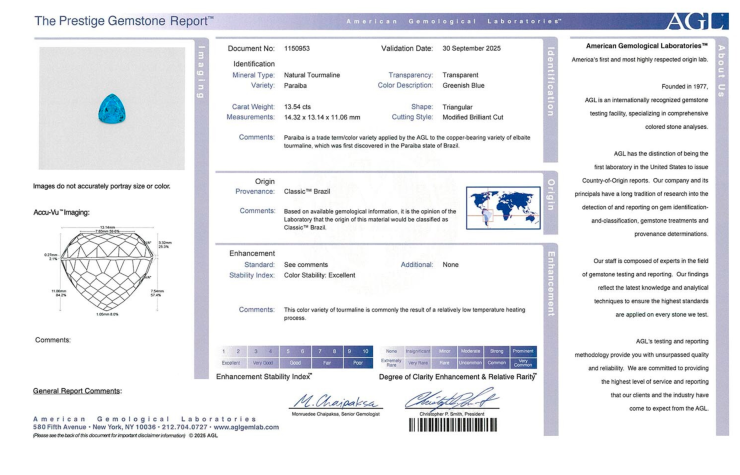
The top lot was a breathtaking Tiffany & Co. necklace featuring a 13.54-carat triangular modified brilliant-cut Paraíba tourmaline, surrounded by a cascade of round, pear, and square-shaped diamonds. From the esteemed collection of prominent art collectors and philanthropists Max and Cecile Draime, this piece soared to $4,223,000 (including fees) after intense bidding in the room, online, and on the phones. That’s over ten times its low estimate of $400,000–$600,000, and it delivered a record-breaking $311,000+ per carat—proving that Paraíba tourmalines can outshine even the most prized colored diamonds.
Accompanied by an AGL Prestige Gem Report, the 13.54 was described as greenish blue (blue as the primary hue, green secondary), classic Brazilian material with low-heat treatment and excellent stability. True vintage Brazilian Paraíbas like this are legendary for their intense saturation and inner “glow”—a neon-like brilliance that’s hard to match from later sources.
Matched Pair
 |
| Paraiba earrings, courtesy of Christie's |
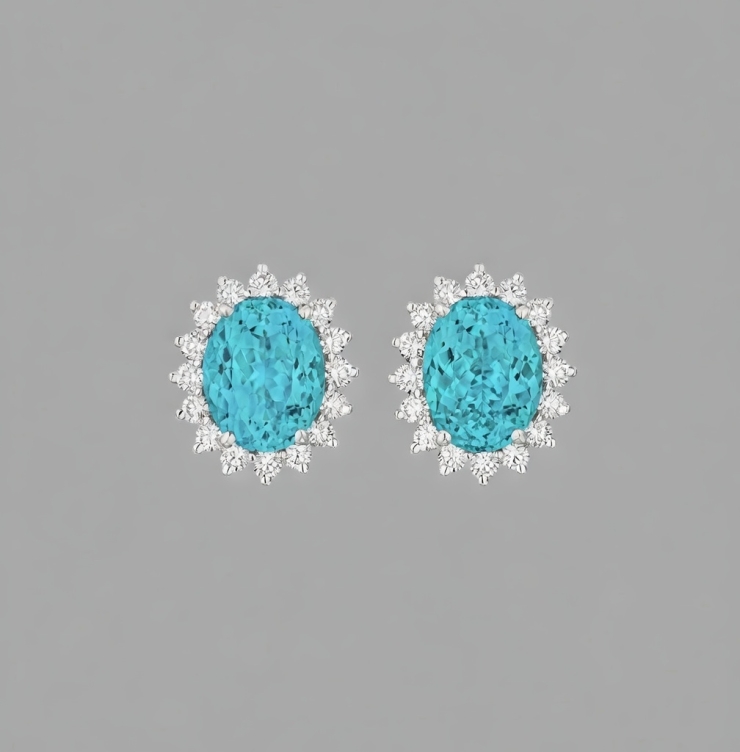
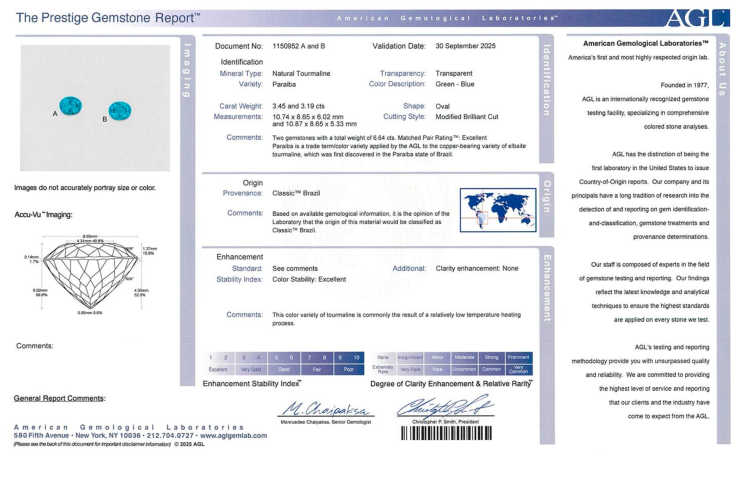
The excitement didn’t stop there. The suite also included a perfectly matched pair of Tiffany & Co. earrings set with oval Paraíba tourmalines weighing 3.45 and 3.19 carats (total 6.64 carats). These beauties, also from the Draime collection and graded by AGL (one with a Prestige report), achieved Excellent matching and sold for $1,270,000—again exceeding ten times their high estimate of $180,000, or roughly $195,000 per carat.
The AGL reports noted a green-blue color balance (roughly 50/50, akin to colored diamond grading), with the same desirable low-heat treatment for stability. These stones hail from the original Brazilian deposits, prized by collectors for decades.
What made these results so extraordinary? The low reserves sparked a true bidding frenzy,
highlighting the surging demand for rare, untreated or minimally treated classic Brazilian Paraíba tourmalines from old collections. As Christie’s noted, tourmaline was the surprise star of the entire $46.5 million sale.
For gem enthusiasts, this auction reaffirms why these electric gems remain among the most coveted in the world—rare, radiant, and now setting new benchmarks.
 |
| Fancy vivid purple-pink diamond, courtesy of Sotheby's |
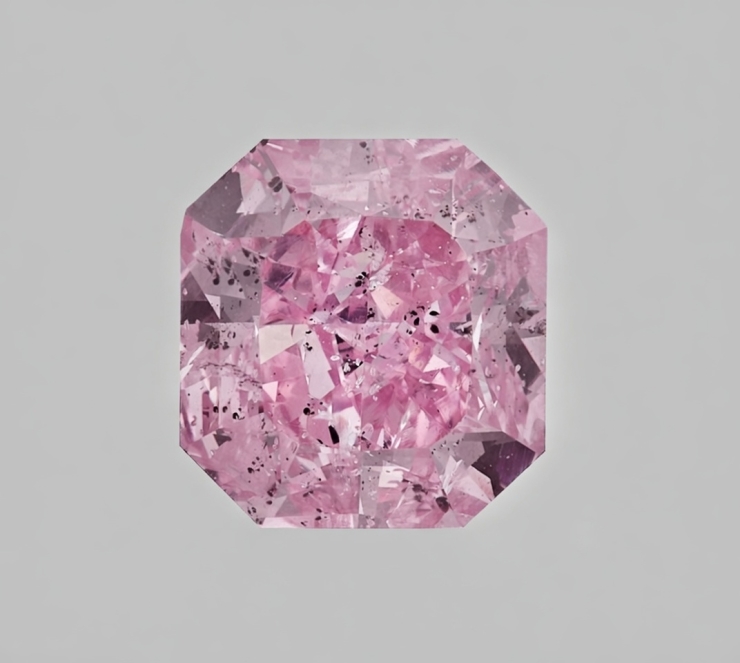
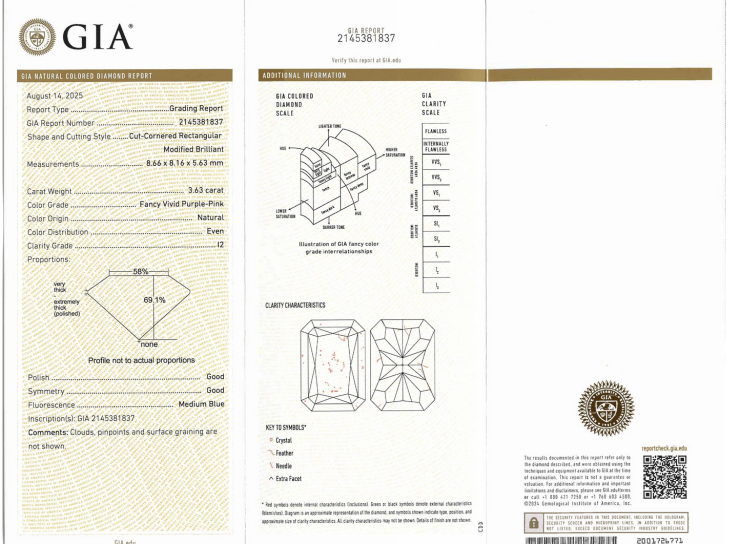
The headline lot in Sotheby’s December 11, 2025, Fine Jewelry auction in New York was an unmounted, cut-cornered rectangular modified brilliant-cut, 3.63 carat fancy vivid purple-pink diamond (approximately 50% purple and 50% pink). Certified by GIA, it carried the ultra-rare vivid designation and a pre-sale expectation of at least $1.5 million (over $400,000 per carat). Despite the hype, the stone went unsold, contributing to an overall sale total of $11.8 million.
In colored diamonds, clarity is rarely the deal-breaker—inclusions often play a role in producing those coveted hues, and intensity of color reigns supreme. However, there’s a threshold. In this case, the eye-visible black inclusions were likely too prominent for bidders to commit to seven figures.
You can even be arrested for dealing gems in Burma now. Not good for the worldwide demand for Burmese gems. Seems only the Chinese can obtain some of these rare stones. ED
Gem traders in major cities like Yangon, Mandalay, and Sagaing are being repeatedly summoned and interrogated by the military regime over alleged links to resistance groups, according to industry sources.
Business owners said the junta’s President’s Office recently sent warning letters to local associations and traders via the Union of Myanmar Federation of Chambers of Commerce and Industry (UMFCCI).
The letters warn gem traders to avoid contact with resistance organizations and to report any information about anti-regime activities immediately, a gems trader told The Irrawaddy.
“Authorities question us whenever they feel like it, but so far there have been no arrests.”
The interrogations have forced traders to exercise caution in doing business. The junta claims the questioning is part of efforts to combat money laundering, but merchants say the real focus is on whether they are supporting resistance groups.
A Mandalay‑based trader explained: “Sometimes they call us under the pretext of a meeting. Sometimes, officials ask us by name to come to their office for a short inquiry. It doesn’t happen regularly, but we are very careful in our dealings now.”
In February 2022, the junta detained more than 460 people, including over 100 Chinese nationals, and charged them under the Gemstone Law with conducting online jade sales outside official markets.
In August that same year, gem magnate Kyaw Thu Ya, vice‑chair of the Myanmar Gems and Jewelry Entrepreneurs Association, was arrested for allegedly supporting the shadow National Unity Government and its armed wing, the People’s Defense Force. The regime seized his assets worth nearly 12 billion kyats in Mandalay, Hpakant, and Naypyitaw.
The scrutiny is not limited to gems traders. Fuel, rice, cooking oil, gold, and foreign currency dealers have also been frequently questioned under the pretext of “measures to stabilize the market”.
Trade was sluggish at the 60th Myanmar Gems Emporium, held by the regime in Naypyitaw from November 17 to 26. Traders said only around 4,500 of the 5,200 jade lots displayed were sold out, citing limited supply from conflict‑hit mining areas including Kachin and Mogok.
“Gemstones from Kachin can no longer be supplied to Mandalay. So, traders have to go to the places where they can buy gemstones,” said one trader. “Most of the buyers were Chinese. Local traders from Mandalay and Sagaing were few.”
Merchants said many stones are now being exported directly over the border to China because of security concerns along routes to domestic markets.
The resistance to the junta loses Mogok. The fighter bombing and drone campaigns were too dangerous to the people of Mogok. Another troubling event for the future of Burmese gems. Do not expect any new goods for the foreseeable future. Most residents have abandoned Mogok for other towns or crossed into Thailand. ED
The Ta’ang National Liberation Army (TNLA) withdrew its administration and licensed gem-mining companies from Mogok in Mandalay Region on Tuesday, as it prepares to hand back Myanmar’s ruby town to junta forces this weekend.
Nearly all TNLA-run departments—including health, education, judiciary, forestry, fire services, and municipal offices—have transferred out of the town, leaving only administrative and police units in place until the handover, a source close to the ethnic army told The Irrawaddy.
“All the offices in Mogok were moved to Namhsan yesterday. Administrators and police will remain in town to keep order until the transfer to the regime is completed,” the source said on Wednesday.
Gem-mining companies licensed by the TNLA have also left the ruby-mining hub, bringing all operations to a halt, a local businessman said. Mining companies linked to TNLA allies—the United Wa State Army (UWSA) and the Myanmar National Democratic Alliance Army (MNDAA)—have also withdrawn, relocating machinery to TNLA-controlled Monglon town in Kyaukme Township, over the border in northern Shan State.
TNLA battalions previously stationed in Mogok have been pulled back to rear bases, though some units remain deployed in surrounding areas to monitor the handover. Troops are reportedly positioned to guard the approaches to Monglon, about an hour southeast of Mogok.
TNLA-led forces seized Mogok in July last year during the second phase of Operation 1027, in a battle notable for the presence of resistance groups from the Bamar heartland.
Resistance sources said the junta is expected to reenter Mogok and Mongmit, just across the border in northern Shan State, on Sunday and Monday, under a China-brokered agreement.
Hundreds of junta troops have arrived at a crucial junction about 24 km from Mogok, along the road from Nawnghkio. With only one TNLA unit controlling the stretch between the junction and Mogok, observers expect junta troops to move in soon.
Following reports of the TNLA’s pullout, the shadow National Unity Government set up an emergency command unit to direct its resistance groups in Mogok and Mongmit. How the allied resistance groups will react to the handover remains unclear.
Meanwhile, Kachin Independence Army (KIA) units have advanced close to Mongmit, prompting the TNLA to reinforce security. Both ethnic armies took part in the anti-regime Operation 1027 but have since competed for control of overlapping territory seized from the regime.
Most Mogok and Mongmit residents have fled to Mandalay and northern Shan towns ahead of the junta’s return, leaving the towns eerily deserted, said a local man who left Mogok on Sunday.
The TNLA announced on October 29 that it had agreed to withdraw from the two towns following China-brokered ceasefire talks with the junta. However, the group has not commented on the planned handover.