Vol. 44, #1, Spring 2026
Tucson Gem Shows 2026: Are the high end shows dead?, Gem News, Gemstone Charts (1975-2025)
- Home
- Newsletter
- Vol. 44, #1, Spring 2026

Tucson Gem Shows 2026: Are the high end shows dead?, Gem News, Gemstone Charts (1975-2025)
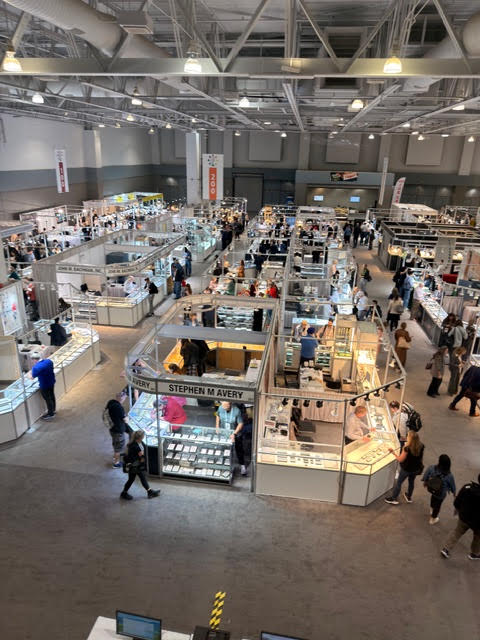 |
In years past, the first day of the AGTA show was packed rows deep with people. It was hard to get to the stones you were interested in. Often, when you got to the booth, the stone you desired was gone.
2026? This year?The slowest show I have ever witnessed. Empty aisles. Quiet conversations.
The question on many’s lips: Is Tucson dead? Let's examine some potential reasons:
Trump's Fault?
Some commentators on social media blame Trump for tariff uncertainty. Supposedly the foreign dealers, subject to import tariffs, had to post a 1/3 bond on the value of the imported stones. If someone wants to buy the tariffed goods, they must be exported back to the home country for more paperwork and then exported back to the US. Seems like such a hassle, who would jump through these export-re-export hoops? We never heard anyone specifically discussing this issue at the gem show though.
The second reason one might conclude it was Trump's fault is all of the new immigration issues with entering the US. According to this line of thinking, many people who attend the shows from around the world are afraid of entering the US today. We did notice a dramatic decrease in international attendance. There might be some truth to this argument.
Vendor Economics
It has gotten seriously expensive to attend these shows. Consider the flight expenses for the principals and staff from Africa, Asia, or Europe. Then you've got hotel expenses of at least $250 per night per room for one to three weeks. In Tucson, you need a rental car to get around this sprawling city. Depending on the specific show, add booth fees from $8000-$20,000. You would need to sell a great deal of goods to recoup these expenses. It's possible these numbers just no longer make sense to justify the trip for many.
World Economics
The global economy is projected to slow down in 2026 to 2.7%. This is due to slowing growth, trade tensions, fiscal strains, and Middle Eastern conflict. Many First World countries show resilience, but others are lagging behind. As we know, many in the gem trade are from Third World countries. The slowdown was visible in thinner crowds and cautious buying.
Internet Changed Everything
Does it even make sense to go to the Tucson Gem Shows anymore? In decades past, you needed to go to these shows to find new goods. Pre internet, these shows were crucial. Is that the case anymore? A dealer in Bangkok or Nairobi is one video call away. 360° videos and high-resolution images can deliver almost everything you need without leaving your desk. Does it really make sense to spend $10,000 to go these shows when you can see the same things from your computer? Did I really spend money to see an emerald close up in person when 5 second iPhone video would have given me all the information necessary. Regretfully yes.
Tucson Petri Dish
One of the hottest topics wasn’t tariffs—it was illness. “Are you sick? What are your symptoms?” Stories of lingering flu, respiratory bugs, and even wild coronavirus theories spread faster than the gems. One of my closest associates was sick for months last year after Tucson. For many, the health risk now outweighs the reward.
Vendors' Views
Many of my best friends are vendors. However, they have a vested interest in these shows. They don't want to say anything disparaging, even if business is very slow. They will look at you with a straight face and say they had a "great show." This was also true during Covid and numerous other financial crisis periods. One vendor told me she had a great show and did $40,000 in business in 2026. I remember last year she sold two top Paraibas for $500,000. Both statements can’t be true—and everyone knows it.
Bottom Line
Tucson 2026 was a high end bust. Although this might not be true for the middle and lower end vendors, the high end has always driven these shows. Through good times and bad times, these show have prospered. Could this just be a temporary blip or is this a permanent feature of high end gems? Let's face reality, there has been little to no high end Burma ruby, sapphire and spinel to be found. Forget about Kashmir sapphires and Brazilian Paraiba. Non treated eye clean Colombian emeralds will always be super rare. Does it make sense to travel to Tucson hoping to score a super gem? Maybe it is wiser to seek out collectors who want to sell anytime during the year and buy these goods, rather than trek to Tucson on a hope and prayer. This strategy negates the expense, the hassle, and the risk. Stay well and buy smart.
Financial Times Gem Story: Important and unacceptable Paraiba Error
We were pumped when the Financial Times called us about high-end gems. They were once a pinnacle, alongside the Wall Street Journal. Major flaw: The lead story on Mozambique Paraiba gives the false impression it matches Brazilian Paraiba in quality or price. It doesn’t. Mozambique material is lighter in color and tone, usually heated and fracture-filled. This is like claiming African ruby equals Burma ruby in color and value. NOT true. All prices in the article are Brazilian gems, not Mozambique—seriously misleading to non-discerning readers. African dealers love the confusion. Understand: writers and editors aren’t gemologists. This article could have been far better researched. But it does make some really spot on points, so we are sharing it here. ED
It took squatters just three months to wreck the Mozambican mine that Kevin Ferreira’s uncle had spent a decade getting up and running. “Everything has been ruined,” says the 33-year-old gemologist. “They’ve completely destroyed the wash plant. We’ve lost two or three dump trucks, an excavator, two front-loaders. “It will take us until at least April or May this year before we’re operational, and even then we’ll probably only be running at about 30 per cent.” The mine, which produces one of the rarest and most expensive gemstones on the planet — Paraíba tourmaline — was the target of a series of land invasions in late 2024 and again in late 2025.
Concessions across Mozambique have been taken offline during civil unrest that has swept the country since disputed elections in October 2024. It has been a terrible setback for a sector still reeling from Covid lockdowns and the disruption they caused to global supply chains. Although they have now been removed, nearly 2,000 people had been illegally working the family’s diggings during the first — and largest — invasion in 2024. They had been drawn to the site in search of the neon blue mineral found only in northern Mozambique, Nigeria and Brazil.
Paraíba tourmaline has featured heavily in collections by luxury brands such as Bvlgari and Tiffany & Co since the pandemic. Demi Moore wore a $7.3mn Chopard necklace at 2024’s Cannes Film Festival that featured a giant, 34-carat Paraíba. The likes of Katy Perry, Rihanna, Beyoncé and Zendaya have all been seen wearing Paraíbas, with the latter photographed at the 2025 Golden Globes sporting a 31- carat pendant surrounded by diamonds. Demand for Paraíba tourmalines has soared, with prices “doubling or even tripling since lockdowns”, according to Ferreira, who works as a curator for luxury jewellers and wealthy individuals looking to buy premium Paraíbas. “People are willing to pay way more to secure a product given this limit on mining operations.” With the family mine shut down, Ferreira’s uncle made the dramatic decision to buy back his own rough gemstones on the open market — for double the amount he was getting before the mine closure.
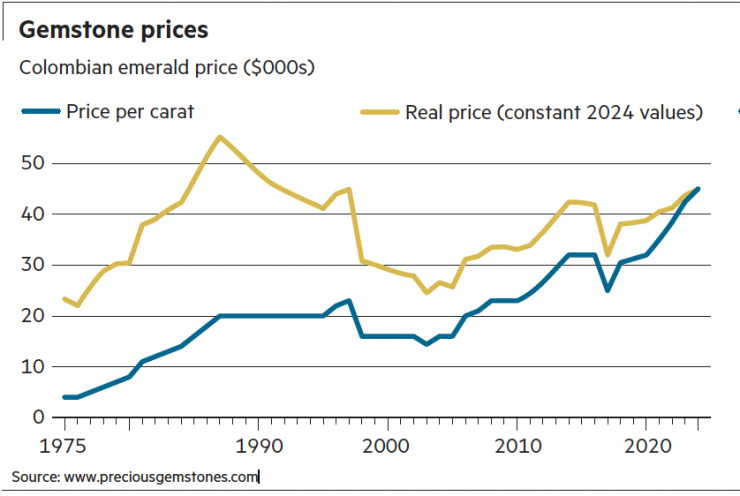
“I watched my uncle pay $25,000, $50,000 per gramme for some special stones,” says Ferreira, who is based in the billionaires’ playground of West Palm Beach, Florida. “Our business model is we want to own the best quality Mozambique material in the world — even if it’s at a higher cost. “We had to buy it at that price because if we didn’t, somebody else would. “You can still get some stones for around $5,000 a carat, but they have low saturation colour, or they’re very green.With Paraíba, you want that fantastic, majestic, wonderful blue colour that everybody is looking for. Colour is going to dominate whether that stone goes up in value or not.” What happened to Paraíba production may be unique, but postpandemic inflation, volatile stock markets and increased demand for tangible stores of value have pushed up the price of many commodities from gold to gemstones in recent years. Colombian emeralds, for instance, have risen “two to three times” in price since the lockdowns, according to Alejandra Velasco, who runs the Cartagena-based Lucy Jewelry. The gemologist — whose customers range from British holiday makers with $100 budgets to Jeff Bezos and his emerald enthusiast wife Lauren Sánchez — says she now pays about $5,000 per carat for high-quality cut stones that cost $1,700 before the pandemic. “Over the past 10 years, the price of Colombian emeralds has increased by 60 per cent,” she says. “However, top quality stones have gone up by huge amounts. I have a client who came in recently with a piece she bought 15 years ago for $2,300; if that same person wanted to buy the same necklace new in the store today, it’s going to be over $10,000, and maybe as much as $13,000 to $14,000.” But even with such dramatic jumps in price, Velasco believes there is still big money to be made buying and selling premium jewellery. “Colombian emeralds sell for four or five times as much as emeralds from other countries because their quality, colour and provenance are so highly regarded.
“We know from our customers that they receive appraisals of two to three times more than they paid in our store, especially in countries like the US and UK, where they know the stone and its value.” Buying and selling gemstones comes with caveats. Velasco advises securing a certificate authenticating any jewels if you plan to sell them on. Imports, including inexpensive jewels bought on holiday, must be declared for VAT purposes — although this can be reclaimed later.
She also says coloured gemstones are not subject to the same sudden, short term price movements as bullion, and instead tend to follow more gradual trends that suit people looking for a more long-term investment.
It’s a view echoed by Robert Genis, president of Arizona-based dealership National Gemstone and editor of the Gemstone Forecaster newsletter, who has tracked the US retail prices of various stones for more than 50 years.
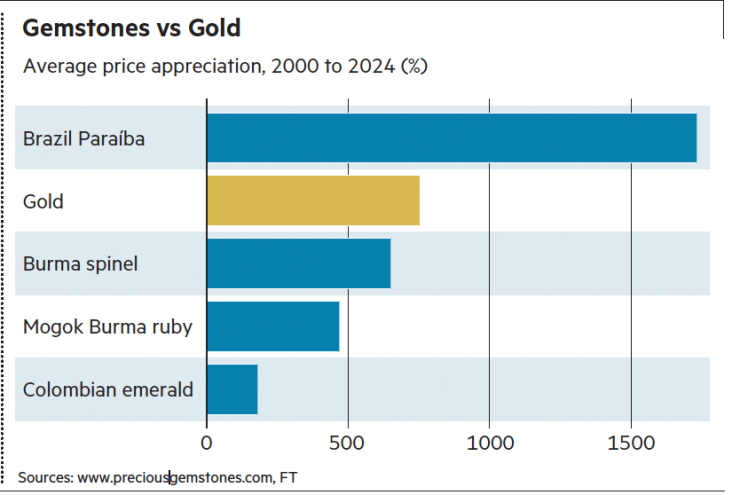
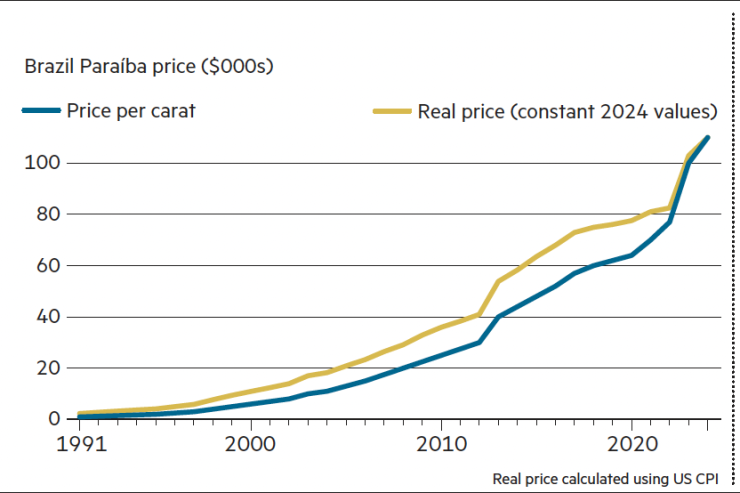
His data, shared exclusively with the FT, compares gemstones of the same cut, colour and clarity for sale at the annual Tucson Gem, Mineral & Fossil Show — the world’s largest such event — to give a true like-for-like comparison of their retail values over the years. It shows that while several gems, including spinels, sapphires and rubies, have outpaced gold since 1975, no other coloured stone has recorded the type of explosive price increases enjoyed by Paraíba tourmalines — which commanded 10,900 per cent more at last year’s show than when they first appeared for sale in Tucson in 1991. The price of gold rose by less than one-fifteenth of that amount over the same period.
In December, a Tiffany & Co Paraíba tourmaline-and-diamond necklace, centered on a 13.5-carat Brazilian stone, sold at Christie’s New York for $4.22mn — a new world record for the stone, according to Genis. A set of Brazilian Paraíba tourmaline earrings weighing more than 6.6 carats also fetched $1.27mn.
The price of Paraíba may be surging, with Middle Eastern collectors showing particular enthusiasm in the stone due to its current popularity among Oman’s ruling dynasty. But David Nassi, president of 100% Natural Ltd, says investors need to do their homework before buying jewellery. He points out that a lot of stones “have shown no noteworthy appreciation over time”, including “quartz (all varieties),tanzanite, peridot, turquoise, lapis, rhodolite garnet, cultured pearls, and most [other] varieties of tourmaline”. He says that those looking to invest should focus on “fine, untreated, natural coloured gemstones”, like rubies, sapphires, emeralds, red beryl, alexandrite, spinel and Paraíba tourmaline.
But while most coloured gemstones have generally appreciated over time, diamonds are down on their all-time high price thanks in part to a flood of lab-made stones. Katerina Perez, an expert in jewellery and coloured gems, says anyone considering investing really needs to find a gemologist they trust who can help them work out which stones are going to be in high supply in future and which are not.
She explains how the biggest price movements often happen when supply suddenly dries up — such as during the recent Mozambique mine closures, or due to geopolitical problems in other mineral-rich regions, such as Russia or Afghanistan.
“Gemstone prices usually go up when they become scarce, such as when a mine is about to close (like the Argyle mine for pink diamonds), or when there’s a rise in demand for a certain gem.
“Paraíba tourmalines used to cost much less, but as more people fell in love with their unique colour, prices soared. Some dealers sold them years ago thinking they got a great deal, but now they regret it.”
She advises would-be investors to track antique jewellery auctions, explaining that this will give them a good indication if their new ring or necklace will retain its value in the short to medium term.
But Germany-based gemologist Constantin Wild thinks personal taste should take more precedence over an item’s potential resale value. “Gems are beautiful products of nature to decorate, collect and enjoy,” says the former vice-president of the German Gemological Association, whose family has been involved in the industry since 1847.
While Wild says he has never bought a gemstone that he didn’t sell on for more money, John Butler, who works as an independent investment adviser to wealthy individuals, stresses that people really need to do their research before buying gemstones. The specialist in “hard assets”, who was once tasked with comparing the difference in investment potential between gold and diamonds, points out that the gemstone trade is highly influenced by trends in fashion. “If my clients are looking to diversify, I always tell them their first step should be gold. But if they want to invest in gemstones — why not? It might be the next bull market.
“As desired objects that are difficult to get out of the ground, they tick that ‘hard asset’ box my investors are looking for. The problem is they’re not ‘fungible’ or uniform like gold, meaning no two stones are the same and you really have to do your due diligence to make sure you’re getting a good stone at a fair price.” Butler says that those curious about gemstone investment could look into an exchange traded fund with gemstone mining exposure as an alternative to buying and selling physical jewels. He warns that mining “carries a high degree of operational risk”, so returns may not be as high, but explains that ETFs “liquefy a sector that is otherwise illiquid”, allowing would-be investors to diversify without worrying about the complexities of buying, insuring and selling jewellery themselves.
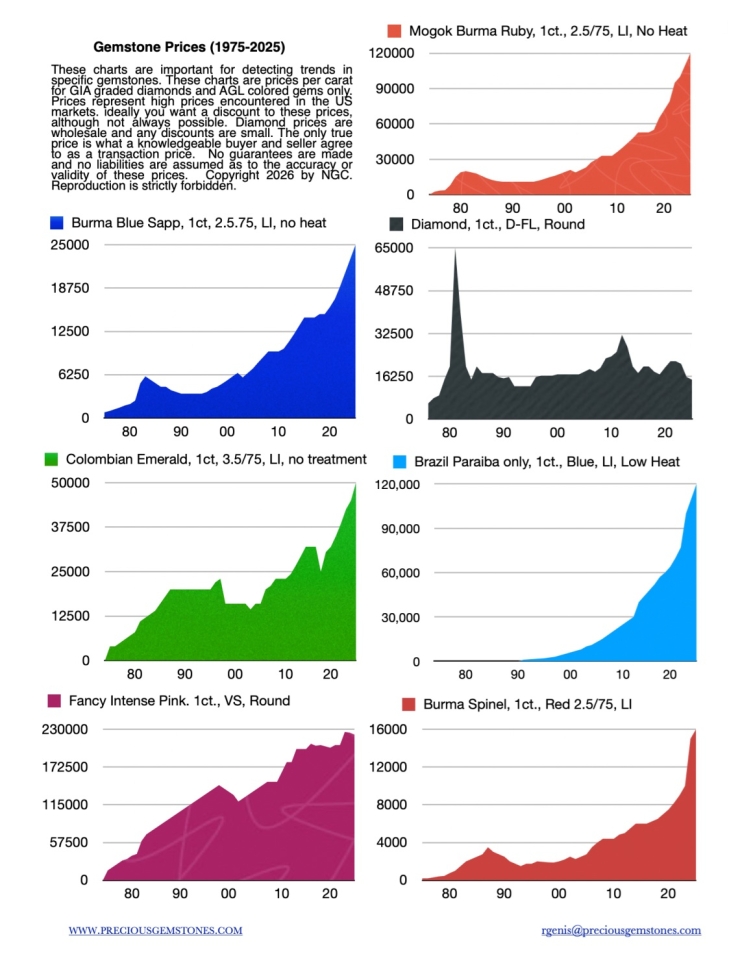
The following charts were published in the Financial Times, January 26. They are all based upon www.preciousgemstones.com data:
 |
 |
 |
At the beginning of the gem shows, AGL released its press statement: sold to IGI.
What? Shockingly, IGI has never had a stellar reputation in the gem world—whether grading diamonds or colored stones. Chris Smith says nothing will change at AGL New York. Color is nervous. We’ll watch closely to see if IGI’s low grading standards leak into AGL. Hopefully they retain their strict colored gemstone standards and never start using “pigeon blood” as a descriptor. We understand why IGI wants the AGL name and its access to auction houses, Fifth Avenue stores, and top collectors. Not clear how this merger benefits AGL. ED
|
I am writing to share an important update regarding American Gemological Laboratories (AGL). A copy of the related press release is linked here, should you wish to review the announcement in more detail. AGL has entered into an agreement to be acquired by the International Gemological Institute (IGI), one of the world’s largest and most trusted independent diamond grading and certification organisations. IGI is a listed company in India and is backed by Blackstone, the world's largest alternative asset manager, whose support has helped IGI strengthen its global capabilities, governance, and infrastructure over time. I want to personally assure you that this development has been carefully considered with the long-term interests of AGL, our clients, and the broader coloured gemstone community in mind. Through IGI, AGL will gain access to a global infrastructure, strategic resources, and markets where we are not currently present. Together, we believe this combination will accelerate AGL’s growth in the coloured gemstone sector while preserving the values and standards that define our work. Most importantly, AGL will continue to operate independently, under the AGL name, from our headquarters in New York. Our scientific methodology, reporting standards, and commitment to independence remain unchanged. I will continue to serve as President and Chief Gemologist of AGL, and the team you work with today will continue to serve you with the same care, rigour, and attention to detail you have come to expect. This transaction is intended to support AGL’s future, not to change its foundation. It brings together unmatched global scale and infrastructure with the deepest scientific expertise in coloured gemstones, positioning the combined group at the forefront of certification & trust in the global gem and jewellery industry. This long-term investment approach provides additional strength and stability to support AGL’s continued growth, investment in science, and commitment to excellence. My new business partner - Tehmasp Printer, Managing Director and Global Chief Executive Officer of IGI, also joins me in letting you know that this is a transformational step for the industry. By combining AGL’s scientific leadership in coloured gemstones with IGI’s global platform, we are building a future-ready certification ecosystem that delivers scale without compromising integrity or science. Together, we are setting a new global benchmark for trust, transparency and consistency in gemstone certification. For our clients, this means continuity first — and opportunity over time. There will be no changes to how we operate, how we report, or how we engage with you. Any future developments will be guided by AGL’s longstanding principles of scientific excellence, transparency, and trust. We are grateful for the confidence you place in AGL and for the relationships we have built over decades. Should you have any questions, please do not hesitate to reach out to me or any member of the AGL team. Thank you for your continued trust and support. Christopher Smith |
Natural Diamonds: Searching for a Bottom
The white diamond market showed faint signs of finding a floor, yet prices kept sliding. Benchmark D-IF one-carat stones fell from last year’s $16,000 per carat to $15,000. Every color and clarity dropped. Once viewed as the ultimate crisis hedge, they’re now eclipsed by precious metals, precious gemstones, crypto, and the strong U.S. dollar.
Lab-grown diamonds finally look finished. They were the “it” stone—until they weren’t. The tide has finally turned. Hopefully naturals regain their shine while LGDs settle as cheap synthetics, like cubic zirconia.
Colored diamonds proved their value by moving sideways in a down market. Blues slipped under 1%, though vivid blues over 8 carats rose, lifted by collectors and investors. Pinks dipped just 1%, except 2-carat Fancy Intense examples gained 1.3%. Vivid and Intense yellows fell 2%, especially top Fancy Vivid gems.
Burma Goods: Pricier and Rarer
All Burmese gems—ruby, sapphire, and spinel—continue climbing due to high-end demand and zero supply. No new material has left Burma in five years because of the civil war. Only old collector and old dealer stock remains. African spinels stay plentiful and steady.
Colombian Emeralds: Trust but Verify
No-treatment top LI Colombian emeralds climbed higher in 2025, driven by nonstop collector demand. The market is messy—labs soften clarity issues with terms like “minor” or “insignificant” filler. Don’t be fooled. Buy only with brand new reports stating “none.” That tiny pool is exactly what elite buyers want.
Paraiba Tourmaline: Blue Reigns
Brazilian Paraiba blue tourmaline dominated again, its electric color sending prices sky-high. One two-carat blue topped $200,000 per carat at the show—sold the next day. That’s the game. Owning a fine Paraiba is the ultimate gem dream. Zero supply meets endless demand: the rise won’t slow. Mozambique pieces trade far lower. Like emeralds, insist on “none” clarity-enhancement reports—many are treated. Beware.
Chasing Phantoms
Collectors, keep dreaming. Burma gems, Brazilian Paraiba, Kashmir sapphires, and no-treatment lightly included Colombian emeralds are turning into legends—rarer every day. Unicorns of the gem world, they leave us hunting shadows for years. It's the reality of the high end gem world in 2026.