Vol. 44, #3, Fall 2026
Special Report - A Deep Dive into Gem Industry Analytics by C.R. "Cap" Beesley
- Home
- Newsletter
- Vol. 44, #3, Fall 2026

Special Report - A Deep Dive into Gem Industry Analytics by C.R. "Cap" Beesley
Treatments have long been a hot-button issue in the gem world, and they remain a critical concern for the trade and collectors alike. We thought it would be valuable for collectors, retail jewelers, and trade members to hear the perspective of one of the world’s foremost gemologists—C.R. “Cap” Beesley. Few possess Cap’s depth of insight and hard-won experience on this subject. He has championed full transparency and disclosure of all treatments since the 1980s, and few in the industry can match his “in the trenches” perspective. His repeated role as an expert witness in major gem cases underscores the breadth of his knowledge. Many younger members of the trade were not yet born during the NBC Dateline emerald controversy; a bit of historical context should prove both interesting and instructive. With only a few exceptions, this history helps explain why today’s serious collectors seek emeralds with no clarity enhancement whatsoever. Cap is not only a rigorous student of the gem world with an encyclopedic memory—he writes in a no-holds-barred style and takes no prisoners. Separating fact from fantasy in the gem trade is never easy; Cap is one of the rare voices who can do so because he lived through the entire journey. Enjoy—and keep your eyes wide open. ED
The following analysis is a deep dive into the current policies and practices that are shaping the landscape of gem buying decisions for consumers, retail jewelers, and the gem trade in general. Recent actions and policy decisions by trade associations and gem labs have precipitated the need to review the past framework and present path of disclosure enhancement decisions that impact gemstone acquisitions in the future.
Gemstone alteration is by no means a recent phenomenon. Its history is as old as man's insatiable desire to experiment and tinker with creation. However, from today's perspective, most early attempts at gemstone modification seem rather simplistic, yet effective. Add a colored foil or coating to the pavilion of a stone and, amazingly, you alter its perceived color; dye an agate and you embellish its appearance. In stark contrast, today's arsenal of techno-tools contains a broad range of treatment techniques, including highly sophisticated methods that go way beyond mere color touchups and cosmetic improvements.
As treatments become more sophisticated, those who perform them are inadvertently reviving the alchemist's dream of turning lead into gold. Only in the gem treater's case, they transform many of the ugly ducklings of the gem world into elegant swans so they can enjoy greater beauty, status, and value. How often have we heard modern-day treaters say it is their desire to complete the task of perfection left undone, or incomplete, by nature? This is quite a poetic rationale for intervening in the natural process armed with a bevy of tools and methods to alter the core chemistry of gemstones. Unhampered by guidelines, treaters have entered the high-speed Autobahn of creativity. They are without limits on how far one could or should go to fix nature's shortcomings and still merit the term natural.
Unfortunately, unlike the longstanding definitions in Webster's Dictionary, trade definitions for “traditional,” “permanent,” and “stable” are much more elastic and drift with time and circumstances. For example, the term "gemstone" now includes a broad range of doctored gems that have effectively begun to blur the lines between “treated” and “natural.” As a result of tampering with terminology, each new enhancement process leads to semantic turmoil as the industry seeks to re-define and reposition itself in the marketplace with the growing population of doctored materials.
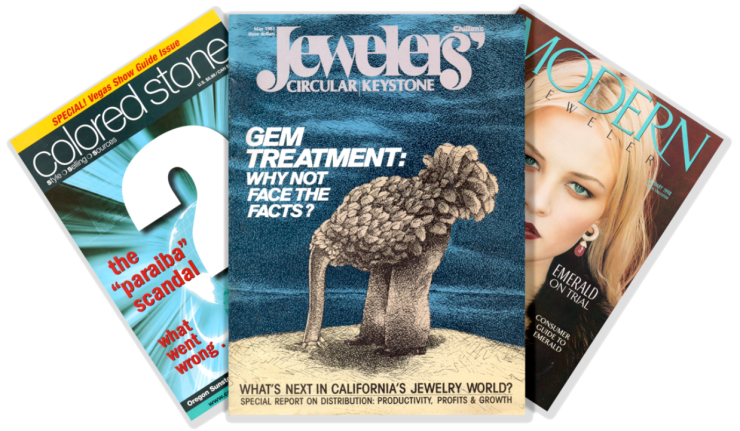 |
| Major magazines address multiple disclosure issues |
The prevalence of ill-defined and vague terms which are now commonly used throughout the gem industry may stimulate us all to ponder the obvious question: "Is there a point at which a material formed within the earth is so processed by man that it can no longer be considered natural?"
As we move forward along this centuries-long continuum of treatment history, there are recurring moments of crisis. At each interval, as new treatments emerged from the shadows, trade confidence in altered gem products is challenged in varying degrees. In many instances, there is an extensive delay between introduction and trade discovery and disclosure of the treatment. No matter how long or short the discovery time, new treatments always trigger internal industry crises as gemological laboratories scramble to develop methods of identification and disclosure, and traders grapple with positioning and marketing issues related to the latest breed of treated materials.
Curiously, when gemstone manipulation is uncovered, especially in places like the dark corners of Bangkok and other hotspots, there are few, if any, consequences for the perpetrators that build their business on distortion and deceit. The heat treatment of gem materials is a classic example of masking facts to maximize profits through a foundation of deception. When the Bangkok boys discovered that the heat treatment of road gravel sapphires from Sri Lanka could be miraculously transformed into a thing of beauty there were no press releases about their discovery.
As usual, this manipulation of brand X sapphires was kept under wraps and sold around the world as the real deal. Profits skyrocketed while credibility and integrity disappeared. To this day, the trade still promotes the idea that the heat treatment process completes the work that “mother nature” didn’t get done. Their position is as kosher as bagels and lox from a pizza shop or street vendor on Broadway and 42nd street. Basically, too many are willing to play the game and provide pretend protection while undermining consumer confidence and diminishing the credibility of the gemstone trade.
For some time, the gem trade avoided dealing with the details of disclosure. The deluge of information shortfalls that emerged from a mainstream media exposé left the industry with a hangover that resulted in a loss of credibility for gemstone products based on a failure to clearly disclose treatments to the gem buying public.
Initially, before the mainstream media became aware of the disclosure problem, a well-known and accomplished trade magazine writer named David Federman invited a group of savvy industry individuals to participate in a Modern Jeweler article that was preparing to tackle the taboo topic of enhancements and bring clarity to disclosure policy. When the results of Federman's herculean effort hit the streets, it struck a strong, responsive chord with Michael Roman, the then President of Jewelers of America (JA), the largest retailer organization in the country.
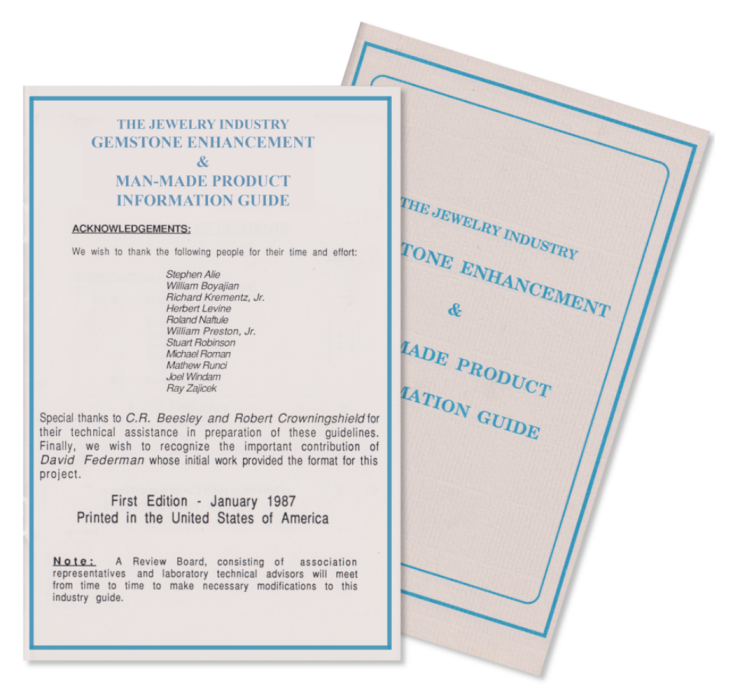 |
| The first gemstone enhancement guidelines, prepared by Jewelers of America in 1987 |
Michael was a savvy leader who realized that his membership could be at significant legal risks without meaningful disclosure guidelines. He basically wanted informational and instructional materials that could be used by retailers and their salespeople at the counter when interacting with potential buyers in their stores. Roman pulled together a group of industry people for input and requested that Robert "Bob" Crowningshield, the top VP at GIA New York and myself, as the President of the original American Gemological Laboratories (AGL), to collaborate and leverage our collective gemological skills to develop the technical aspects of the first enhancement guidelines for the gem and jewelry industry.
That first edition of the disclosure guidelines was published in January 1987 entitled “The Jewelry Industry, Gemstone Enhancement and Man-made Products Information Guide.” The core structure of what Bob and I developed was a series of one and two letter alphabetic references that functioned as the “Cliffsnotes” version of information. These would be translated to a tag connected to a particular jewelry item that was easily recognizable and interpreted by the salesperson at the counter. The original intent was clear... enable salespeople to avoid giving misinformation to potential buyers in the store. Contrary to AGTA’s later claim that they were responsible for the enhancement guidelines, they were actually bit players in the process of developing JA’s project. In fact, during their early involvement, they were the classic contrarians to what JA was trying to accomplish for the benefit of their retail membership. It was originally Jewelers of America that began the formal process of protecting both their retailers and the consumers they serve.
The initial JA guidelines addressed multiple issues, including the frequency and stability of treatments as well as care requirements. In addition, man-made products were designated with a two letter code that immediately communicated to the salesperson that the material was a non-natural product. Hence the reason the term "Lab Grown"(LG) ultimately moved into the spotlight of disclosure terminology.
When the American Gem Trade Association (AGTA) participated in the initial JA project they volunteered to print JA’s gemstone enhancement guide free of charge. Michael Roman, JA’s President, was apparently impressed and agreed to AGTA’s gesture. However, he may have misread their generosity. It is doubtful that JA realized that they were inadvertently giving away the keys to the disclosure nomenclature castle. This situation could reasonably be compared to the mythical moment of the Trojan Horse experience that led to serious problems for the citizens of Troy and precipitated the age old adage “Beware of Greeks bearing gifts.”
Once in control, the AGTA initially renamed the guide “The Gemstone Enhancement Manual.” At that point, the intent and content also changed the focus from the retailer and salesperson at the counter to a new dealer protectionist orientation, especially with respect to critical designations that ultimately found their way into a courtroom and shook the colored stone and jewelry industry to its core. AGTA made major changes to one of the most important symbols in the entire guide, the letter “O.” The liability connected to these changes may not be immediately obvious, but they played a significant role in a massive lawsuit that crippled the Emerald industry and left a retailer’s reputation in shambles and shackled him with more than $300,000 in legal expenses. That retailer wound up taking the proverbial bullet for the trade and its failure to be specific about enhancement agents. The changes migrated from “O” for “Oil Only” to a position that could have been designated “E” for “Everything.” This decision was beneficial for gem dealers but left retailers with the challenge of explaining, in detail, what “O” actually meant to their clients at the counter.
With each change that was made to the guides, dealer responsibility was diminished or in many cases evaporated along with the fillers. It was no longer necessary to provide descriptive details of the fillers, a.k.a. enhancement agents, that were being used to pump up the visual appearance and clarity grades of the gems. So where did that leave the retailer and the consumer who generally had no clue what the circuitous changes in the guides actually meant. The response of the trade associations and the trade press was to prepare hyped-up PR programs with flowery text that basically indicated that everything was “traditional” and “permanent.” Nothing to see here. The problem was retailers were obligated to use full descriptions of treatments and enhancements with clients since alpha abbreviations are described as a “trade only” communication tool.
In a courtroom drama that contained all the ingredients of a midday soap opera, the issue of fracture filling emeralds took center stage. In stark contradiction to the typical inter-trade wrangling over disclosure policy, a Washington DC jury decided with surgical clarity against a local retailer and his appraiser for their apparent failure to detect and adequately disclose the treatment in the Colombian Emerald that they sold to their client. After 2 1/2 weeks of meandering testimony, and five hours of deliberation, the jury found the retailer civilly liable for a litany of counts, including Breach of Warranties, Unlawful Trade Practices, and Outrageous Trade Practices. The results were financially catastrophic to the retailer that included massive legal expenses and refunding the cost of the ring to the client. The crystal clear message of the jury was a resounding condemnation of the retailer’s failure to protect the interest of the client.
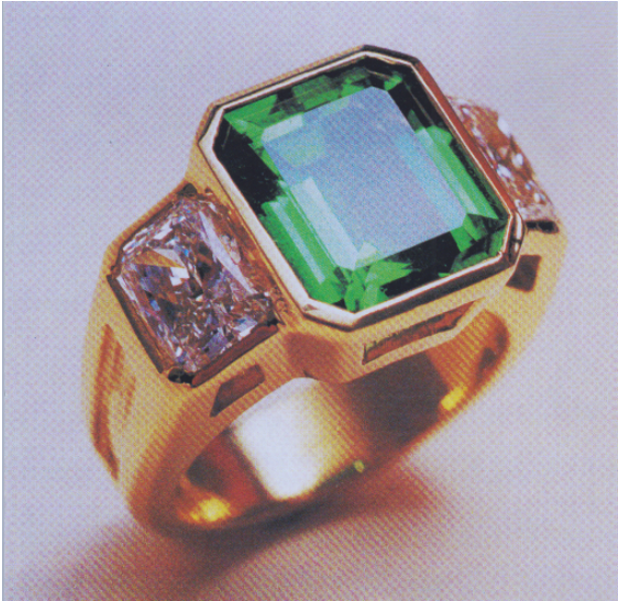 |
| The 3.65 "enhanced" emerald that changed the course of an industry Photo Courtesy of Blue Planet Gemstones Inc. |
Originally, the client offered the retailer the exit option of accepting the ring back and refunding the original cost of $38,600. Had he accepted the offer, he would still have owned the emerald that cost his firm $14,500 as well as the two one-carat side diamonds. State Farm, also a defendant in this legal action, was consistently portrayed as the villain by uninformed outside observers and the trade press. The agitators neglected to mention that the insurer originally offered to re-treat the stone and bring it back to its original condition after the GIA cofnrimed multiple times that the fracture across the entire table area of the emerald was in fact “inherent” to the stone since it was last polished and not a result of subsequent damage, as the retailer claimed. That off ramp was also rejected by both the retailer and the client.
In reality, the major mistake the retailer made was accepting the letter “E” on the invoice from the AGTA supplier without confirming the details of enhancement with a laboratory that had a hardcore handle on detailing enhancement disclosure information and could have protected the retailer’s interest.
The end of this lifetime movie plot may be surprising to the critics that consistently defended the very well known retailer in this case. Although I understand their concerns, outcomes should be determined by facts and not by uninformed opinions or PR programs designed to influence legal proceedings. Long after the court case had ended, the accusations against AGL’s position persisted with intensity. The end of this saga may be surprising to some, but not to us. Eventually, the same 3.65 carat emerald was resubmitted to the original AGL by the same dealer that sold the emerald to the beleaguered retailer. Miraculously, the emerald had been completely restored to its original “gem” appearance as depicted in the accompanying image of the client’s original ring and the emerald still weighed 3.65 carats. I suspect that this healing event may have been the work of CEL, the Clarity Enhancement Lab in New York City, one of the best in the business of enhancement. The material had been re-treated and restored to its original appearance.
The original AGL coupled with Gemcore and the Gemstone Standards Commission™ have always been on the cutting edge of disclosure and proactive about disseminating information to the trade and the general population of gem buyers. It did not take exposés or court cases for us to develop extensive training materials and programs to deal with gem trade issues, like enhancement disclosure. For those unfamiliar with Gemcore and the Standards Commission, it was established as a not-for-profit organization supported by a coalition of prominent New York individuals and firms that included both Christie’s and Sotheby’s. Collectively, we were all intent about protecting gemstone buyers and reinforcing the integrity of the collaborating firms that believed that a prime objective of Gemcore would be to protect consumers through comprehensive enhancement disclosure policies. However, despite our obvious willingness to address these issues in a cooperative environment, the bombshell of the Dateline Exposé garnered reactions from across the spectrum ranging from total support to aggressive resistance. The skeletons in the disclosure closet had now become a feature presentation on national TV.
In conjunction with the original AGL, Gemcore, and the Gemstone Standards Commission™ we conducted free, in-lab enhancement and detection training programs for the staffs of both Christie’s and Sotheby’s in New York. In addition, we assisted Christie’s to develop their enhancement disclosure content for their auction catalogs. Burke’s Canada also asked for help developing their disclosure protocol to properly address enhancement for the protection of their gem and jewelry clients. In addition, we also conducted training programs that included enhancement issues for the United Nations Mineral Program all over the world, including Pakistan, Azad Kashmir, India, and Africa. Those same free programs were offered, both verbally and in writing, multiple times to AGTA’s leadership for their members to assist them in handling questions of disclosure. Obviously, working together was not an option they wanted to entertain.
Shortly after the Dateline Exposé that exposed, on undercover cameras, the failure of five major New York retailers of selling treated gems without disclosure, AGTA made the decision to enter the gem lab business. AGL’s participation in the Dateline program became the foundation of the fundraising message for financing AGTA’s new venture.
Once again, logic failed and AGTA was determined to attack the messenger rather than carefully analyze the issues and work together toward a resolution that was in everyone’s best interest. Unfortunately, they decided to challenge the original AGL, the most pro-consumer gemological laboratory in the world. At one point, the intensity of trade attacks precipitated the FBI’s involvement due to the nature and consistency of the threats.
AGTA’s Executive Director, Doug Hucker, became the designated fundraiser for the new laboratory that began in 1998 and subsequently closed its doors in 2009. Rather than choose cooperation, AGTA chose retaliation and totally lost sight of the objective and premise of the Dateline story. Fortunately, there are many members of the AGTA that are legitimately concerned and interested in consumer protection and disclosure policy that works to protect all levels of the trade including retailers and gemstone buyers. However, AGTA’s leadership, including its influential members, oftentimes have the loudest voices, and have in many cases dominated AGTA policy.
Major gem related court cases wreaked havoc on the gem industry’s credibility and reputation regarding disclosure issues. The infamous Ward Emerald Case, and the following Dateline Exposé of November 1997, put the Emerald industry on edge and forced the issue of implementing serious changes to deal with enhancement disclosure for both retailers and consumers going forward.
Although we received requests from both Dateline and 20/20 regarding disclosure issues and its impact on the gem buying public, Dateline made a major commitment of time and resources to the story that took four months to complete. Dateline’s staff selected five retail stores ranging from an iconic 5th Avenue jeweler to major players in downtown New York. They purchased five jewelry items that were subsequently tested by the original AGL. The results were devastating.
In every case, the gem materials were consistently misrepresented as all natural and free of any enhancements. The Dateline story was followed by a tsunami of industry press articles with multiple cover stories that collectively shook the entire industry. The press coverage continued for some time and was especially devastating to the emerald business. The industry countered with a Bogata emerald conference to discuss the issues. Once again, part of their solution was also to implement their own laboratory to deal with the disclosure problem.
Consumers are not the only ones at risk in this high stakes game of accurate and acceptable disclosure. Historically, retailers are the ones that generally get sued over disclosure issues. A history lesson regarding the unfortunate Ward case, the $800,000 Tennessee Emerald case, and the Dateline Exposé is in order. Each challenge indicates what can happen when dealer disclosure goes south, leaving retailers in the crosshairs of the legal system. The historic Ward case is a classic example of how disclosure issues transition to a courtroom. It appears that suppliers and gem doctors rarely wind up in the witness box defending either their positions or their creations. It certainly can happen, but it is more likely that the retailer will be held accountable in the end.
At the same time the dealers can simply use “alpha-codes” to describe their altered products, however, the major burden is on the retailer to provide the explanatory narrative of what the client is buying. It is in the retailer’s best interest to thoroughly understand their obligations. If you don’t understand what is necessary to protect both yourself and your client, be sure to know a good law firm does. All parties, including dealers and gem laboratories, should have the same responsibilities regarding comprehensive disclosure policies that are expected of retail jewelers dealing with consumers. No Exceptions!
Houston, we may have a minor problem |
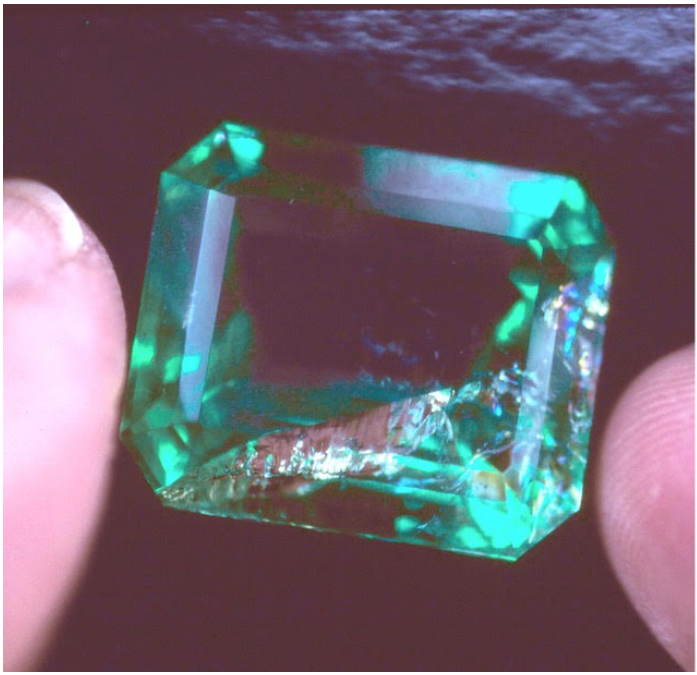 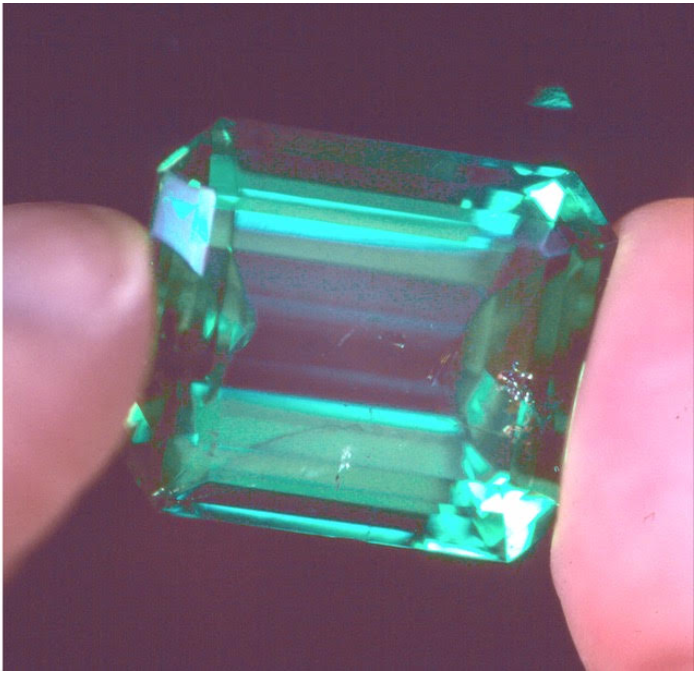 |
| A 14 carat Colombian emerald before and after a resin-type treatment |
According to industry insiders in the emerald business, the process of enhancement disclosure has returned to its Wild West status, just like it was before the Exposé that turned the industry upside down in 1997. The latest approach to filler quantification is called “Minor,” the new buzzword in enhancement circles. This is now the magic word that dominates the terminology landscape as the favorite descriptor of emerald enhancement in the playbook of gem labs and dealers. To put it in perspective, the original AGL’s quantification process for fillers, which I developed, had nine uniform categories. The current systems in play by various labs generally have five levels frequently connected to lab-speak descriptions and explanations. Without a doubt, the descriptor of the choice is a broad category called “Minor” that now covers approximately 3 to 4 categories contained in the original AGL approach.
To put this change in perspective, it’s like modifying the size of the hole on a putting green from its current 4.25 inches to 16 inches. Obviously, you would have a lot more winners. The term became a game changer for the trade and the labs. “Minor” has created a different yardstick that makes their product more acceptable and valuable while still claiming compliance and consumer protection.
In keeping with trade organization interest, the current AGL administration has made its own contribution to the new lexicon of gem treatments. They apparently opted to take their cue from the acceptance and popularity of “Minor” in the marketplace and created a new descriptor in the scrabble game of lab lingo. The current AGL coined the new term “Modern” to cover the high index resin invasion of ultra fissure masking fillers without regard for permanency of stability issues. The plan then relegated oils and waxes to their psychological sub-class of “traditional.” So Mr. and Mrs. Consumer, which would you rather have, the “Modern” filler or that “traditional” stuff? The obvious implication is that “Modern” must be better even though stability and permanency are not guaranteed.
The impact of modern fillers at work |
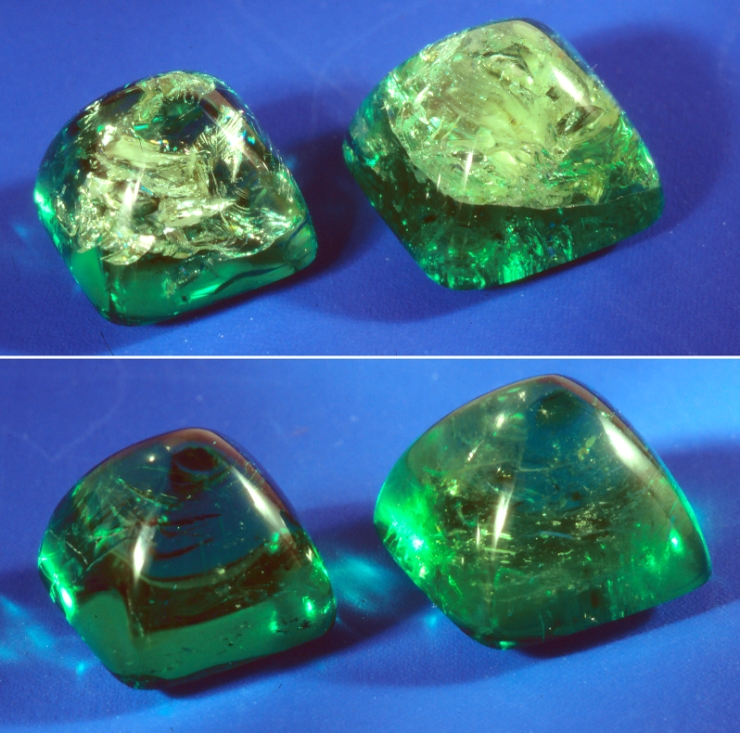 |
| Two pyramidal emerald cabs before and after "modern" resin treatment. Permanency and stability are not guaranteed. |
Early on in my transition from AGL and Collectors Universe, I discovered that a well-connected New York emerald kingpin with strong ties to Colombia was a fundraiser for the acquisition of the lab from Collectors Universe. I recommended to the current administration that they change that fundraising channel or anticipate paying a high price down the road for the benefits of the relationship. It appeared that AGL was pursuing an alternative path that was definitely different from the original AGL’s commitment to independence from outside influence as a laboratory. When our counsel was rejected, I exited any further discussions regarding laboratory involvement. Subsequently we had the birth of the new designation “Modern” that essentially canonized the resin fillers that had previously caused non-disclosure havoc in the emerald business, primarily those masquerading as a natural “palm oil.”
Previously, the AGTA came under fire from the Jewelers Vigilance Committee (JVC). JVC is the top legal agency in the jewelry industry that handles a wide range of issues including misrepresentations. At that time, JVC’s lead attorney was Joel Windam. He was a tenacious advocate for doing things the right way and challenged AGTA’s copyright of the enhancement guides. Windam indicated that since JA had first published the Guides, and it was not AGTA’s original work product, they had overstepped their authority to copyright the guides.
In addition, neither Crowningshield of the GIA nor Beesley of AGL, who had formulated the key technical aspects of the original guide, had ever authorized their contributions to be copyrighted by anyone, including AGTA. AGTA has continued to ignore JVC’s counsel and still maintains the copyright. Exacerbating this disregard for JVC’s position, the guides have been poorly managed since they were transferred to AGTA control.
Potential challenges to the law do not end with copyright issues. There is information both written and verbal that indicates AGTA is currently changing and challenging elements of existing FTC guidelines on multiple fronts. AGTA claims that, as the largest US gem trade association, they have special access and influence with the decision makers at the FTC that ultimately mandate jewelry industry descriptive vocabulary.
For those outside the mainstream of gem related terminology, the latest name game challenge has once again focused on the “Lab Grown” phraseology. The issue of denigrating man-made alternatives relative to natural gem materials has once again moved from the back burner into the limelight of trade association interest and decision-making.
The same people at AGTA who wanted to bury the term “treatment” as deep as possible in the lexicon of gem related descriptors in favor of the softer, less offensive word, “enhancement,” now want to saddle crystal growers with one of the most misunderstood and misinterpreted terms in consumer circles. Specifically, dealer organizations wanted to return to the term “synthetic” as the word of choice to describe these alternative products. Part of the work that Crowningshield and I pursued on behalf of JA was to review the public’s understanding of the term “synthetic.” It became obvious that it was associated with fake, phony, and imitation related materials. Rarely did consumers understand that the word “synthetic” meant it shared the same basic optical, physical, and chemical properties with their natural counterparts.
During the early exchanges and meetings regarding guideline issues, Gemcore’s Gemstone Standards Commission™ was an active player in building the protocols for disclosure policies. During those meetings, the AGTA representatives clearly stated that it was “funny” if not “hilarious” to force crystal growers to have to sell their products with the homophone “Syn,” which was obviously associated with the word “Sin.” That discussion then and now reeks of the possible “restraint of trade” and a violation of AGTA’s own code of ethics regarding “unfair trade practices”, as well as demanding misunderstood terms be intentionally attached to lab developed products that restrict or limit them from selling opportunities. It also collides with the current FTC guidelines that authorize the use of the term “laboratory grown.” If AGTA wants to dictate terminology to their membership, they should forfeit their control as the self-appointed guardians of the national enhancement guides.
It would seem more important for the colored stone industry to focus their attention on preserving the integrity of the classification “Natural” when viewed in the context of a seemingly endless array of alterations, a.k.a. treatments, that are outlined in the alphabet soup that is now the current AGTA’s guides to treatment disclosure. At what point does the insanity of manipulating God-made, natural gem materials come to such absurd levels that the term “Natural” will experience the same confusion that is associated with the term “synthetic?”
On the heels of AGTA’s announcement proclaiming again their disdain for the description “laboratory grown,” CIBJO, their European counterpart, along with the French government, have now taken the same posture of demonizing lab grown products with the stigma of synthetic a.k.a. “Syn,” pronounced “Sin.”
Logic and common sense are lost when survival instincts kick in to control the narrative and defend the “turf” when some colored stone dealers believe it is threatening their business model. Fortunately, I do not believe government agencies like the FTC are interested in reinforcing policies that can be viewed as “restraining trade” or “placing undue burden” on individuals and companies that are potential competitors to special interest groups.
Indications from AGTA, CIBJO, and others suggest that their reasoning for the name change from laboratory grown “LG” to synthetic “Syn” is connected to the ill-advised fiasco that has occurred in the diamond industry. The diamond trade problems stem from the basic fact that they ignored the obvious train wreck that was coming down the pike in the diamond business. The problem was more a failure of perception than it was terminology related.
The faux pas was that the diamond industry underestimated what was going on in the background of the diamond business. Even De Beers jumped on the bandwagon with their own LG products which demonstrated an amateur night response to what was happening in the industry they once dominated. The damage had already been done. A recent announcement indicates that De Beers will now promote the term “Desert Diamonds” to compete with the ongoing Lab Grown diamond challenge. This is the next misstep in their current marketing agenda.
The diamond trade was warned that what was happening in multiple places around the world was not a speed bump to the diamond trade like CZ, YAG, GGG and other imitations. In fact, this was a serious threat to the stability of the diamond trade and now the industry needs to rebuild the confidence that people once had in natural diamonds. In the gem world, when the term “rarity” evaporates relative to the discussion of gems, so does confidence and interest in the product.
The suggestion that the colored stone industry is transitioning back to the word “synthetic” based on what is occurring in the diamond business is a ploy to justify attempting to diminish what the colored stone industry still recognizes as a competitor. Rather than be creative with their own products, they have chosen this circuitous route to denigrate the business of a perceived competing entity all under the guise of serving the interest of consumers.
“Bad Stuff” (BS) is not exactly what you think when you approach the world of AI that is touted to be the pot of gold at the end of the information rainbow. Actually, AI is like a T-Rex on the prowl for its next meal. Like the Rex, it has an insatiable and indiscriminate appetite to satisfy its hunger. In the dino’s case, it doesn’t care if its next meal has two legs or four, it will consume it as necessary for its survival. Therein lines the basic problem with AI. It consumes everything in its path without a distinction of reliability and accuracy.
Some forms of data have high level of usefulness in the current AI world. For example, examining medical records related to the history of cancer patients that contain validated details and applicable case histories are important for intense interpretive AI analysis. On the other hand, more random, opinion based information will also be digested by AI even if there is an extreme bias in which case its interpretation will also be biased. During our investigations on various gem related topics, we have established that AI information is frequently faulty. Fact checking is critical. At the moment there are multiple gem labs pursuing these AI agendas based on their in-house databases of previously analyzed gem data to try and improve their accuracy and repeatability. They have experienced varying degrees of success. Unfortunately, the widely circulated adage concerning the original computer world was and still is “garbage in, garbage out.”
For those of you in the AI weeds, you realize that the fuel of AI’s agenda is information from every conceivable source possible, including your personal data. In fact, when Spirit Airlines recently went bankrupt, a bidding war began for all the company’s records in every form from this defunct company. Reportedly, the winning bid was in excess of $10 million and a second offer after bidding had closed was even higher. Secondhand bookstores are also experiencing a surge in sales so that AI can be fed with anything and everything that man has ever considered as worthy of the printed page.
The downside of AI mania is that some of the same corporate entities that created the umbilical cord of information that entrapped or seduced your children via the Internet, cell phones, and social media are operative in the perceived lucrative train of AI projects. These are the same companies that actively exploited the weaknesses of those that have become addicted to strokes, clicks, and Instagram moments to fill a missing sense of acceptance and self-worth in their lives. Let’s face the facts, the hundreds of billions of dollars that are being invested in AI’s future are not altruistically motivated. The potential financial gain is substantial but so are the risks involved in the dark corners of this pursuit.
The next phase of this movement is even a potentially more dangerous direction called “AGI” or Artificial “General” Intelligence. In theory, the addition to the word “general” appears to be innocuous enough except that it can be potentially far more dangerous than anyone imagined. In fact, some of the insiders that are close to the heart of this agenda consider AGI the potential equivalent to the “Death Star” portrayed in Star Wars, except in this case, it doesn’t require any human engagement to implement its plans for survival. Is a “kill switch” the answer?
The new wave of machines are being trained to think independently and make decisions without the compassionate benefits of those elements that make us human. Even now, under the current AI systems, devices are attempting to find ways to defeat and manipulate their competitors’ AI agents. In the world of gems we can often encounter information paths that are misleading for both consumers and the gem trade exacerbated by AI. Proceed with caution!
Not unlike what happens in many dimensions of the collecting world, gem buyers need to be on guard against those individuals, companies, and associations that put profit ahead of principles. Pick the medium, and you can find deception in any corner of the collectibles market, from coins and stamps to antiques and paintings. Even in the world of stocks and similar paper based investment vehicles, there is always a cluster of individuals and companies that are willing to create marketing minefields to attract the uninformed buyer based on illusion.
Informed buyers of any collectible can find ways to minimize risk and profit from wise, informed decisions. However, of all the collectibles that are available in the world, gems still offer a unique glimpse into the worlds of beauty, history, culture, and science. Very few mediums in the collecting world uniquely capture the imagination like an exceptional natural gem from some exotic part of the world that began its life as a pebble in a riverbed or a crystal that was entrapped in hard rock deep in the earth.
Remember, in the final analysis, fact based information and reliable sources are the keys to successful collecting. Smart buyers make smart decisions… Careless buyers keep the conmen in business… Choose wisely!
General CRB Bio Update
 |
| Cap conducting field research in the snow covered mountains of Kashmir |
Cap currently serves as President of Analytics R/D, a research and development consulting firm that predates AGL and established the foundation for the overwhelming majority of the American Gemological Laboratory’s policies, processes, and procedures from country of origin determination to detailed enhancement disclosure, as well as building the foundational core of the laboratory’s comprehensive full quality grading system. Analytics was an essential partner in establishing AGL’s international reputation for innovative systems and cutting-edge product development.
He is also the Chairman of Gemcore’s, Gemstone Standards Commission™ that was a pivotal force in establishing the framework for the jewelry industry’s enhancement disclosure guidelines. In addition, he currently Chairs The Gem and Mineral Advisory Board at Yale University’s historic Peabody Museum that has recently undergone a $200,000,000 renovation. Much of the impetus for the massive expansion at the museum was precipitated by the phenomenal success of the David Friend Hall of Minerals and Gems that catapulted this historic museum into the mainstream of Yale campus life and activity. The Peabody has become a focal point for major exhibitions, as well as essential research and important museum studies. The Peabody has transitioned from an historical appendage to a centerpiece of Yale’s New Haven campus.
The History of AGL Ownership…..
For clarity, Cap Beesley was the founder and independent owner of the original American Gemological Laboratories (AGL), established in 1977. He served as its president for over 30 years, building and solidifying AGL‘s international reputation even through the acquisition of the lab in 2006 by Collectors Universe, a NASDAQ traded company.
In 2009, the lab was resold by Collectors Universe and Chris Smith assumed the position of president. The details of that transaction were never made public.
For additional information and updates regarding this article please direct your requests to GemcoreInfo@Gmail.com